
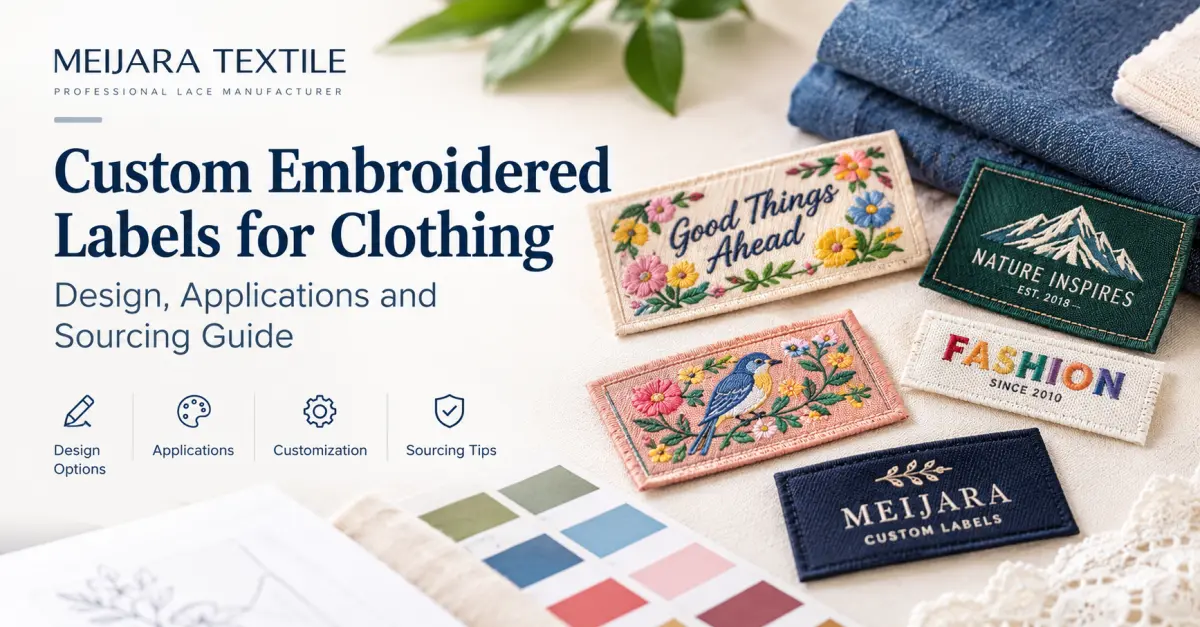

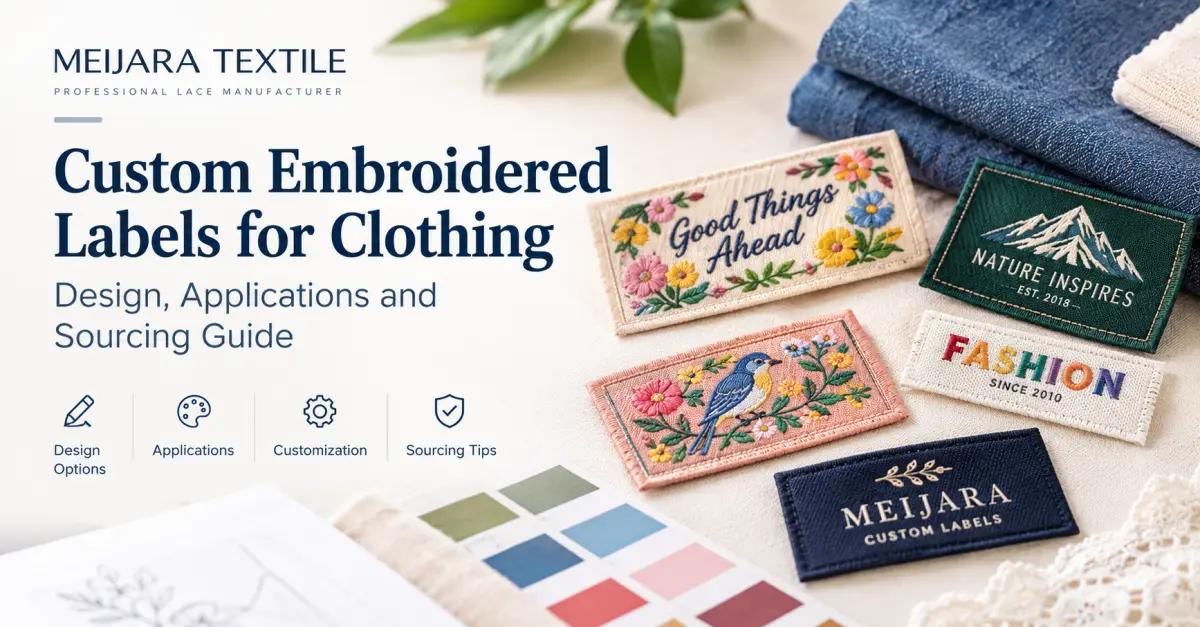
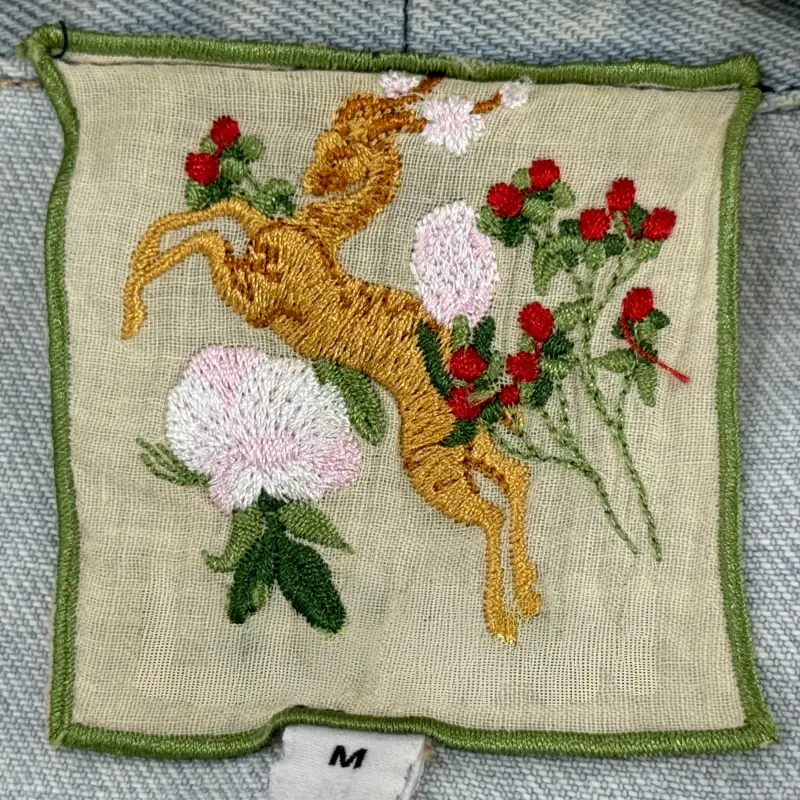
For fashion brands, a clothing label is more than a place to display a logo. It can become part of the garment's visual identity, especially when the label uses embroidery, multiple thread colors, textured stitching, or a distinctive shape.
Custom embroidered labels are widely used on fashion garments, jackets, denim, casualwear, accessories, and designer collections. Compared with standard printed labels, embroidered labels can add texture and a more crafted appearance while giving brands greater flexibility in color, artwork, size, and finishing.
However, developing a custom embroidered label is not simply a matter of sending a logo to a supplier. Artwork, embroidery density, label size, thread colors, edge finishing, attachment method, and production quantity can all affect the final result.
For fashion brands and garment manufacturers, understanding these factors before development can reduce sampling problems and make bulk production more predictable.
What Are Custom Embroidered Labels?
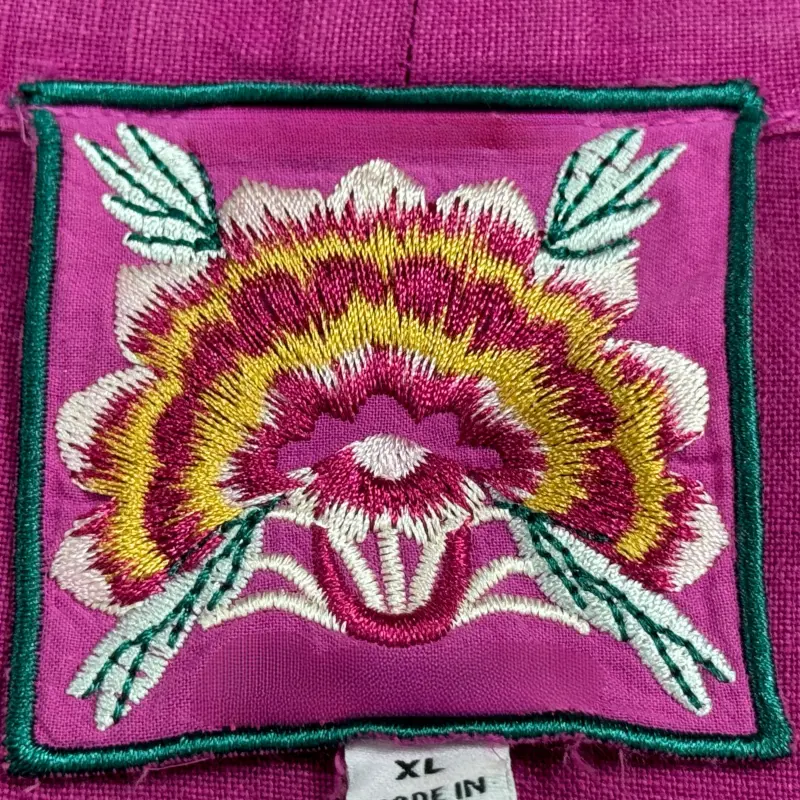
Custom embroidered labels are textile labels developed specifically for a brand, garment, collection, or product line. Instead of relying only on printed graphics, the design is created with embroidery thread on a textile base.
Depending on the design, an embroidered label can include:
Brand names and logosFloral or botanical motifsDecorative symbolsLetters and numbersCollection-specific graphicsMulticolor patternsSmall embroidered illustrationsCombination logo and decorative elements
The final appearance depends heavily on the relationship between the artwork and the embroidery structure.
A simple logo with large lettering may be relatively straightforward to reproduce, while a detailed multicolor illustration can require more careful digitizing, stitch planning, and sampling.
This is particularly important for fashion brands because the label needs to work with the garment rather than appear as an isolated decorative element.
For example, a small embroidered label on a casual jacket may require a completely different visual treatment from a decorative label used on a women's fashion dress.
Why Fashion Brands Use Custom Embroidered Labels
A custom label can serve both a branding and decorative function.
Brand recognition
The most obvious purpose is to make the brand identifiable. A consistent embroidered logo can become part of the visual language used across different collections.
Product differentiation
When garments use similar silhouettes or materials, details such as labels, patches, embroidery, and trims can help create a more distinctive product.
Decorative value
An embroidered label does not necessarily need to be hidden inside the garment. Depending on its design and placement, it can become a visible fashion detail.
This is especially useful for:
-
Jackets
-
Denim
-
Casualwear
-
Streetwear
-
Children's clothing
-
Bags and accessories
-
Designer collections
Collection identity
Brands can also develop different label designs for seasonal collections, collaborations, special editions, or limited products while maintaining consistent brand elements.
For this reason, custom embroidered labels are often developed as part of a broader product-development strategy rather than as a simple packaging component.
Embroidered Labels vs. Woven Labels vs. Printed Labels
Different labeling techniques create different visual and tactile results.
| Label Type | Main Characteristic | Suitable For |
|---|---|---|
| Embroidered label | Raised thread texture and visible stitching | Fashion garments, jackets, denim, decorative branding |
| Woven label | Fine woven details and clean lettering | Brand labels, care labels, apparel identification |
| Printed label | Graphics printed directly onto a textile surface | Detailed graphics, information labels, cost-sensitive applications |
The choice depends on the design and application.
Embroidered labels are particularly useful when texture and visible craftsmanship are part of the design.
Woven labels can work well when the design contains fine lettering or detailed woven graphics that need a flatter appearance.
Printed labels can be considered when the artwork contains photographic details, gradients, or information that would be difficult to reproduce efficiently with thread.
For some brands, these techniques can also be combined across different products within the same collection.
The important point is not to select a label type based only on appearance. The garment material, label size, artwork complexity, washing requirements, and positioning should all be considered during development.
What Can Be Customized?
One advantage of custom embroidered labels is the number of variables that can be adjusted during development.
Artwork and pattern
The supplier can work from a brand logo, artwork, reference image, or design concept.
Simple logos are generally easier to translate into embroidery, while highly detailed artwork may need to be simplified to maintain clarity at a small size.
Thread colors
Multicolor embroidery allows brands to reproduce different elements of a logo or decorative design.
Brands can provide reference colors or Pantone specifications when color accuracy is important.
The final result should still be checked through sampling because thread and textile surfaces can affect how a color visually appears.
Size and shape
Labels do not have to be rectangular.
Depending on the application, brands can consider:
Rectangle Square Circle Oval Custom silhouette Irregular decorative shapes
The size should be considered together with the garment and the artwork. A detailed logo that works well at 8 cm may lose clarity if reduced significantly.
Embroidery density
Stitch density influences both appearance and physical feel.
Too little embroidery may make a design appear incomplete, while excessive density can create unnecessary stiffness or affect small details.
The appropriate density depends on the artwork, label size, thread, base material, and intended application.
Base fabric
The base textile influences the overall appearance and hand feel of the finished label.
For fashion applications, the base should be considered together with the garment fabric so that the label does not feel visually or physically disconnected from the product.
Edge finishing
The edge is another important design element.
Depending on the label construction, brands may require different edge treatments to achieve a clean appearance and suitable attachment to the garment.
Brand name or logo
A label may contain only a logo, or combine a logo with:
Brand name Collection name Product line Year Slogan Decorative graphics
The amount of information should be balanced against the available label area.
Embroidered Label or Embroidered Patch: Which One Do You Need?
The terms embroidered label and embroidered patch are sometimes used interchangeably, but they usually serve different purposes.
An embroidered label is often associated with brand identification or garment labeling. It may be sewn into or onto a garment as part of the product's branding.
An embroidered patch is generally treated more as a decorative element. It can be attached to jackets, denim, bags, uniforms, caps, and other products.
The distinction becomes important during development because the attachment method, edge treatment, size, and overall construction may be different.
If the primary purpose is brand identification, a custom embroidered label may be more appropriate.
If the primary purpose is decoration or a graphic feature, an embroidered patch may be a better direction.
For fashion brands, the two can also be developed as complementary elements.
Where Are Custom Embroidered Labels Used?
Custom embroidered labels are not limited to one type of garment.
Dresses and fashion garments
Decorative embroidered labels can add a subtle branded element to fashion collections without competing with the main fabric or silhouette.
Blouses and shirts
Small labels can be used as discreet brand details, particularly around collars, cuffs, side seams, or other selected positions.
Jackets and coats
The relatively structured construction of jackets makes them suitable for more visible embroidered labels and patches.
Denim and casualwear
Embroidered branding is commonly compatible with the visual language of denim and casual garments, particularly when brands want a more tactile detail.
Children's clothing
Colorful embroidered labels can become part of the visual design while providing recognizable brand elements.
Bags and accessories
Labels and embroidered patches can also be incorporated into bags, hats, fabric accessories, and other textile products.
Designer and limited collections
For special collections, brands can develop exclusive label artwork rather than using the same standard label across every product.
How to Prepare Artwork for Embroidered Labels
One of the most common mistakes in custom label development is assuming that any digital image can be reproduced exactly as embroidery.
Embroidery is a physical process. The artwork must eventually be translated into stitches.
Before sending artwork to a supplier, buyers should prepare the following information where possible:
Original logo or artwork Vector file if available Reference image Required label dimensions
Number of colors Pantone references where applicable Preferred shape Intended garment or product Approximate order quantity
Simple artwork usually gives more flexibility
A logo with clean lines and clear shapes is generally easier to reproduce at a small size.
Very thin lines, tiny text, complex gradients, and extremely detailed illustrations may require design adjustments.
The objective is not simply to reproduce every pixel from the original artwork. The objective is to create an embroidered version that remains visually clear at the final production size.
This is why technical review before sampling is important.
What Affects the Cost of Custom Embroidered Labels?
There is no single price for custom embroidered labels because production cost depends on the specific design and order requirements.
Important cost factors include:
Label size
Label sizeLarger labels generally require more material and embroidery work.
Number of colors
Number of colorsA design using several thread colors may require more complex production than a simple one-color logo.
Artwork complexity
Artwork complexityDetailed graphics generally require more embroidery planning than basic lettering or simple symbols.
Embroidery density
Embroidery densityHigher stitch density can increase production time and material consumption.
Label construction
Label constructionBase fabric, edge finishing, backing, and other construction requirements can affect the final cost.
Order quantity
Sampling and bulk production have different cost structures. Larger production quantities may also change the unit economics.
Custom development requirements
Special artwork adjustments, unusual shapes, or additional development requirements may increase the overall development cost.
For B2B buyers, it is therefore more useful to request a quotation based on a complete specification rather than comparing suppliers using only a general "price per label."
Custom Embroidered Label Development Process
A well-organized development process can help reduce misunderstandings between the brand and supplier.
Step 1: Artwork submission
The brand provides the logo, artwork, reference image, or design concept.
Step 2: Digitizing and technical review
The artwork is evaluated for embroidery.
At this stage, the supplier can identify potential problems with small text, thin lines, color combinations, density, or overall dimensions.
Step 3: Sample development
A physical sample is produced so the buyer can evaluate the actual embroidery rather than relying only on a digital preview.
Step 4: Sample approval
The buyer checks the artwork, colors, dimensions, embroidery details, edge finishing, and overall appearance.
If adjustments are required, they should be completed before bulk production.
Step 5: Bulk production
Once the sample is approved, the confirmed specifications are used for production.
Step 6: Inspection
Finished labels should be checked for consistency in areas such as:
Dimensions Color
-
Pattern
-
Embroidery quality
-
Edge finishing
-
Quantity
-
Overall appearance
This process is particularly important for repeat orders. A successful first sample is useful only if the approved standard can be maintained during later production.
What Should Buyers Check Before Approving a Sample?
A sample should not be approved based only on whether the logo "looks right."
A B2B buyer should check several details.
1. Dimensions
Confirm the actual length, width, and overall shape.
2. Artwork clarity
Check whether small lettering and fine details remain readable.
3.Color
Compare the physical thread colors with the approved references.
4. Embroidery density
Look for areas that appear too sparse, too heavy, uneven, or overly stiff.
5. Edge finishing
Check whether the edge is clean and suitable for the intended attachment method.
6. Base fabric
Make sure the base material is consistent with the garment and the expected hand feel.
7. Attachment and positioning
If the label is intended for a specific garment position, test how it looks and behaves when attached.
8. Washing and use requirements
For garments that will be washed frequently, the label should be evaluated according to the product's actual care and use conditions.
A physical sample is especially important for multicolor or highly detailed embroidered labels because the appearance of thread on fabric can differ from a digital artwork file.
What Information Should You Send to a Label Supplier?
A complete inquiry allows the supplier to evaluate the project more efficiently.
Instead of sending only a logo and asking for a price, buyers should provide as much of the following information as possible:
| Information | Example |
|---|---|
| Artwork | Logo or design file |
| Label size | 60 × 40 mm |
| Shape | Rectangle / custom shape |
| Colors | 3–5 thread colors |
| Color reference | Pantone or physical sample |
| Base fabric | Supplier recommendation or specified material |
| Application | Jacket / dress / denim / bag |
| Quantity | Estimated bulk requirement |
| Finishing | Required edge treatment |
The more complete the specification, the easier it is for the supplier to provide a meaningful quotation and development plan.
How to Choose a Custom Embroidered Label Supplier
Price is only one part of supplier evaluation.
For fashion brands and garment manufacturers, several other factors can affect the success of a custom label project.
Custom development capability
The supplier should be able to work with different artwork styles, colors, sizes, and construction requirements rather than offering only standard label designs.
Sampling capability
A physical sample allows the buyer to evaluate the actual product before committing to bulk production.
Production consistency
For repeat orders, maintaining the approved color, dimensions, embroidery details, and finishing is critical.
Communication
Clear communication during artwork review and sample approval can prevent avoidable production problems.
Product range
For brands developing multiple textile details, working with a supplier that can support different embroidery and lace-related products can simplify sourcing.
Meijara Textile develops customized embroidery and lace solutions for fashion brands, garment manufacturers, and apparel designers, including custom multicolor embroidered woven labels and other decorative textile products.
Explore Custom Multicolor Embroidered Woven Labels
Frequently Asked Questions
Can I customize the logo on an embroidered label?
Yes. Custom embroidered labels can be developed from brand logos, artwork, reference images, or design concepts. The artwork may need to be adjusted for embroidery depending on its size and level of detail.
Can embroidered labels have multiple colors?
Yes. Multicolor embroidery can be used for logos, floral motifs, illustrations, and other decorative designs. Buyers can provide color references or Pantone specifications when required.
Can I request a custom label shape?
Yes. Custom label shapes can be developed according to the design and garment application.
Are embroidered labels suitable for jackets and denim?
Yes. Embroidered labels and patches can be used on jackets, denim, casualwear, and other garments where a more visible or textured branding detail is desired.
What file should I send for a custom embroidered label?
A vector logo or high-resolution artwork is useful for development. Buyers should also provide the required size, colors, shape, and intended application whenever possible.
Should I approve a sample before bulk production?
For custom products, physical sample approval is strongly recommended. It allows buyers to check color, dimensions, embroidery details, edge finishing, and overall appearance before bulk production.
What determines the price of custom embroidered labels?
Size, artwork complexity, number of colors, embroidery density, materials, finishing, quantity, and development requirements can all affect the final cost.
Can embroidered labels be used as decorative elements rather than brand labels?
Yes. Depending on their design and construction, embroidered labels can function as decorative textile elements on garments, bags, accessories, and fashion collections.
Conclusion
Custom embroidered labels can play a much larger role in fashion products than simply identifying a brand. With the right combination of artwork, thread colors, embroidery density, label size, shape, and finishing, they can become part of the garment's overall design language.
For buyers, the key is to treat label development as a product-development process rather than a simple printing order.
Start with the intended application, prepare complete artwork and specifications, review the technical details with the supplier, approve a physical sample, and then move into bulk production based on the confirmed standard.
For fashion brands developing custom labels, patches, embroidered fabrics, or other textile details, this approach can make development more predictable and help maintain consistency across production.
Related Meijara products: custom embroidery, multicolor embroidery, embroidered fabrics, lace trims, and other customized textile solutions for apparel brands and garment manufacturers.