
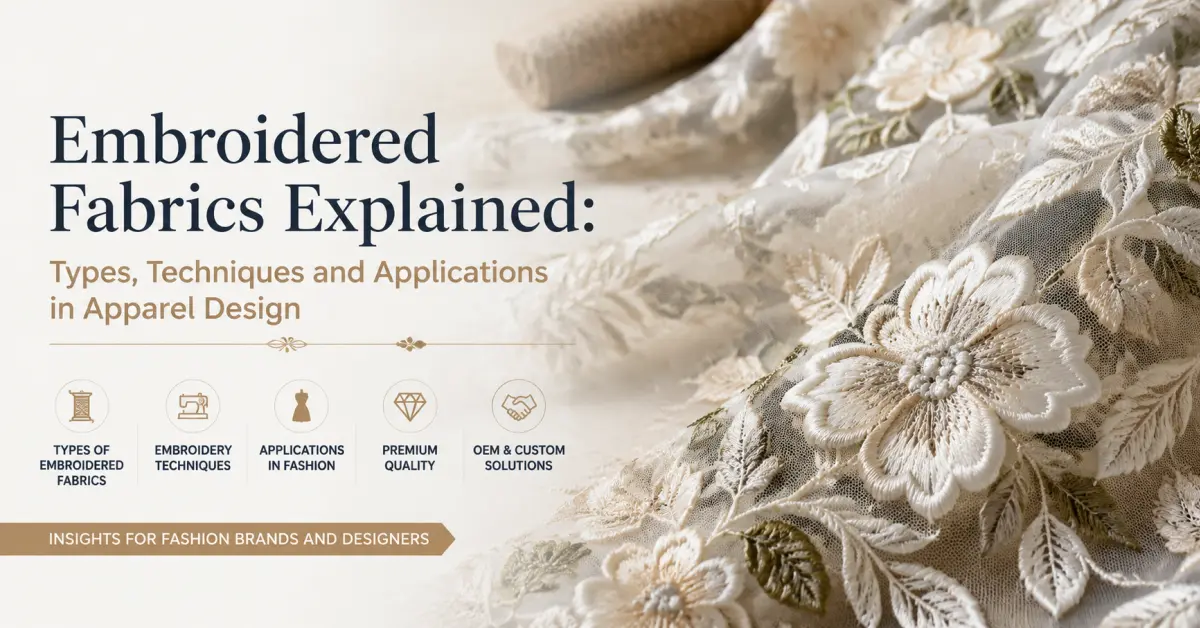

Why Embroidered Fabrics Have Become a Key Element in Modern Fashion
In today's fashion industry, fabric is no longer only a base material for garment construction. For many fashion brands, especially those focusing on premium collections, contemporary womenswear, and designer apparel, the fabric itself has become a major part of brand identity.
Among various decorative textiles, embroidered fabrics remain one of the most versatile and valuable materials used in apparel design. Through advanced embroidery technology, manufacturers can transform ordinary fabrics into visually rich surfaces with complex patterns, textures, and three-dimensional effects.
From luxury dresses and evening wear to ready-to-wear collections, embroidered fabrics allow designers to create garments that communicate craftsmanship, uniqueness, and premium positioning.
For fashion brands, selecting the right embroidered fabric supplier is not only about finding attractive patterns. It requires understanding:
-
Different embroidery fabric types
-
Embroidery production techniques
-
Fabric compatibility
-
Design customization capability
-
Quality control standards
-
Bulk production consistency
A professional embroidered fabric manufacturer plays an important role in helping brands move from initial design concepts to commercially viable collections.
With modern embroidery machines, digital pattern development systems, and advanced finishing technologies, manufacturers can now produce customized embroidered fabrics that meet the requirements of global fashion markets.
This article explains the different types of embroidered fabrics, production techniques, and their applications in apparel design, while providing practical insights for fashion brands looking for reliable manufacturing partners.
What Is Embroidered Fabric?
Embroidered fabric refers to a textile material that has been decorated with decorative stitches, threads, or additional embellishments to create patterns, motifs, and surface effects.
Unlike printed fabrics, where designs are applied onto the surface using ink or dyes, embroidery creates a physical texture by adding threads onto the fabric structure.
This difference gives embroidered fabrics several unique characteristics:
-
Raised surface texture
-
Three-dimensional visual effects
-
Better craftsmanship appearance
-
Strong decorative value
-
Premium product positioning
Depending on the production method, embroidered fabrics can include:
-
Machine embroidery fabric
-
Hand embroidery fabric
-
Water soluble embroidery fabric
-
Sequin embroidery fabric
-
Beaded embroidery fabric
-
3D floral embroidery fabric
For modern apparel brands, embroidered fabrics are widely used because they combine decorative beauty with practical garment production requirements.
Why Fashion Brands Choose Embroidered Fabrics
The growing demand for embroidered fabrics comes from the changing expectations of global consumers.
Today's customers are looking for garments that feel more exclusive and visually distinctive. Simple fabrics often struggle to create product differentiation, while embroidery provides designers with more opportunities to develop signature styles.
1. Creating Unique Brand Identity
For fashion companies, fabric selection directly influences how consumers perceive a collection.
A floral embroidered fabric can create a romantic and feminine style, while geometric embroidery can communicate a modern and architectural design language.
For example:
| Fabric Style | Brand Image Created | Common Fashion Application |
|---|---|---|
| Floral embroidered fabric | Elegant, feminine, romantic | Dresses, blouses, skirts |
| Geometric embroidery | Modern, structured, artistic | Jackets, luxury apparel |
| 3D floral embroidery | Premium, handcrafted feeling | Designer collections |
| Sequin embroidery | Glamorous, eye-catching | Evening wear, stage fashion |
2. Increasing Product Value
Compared with basic woven or printed fabrics, embroidered fabrics usually have higher perceived value.
A garment made with customized embroidery can be positioned as:
-
Premium collection
-
Limited edition product
-
Designer line
-
Luxury fashion item
For fashion brands, embroidery is not simply decoration—it is a way to improve product differentiation and market positioning.
3. Supporting Custom Fashion Development
Many fashion brands today do not want to purchase standard fabrics available from multiple suppliers.
Instead, they require:
-
Exclusive embroidery patterns
-
Customized colors
-
Different fabric bases
-
Modified motif sizes
-
Special finishing effects
This creates demand for custom embroidered fabric development.
Professional manufacturers usually provide OEM services that include:
-
Design consultation
-
Pattern development. Learn about pattern design development.
-
Sample production
-
Fabric adjustment
-
Bulk manufacturing
Main Types of Embroidered Fabrics Used in Apparel Manufacturing
Different embroidery techniques create different visual effects and performance characteristics.
Choosing the right embroidered fabric depends on:
-
Garment category
-
Target price level
-
Design requirements
-
Production quantity
-
Fabric performance expectations
Below are the most common embroidered fabric categories used by fashion brands.
1. Embroidered Lace Fabric
Embroidered lace fabric is one of the most widely used decorative textiles in fashion.
It combines the lightweight structure of lace with embroidery techniques to create detailed surface patterns.
Typical characteristics include:
-
Floral motifs
-
Transparent texture
-
Lightweight construction
-
Elegant appearance
-
Soft hand feel
Embroidered lace fabrics are commonly used for:
-
Dresses
-
Skirts
-
Tops
-
Luxury womenswear
-
Evening collections
-
Resort wear
Unlike traditional lace, embroidered lace allows more flexibility in pattern development.
Manufacturers can customize:
-
Embroidery density
-
Pattern size
-
Thread color
-
Base mesh
-
Fabric width
Common Embroidered Lace Fabric Structures
| Type | Features | Fashion Applications |
|---|---|---|
| Floral embroidered lace | Classic flower motifs | Dresses, feminine apparel |
| Cotton embroidered lace | Natural texture and soft feeling | Casual fashion. Explore cotton lace trim. |
| Mesh embroidered lace | Lightweight and transparent | Tops, overlays |
| Guipure embroidered lace | Thick dimensional patterns | Premium garments |
| Water soluble lace | Complex standalone embroidery | Luxury fashion |
2. Water Soluble Embroidered Fabric
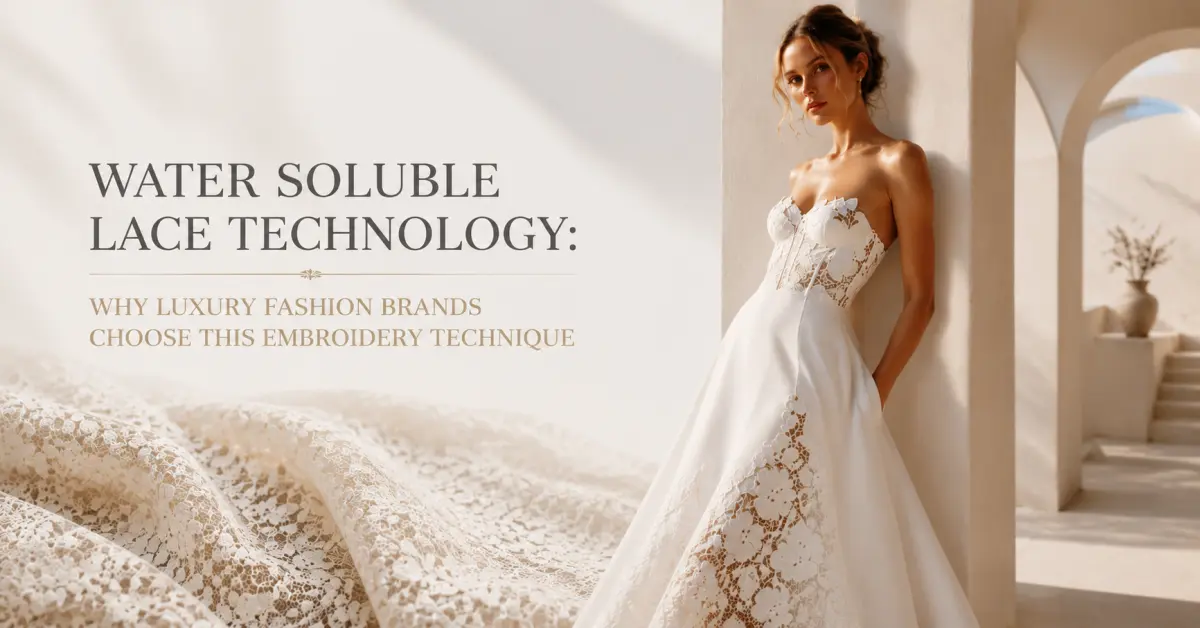
Water soluble embroidery is an advanced embroidery technique widely used in luxury fashion development.
During production, embroidery patterns are created on a water-soluble backing material. After embroidery is completed, the backing is removed through washing, leaving only the embroidered structure.
This process allows manufacturers to create:
-
Extremely detailed patterns
-
Independent lace structures
-
Complex floral designs
-
Lightweight decorative elements
Because of its technical complexity, water soluble embroidery is often associated with premium fashion applications.
Common uses include:
-
Haute couture garments
-
Luxury dresses
-
Designer collections
-
Fashion runway pieces
3. 3D Embroidered Fabric
3D embroidery creates raised patterns that stand above the fabric surface.
This technique adds depth and visual impact to garments.
Common 3D embroidery elements include:
-
Raised flowers
-
Layered petals
-
Textured leaves
-
Decorative motifs
Compared with flat embroidery, 3D embroidery provides a stronger visual effect.
| Feature | Flat Embroidery | 3D Embroidery |
|---|---|---|
| Surface effect | Smooth | Raised texture |
| Production complexity | Medium | Higher |
| Visual impact | Elegant | More dramatic |
| Application | Daily fashion | Premium collections |
3D embroidered fabrics are increasingly popular among brands creating statement pieces.
4. Sequin Embroidered Fabric
Sequin embroidery combines thread embroidery with decorative sequins.
The reflective surface creates a luxurious appearance suitable for fashion products requiring attention.
Typical applications:
-
Evening dresses
-
Party wear
-
Stage costumes
-
Luxury fashion collections. See sequins and beads embroidery.
Manufacturers can customize:
-
Sequin size
-
Sequin color
-
Embroidery density
-
Pattern arrangement
5. Beaded Embroidered Fabric
Beaded embroidery uses beads, pearls, crystals, or other decorative materials integrated into embroidery designs.
This technique creates a handcrafted appearance and is often used for premium garments. See crystal elegance bead sequin fabric.
Applications include:
-
Luxury gowns
-
Designer dresses
-
Special occasion apparel
Because bead attachment requires precision, production quality control is especially important.
Embroidered Fabric Classification Table
| Embroidered Fabric Type | Main Material Base | Key Feature | Suitable Applications |
|---|---|---|---|
| Embroidered lace | Nylon/polyester/cotton mesh | Lightweight and decorative | Dresses, tops |
| Water soluble embroidery | Soluble backing + thread | Complex standalone patterns | Luxury fashion |
| 3D embroidery | Fabric + raised embroidery | Strong dimensional effect | Designer garments |
| Sequin embroidery | Fabric + sequins | Shiny surface effect | Evening wear |
| Beaded embroidery | Fabric + beads | Handcrafted appearance | Premium collections |
The Role of an Embroidered Fabric Manufacturer
For fashion brands, choosing a manufacturer is not only about production capacity.
A reliable embroidery fabric supplier needs to provide complete development support.
A professional manufacturer usually manages the following stages:
1. Design Development
The process starts from the customer's concept.
Designers may provide:
-
Sketches
-
Reference images
-
CAD drawings
-
Existing samples
The manufacturer then converts these ideas into embroidery patterns suitable for production.
2. Pattern Digitization
Modern embroidery production requires digital pattern conversion.
During this stage:
-
Motifs are created digitally
-
Stitch directions are planned
-
Density is adjusted
-
Production parameters are optimized
This step directly affects:
-
Pattern accuracy
-
Fabric appearance
-
Production efficiency
3. Sample Production
Before bulk manufacturing, suppliers usually create samples for approval.
Sample evaluation includes:
| Inspection Item | Purpose |
|---|---|
| Pattern accuracy | Confirm design details |
| Stitch quality | Check embroidery stability |
| Fabric hand feel | Ensure comfort |
| Color matching | Maintain brand consistency. Learn about dyeing and color matching. |
| Wash testing | Verify durability |
Major Embroidery Techniques Used in Modern Apparel Manufacturing
The development of embroidered fabrics has evolved significantly with advancements in textile machinery and digital design technology.
For modern fashion brands, embroidery is no longer limited to traditional decorative stitching. Today, manufacturers combine computerized embroidery systems, specialty threads, sequins, beads, and innovative materials to create fabrics with complex visual effects.
A professional embroidered fabric manufacturer needs to understand not only embroidery operation but also fabric behavior, garment construction requirements, and market trends.
Different embroidery techniques create different textures, durability levels, and design possibilities.
1. Computerized Machine Embroidery
Computerized machine embroidery is currently the most widely used embroidery method in commercial fashion production.
Unlike traditional hand embroidery, machine embroidery uses digital embroidery files to control needle movement, allowing manufacturers to produce consistent patterns at scale.
This technique is especially suitable for:
-
Fashion brands with regular collections
-
Large-scale apparel production
-
OEM projects
-
Customized fabric development
Advantages of Machine Embroidery
| Advantage | Description |
|---|---|
| High consistency | Every production batch maintains similar quality |
| Efficient production | Suitable for bulk orders |
| Design flexibility | Supports complex digital patterns |
| Cost control | Lower production cost compared with hand embroidery |
| Repeatability | Easy for long-term supply |
For global fashion brands, machine embroidery provides a balance between design creativity and commercial production efficiency.
2. Hand Embroidery
Although industrial embroidery has become dominant, hand embroidery still maintains value in luxury fashion.
Hand embroidery provides:
-
Unique craftsmanship
-
Artistic details
-
Premium positioning
-
Limited-edition appeal
However, due to higher labor requirements, it is generally used for:
-
Couture garments
-
Designer collections
-
High-end fashion pieces
For most commercial fashion brands, a combination of machine embroidery and handcrafted finishing is often more practical.
Machine Embroidery vs Hand Embroidery Comparison
| Comparison | Machine Embroidery | Hand Embroidery |
|---|---|---|
| Production speed | Fast | Slow |
| Production quantity | Suitable for bulk | Limited quantity |
| Pattern consistency | High | Depends on craftsmanship |
| Cost | More controllable | Higher |
| Application | Fashion production, OEM | Couture, luxury collections |
3. Water Soluble Embroidery Technology
Water soluble embroidery is one of the most advanced techniques used in embroidered fabric development.
This process allows manufacturers to create embroidery structures that cannot easily be achieved with traditional fabric embroidery.
How Water Soluble Embroidery Works
The production process generally includes:
Step 1: Digital Pattern Development
The embroidery design is first converted into a digital file.
The manufacturer analyzes:
-
Stitch direction
-
Pattern density
-
Thread arrangement
-
Structural support
A poorly developed embroidery file can cause:
-
Uneven patterns
-
Fabric deformation
-
Weak embroidery structure
Therefore, professional pattern development is critical.
Step 2: Embroidery on Soluble Material
The embroidery machine creates the design on a special soluble base.
During this stage, technicians monitor:
-
Thread tension
-
Stitch stability
-
Pattern accuracy
Step 3: Washing and Finishing
After embroidery is completed, the soluble base is removed through a controlled washing process.
The final result is a lightweight embroidery structure that can be:
-
Attached to fabrics
-
Used as lace panels
-
Applied as decorative elements
Why Luxury Fashion Brands Choose Water Soluble Embroidery
Luxury and premium fashion brands often require materials that provide uniqueness.
Water soluble embroidery offers several advantages:
| Feature | Benefit for Fashion Brands |
|---|---|
| Complex patterns | Creates exclusive designs |
| Lightweight structure | Improves garment comfort |
| High decorative value | Supports premium pricing |
| Custom development | Enables brand differentiation |
This is why water soluble lace and embroidery fabrics are commonly used in:
-
Luxury dresses
-
Designer collections
-
Premium evening wear
-
High-end womenswear
4. 3D Embroidery Technology
3D embroidery creates a raised surface effect by adding additional layers, padding materials, or special stitching techniques.
This technique has become increasingly popular in contemporary fashion because consumers are attracted to tactile and visually interesting garments.
Common 3D embroidery elements include:
-
Floral petals
-
Leaves
-
Abstract patterns
-
Raised geometric structures
Production Considerations for 3D Embroidery
Creating stable 3D embroidery requires careful control of:
Fabric Support
Thin fabrics may require additional backing to prevent distortion.
Stitch Density
Too much embroidery density can make fabric stiff.
Pattern Balance
Large raised motifs need proper spacing to maintain garment flexibility.
5. Sequin Embroidery Technology
Sequin embroidery combines embroidery stitches with decorative sequins.
It is widely used in fashion categories that require strong visual impact.
Typical applications include:
-
Evening dresses
-
Fashion runway garments
-
Party wear
-
Performance clothing
Sequin Embroidery Production Factors
| Factor | Importance |
|---|---|
| Sequin size | Influences overall visual effect |
| Sequin direction | Determines light reflection |
| Attachment strength | Affects durability |
| Pattern density | Controls garment weight |
A professional supplier must ensure that sequins remain securely attached during:
-
Sewing
-
Garment washing
-
Transportation
-
Consumer use
6. Appliqué Embroidery
Appliqué embroidery involves attaching additional fabric pieces or decorative elements onto a base fabric.
This technique creates layered designs with stronger visual contrast.
Common materials include:
-
Lace pieces
-
Satin fabrics
-
Organza
-
Mesh fabrics
-
Decorative patches
Applications:
-
Fashion dresses
-
Blouses
-
Jackets
-
Luxury apparel
Embroidery Production Process in a Professional Factory
For fashion brands, understanding the manufacturing process helps evaluate supplier capability.
A professional embroidered fabric factory usually follows a structured workflow.
Stage 1: Design Analysis and Development
Before production begins, the manufacturer reviews:
-
Pattern complexity
-
Fabric suitability
-
Target application
-
Production requirements
The goal is to ensure the design can be manufactured efficiently.
Stage 2: Embroidery Pattern Creation
The design team converts concepts into production-ready embroidery files.
This includes:
-
Digital drawing
-
Stitch planning
-
Pattern adjustment
-
Sampling preparation
Stage 3: Sample Production
Samples are produced before bulk manufacturing.
The sample allows brands to evaluate:
-
Appearance
-
Texture
-
Color
-
Fabric performance
Stage 4: Bulk Embroidery Production
After approval, production begins.
Factory technicians monitor:
-
Machine operation
-
Thread quality
-
Pattern consistency
-
Fabric tension
Stage 5: Finishing and Inspection
After embroidery production, fabrics usually go through finishing processes.
These may include:
-
Washing
-
Cutting
-
Trimming
-
Softening
-
Quality inspection. Learn about quality control standards.
Complete Embroidered Fabric Manufacturing Workflow
| Production Stage | Main Activities | Quality Control |
|---|---|---|
| Design development | Pattern conversion | Design accuracy |
| Sampling | Prototype production | Customer approval |
| Embroidery production | Machine operation | Stitch consistency |
| Finishing | Washing and trimming | Fabric stability |
| Inspection | Final checking | Defect control |
| Packaging | Roll packing | Shipping protection |
How Fashion Brands Develop Custom Embroidered Fabrics
For modern apparel companies, custom fabric development has become an important part of product strategy.
Instead of selecting ready-made fabrics, many brands work directly with manufacturers to create exclusive materials.
Step 1: Define Design Requirements
Brands usually provide:
-
Inspiration images
-
Fashion sketches
-
Color references
-
Target applications
The supplier evaluates technical possibilities.
Step 2: Select Fabric Base
The embroidery effect depends heavily on the base fabric.
Common fabric bases include:
| Fabric Base | Characteristics | Suitable Products |
|---|---|---|
| Mesh | Lightweight and transparent | Dresses, overlays |
| Tulle | Soft and flexible | Fashion garments |
| Cotton | Natural feeling | Casual apparel |
| Organza | Structured appearance | Premium dresses |
| Satin | Smooth surface | Luxury fashion |
Step 3: Develop Embroidery Samples
Manufacturers usually create multiple versions.
Adjustments may include:
-
Pattern scale
-
Thread color
-
Embroidery density. Explore multi-color embroidery.
-
Fabric thickness
Step 4: Bulk Production Support
After approval, suppliers need to maintain consistency throughout production.
Important factors include:
-
Same embroidery effect
-
Stable fabric width
-
Controlled shrinkage
-
Reliable delivery schedule
Why OEM Embroidered Fabric Manufacturing Matters for Fashion Brands
OEM manufacturing allows brands to develop products that cannot be easily copied.
A capable supplier can support:
-
Exclusive designs
-
Small batch development
-
Large-scale production
-
Customized finishing. Explore customized processes.
For emerging fashion brands, OEM embroidery development provides an opportunity to compete through unique textile design rather than only pricing.
Key Quality Control Points for Embroidered Fabrics
Quality control is one of the most important factors when choosing an embroidery fabric supplier.
Common inspection points include:
| Inspection Item | Purpose |
|---|---|
| Pattern alignment | Ensure visual consistency |
| Stitch density | Maintain embroidery quality |
| Thread strength | Prevent breakage |
| Fabric width | Support garment production |
| Color consistency | Maintain collection uniformity |
| Surface defects | Reduce production issues |
Factory Capability Checklist for Fashion Buyers
Before selecting an embroidered fabric manufacturer, buyers should evaluate:
| Evaluation Area | Questions to Ask |
|---|---|
| Design capability | Can the supplier develop custom patterns? |
| Production equipment | Does the factory use advanced embroidery machines? Explore laser embroidery. |
| Sampling ability | Can samples be completed quickly? |
| Quality system | Are inspection standards established? |
| Production capacity | Can they support bulk orders? |
| Export experience | Can they support international buyers? Learn about importing logistics. |
Applications of Embroidered Fabrics in Modern Apparel Design
The role of embroidered fabrics in fashion has changed significantly over the past decade.
Previously, embroidery was often considered a decorative technique used mainly for special occasions. Today, with advances in embroidery technology and textile development, embroidered fabrics have become an important material category for global fashion brands.
From luxury collections to commercial ready-to-wear products, designers use embroidery to create:
-
Visual identity
-
Product differentiation
-
Premium garment value
-
Unique fashion experiences
A professional embroidered fabric manufacturer needs to understand not only how to produce embroidery but also how different fabrics perform in real garment applications.
1. Embroidered Fabrics for Luxury Fashion Collections
Luxury fashion brands often use embroidered fabrics because they provide a handcrafted appearance and strong artistic expression.
Unlike standard printed fabrics, embroidery creates physical texture, making garments more visually and emotionally valuable.
Common luxury applications include:
-
Designer dresses
-
Evening gowns
-
Premium jackets
-
Couture-inspired collections
-
Limited edition garments
Why Luxury Brands Prefer Embroidered Fabrics
| Feature | Value for Luxury Brands |
|---|---|
| Three-dimensional texture | Creates premium appearance |
| Custom patterns | Builds brand uniqueness |
| Complex craftsmanship | Enhances product value |
| Exclusive development | Reduces design similarity |
Luxury brands often work directly with embroidery fabric suppliers to develop exclusive patterns that match their seasonal design concepts.
2. Embroidered Fabrics in Ready-to-Wear Fashion
Modern ready-to-wear brands increasingly use embroidery to add design value while maintaining commercial production efficiency.
Compared with fully embroidered couture garments, ready-to-wear collections usually focus on strategic embroidery placement.
Examples include:
-
Embroidered sleeves
-
Decorative collars
-
Front panels
-
Shoulder details
-
Skirt overlays
Common Ready-to-Wear Applications
| Application Area | Embroidery Purpose |
|---|---|
| Sleeves | Add decorative highlights |
| Neckline | Create premium visual focus |
| Front panels | Enhance garment design |
| Outer layers | Add texture and depth |
| Accessories | Improve product differentiation |
This approach allows brands to achieve a premium appearance without significantly increasing production complexity.
3. Embroidered Fabrics for Women's Fashion
Women's fashion remains one of the largest application areas for embroidered textiles.
Common products include:
-
Dresses
-
Blouses
-
Skirts
-
Tops
-
Resort wear
Different embroidery styles help create different fashion identities.
Fashion Style and Suitable Embroidery Types
| Fashion Style | Recommended Embroidery Type |
|---|---|
| Romantic feminine | Floral embroidery, lace embroidery |
| Modern minimal | Geometric embroidery |
| Luxury evening | Beaded or sequin embroidery |
| Natural style | Cotton embroidery |
| Artistic fashion | 3D embroidery |
4. Embroidered Lace Fabric in Contemporary Fashion
Among all embroidered textile categories, embroidered lace fabric remains one of the most widely used materials in fashion.
It combines:
-
Lace transparency
-
Embroidery details
-
Lightweight structure
-
Decorative patterns
Modern applications include:
-
Fashion dresses
-
Designer tops
-
Layered garments
-
Premium blouses
-
Resort collections. Explore bridal lace.
Embroidered Lace Fabric vs Traditional Lace
| Feature | Embroidered Lace Fabric | Traditional Lace |
|---|---|---|
| Design flexibility | High | Limited |
| Pattern customization | Strong | Moderate |
| Texture effect | More diverse | More standardized |
| Suitable for OEM | Excellent | Limited |
| Brand exclusivity | Higher | Lower |
For brands developing exclusive collections, embroidered lace offers more opportunities for differentiation.
5. Embroidery Fabrics for Sustainable Fashion Development
Sustainability has become increasingly important in global apparel sourcing.
Fashion brands are now evaluating not only appearance but also:
-
Material responsibility
-
Production efficiency
-
Manufacturing transparency
Embroidered fabrics can support sustainable fashion through:
-
Longer-lasting garment design
-
Higher product value
-
Responsible material selection
Sustainable Embroidery Material Options
| Material Choice | Benefit |
|---|---|
| Recycled polyester thread | Reduces reliance on virgin materials |
| Organic cotton base | Supports natural fiber collections |
| Eco-friendly fabrics | Meets sustainability positioning |
| Efficient production methods | Reduces waste. Visit our sustainability section. |
For brands focusing on sustainable collections, cooperation with experienced suppliers is essential.
How to Choose the Right Embroidered Fabric Supplier
Choosing an embroidery fabric supplier is an important decision for fashion brands.
A supplier should not only provide attractive fabrics but also support:
-
Product development
-
Technical solutions
-
Production management
-
Quality consistency
1. Evaluate Product Development Ability
The first factor buyers should consider is whether the supplier can support custom development.
A professional supplier should be able to:
-
Understand design requirements
-
Recommend suitable embroidery methods
-
Develop samples
-
Adjust patterns based on feedback
Supplier Development Capability Checklist
| Capability | Importance |
|---|---|
| Custom embroidery design | Creates exclusive products |
| Digital pattern development | Improves production accuracy |
| Sampling service | Reduces development risk |
| Technical recommendations | Improves final results |
2. Check Factory Manufacturing Capability
For international buyers, working with a direct manufacturer provides several advantages.
A strong factory should have:
-
Modern embroidery equipment
-
Experienced technicians
-
Quality inspection systems
-
Stable production capacity
Factory Evaluation Table
| Evaluation Factor | What Buyers Should Check |
|---|---|
| Equipment | Computerized embroidery machines |
| Production team | Skilled technicians |
| Quality system | Standard inspection process |
| Capacity | Ability to handle bulk orders |
| Experience | Previous international projects |
3. Understand Custom Embroidered Fabric Development Process
For fashion brands, custom development is often the most important service.
A professional manufacturer usually follows this process:
Step 1: Design Consultation
The brand provides:
-
Design concept
-
Reference images
-
Fabric requirements
-
Application details
The supplier evaluates feasibility.
Step 2: Embroidery Pattern Development
The factory creates:
-
Digital embroidery files
-
Stitch structures
-
Sample patterns
Technical adjustments are made to ensure production stability.
Step 3: Sample Approval
Brands review:
-
Appearance
-
Texture
-
Color
-
Fabric performance
Adjustments are completed before bulk production.
Step 4: Bulk Manufacturing
After approval, production begins with:
-
Material preparation
-
Embroidery production
-
Finishing
-
Quality inspection. Explore cut piece and processing.
Custom Embroidered Fabric Development Workflow
| Stage | Main Activity | Brand Benefit |
|---|---|---|
| Design discussion | Confirm requirements | Clear project direction |
| Pattern development | Create embroidery design | Exclusive fabric solution |
| Sampling | Test product quality | Reduce production risk |
| Bulk production | Manufacture fabrics | Stable supply |
| Inspection | Quality verification | Consistent results |
OEM Embroidered Fabric Manufacturing for Fashion Brands
OEM cooperation has become an important business model in the fashion industry.
Instead of purchasing standard fabrics, brands can work with manufacturers to create exclusive materials.
Advantages of OEM Embroidery Fabric Production
1. Exclusive Product Development
OEM allows brands to create:
-
Unique embroidery patterns
-
Customized colors
-
Special fabric combinations
This helps brands avoid direct competition with similar products.
2. Better Production Control
Working directly with manufacturers helps brands manage:
-
Quality standards
-
Production schedules
-
Product improvements
3. Long-Term Supply Partnership
A reliable OEM supplier can support:
-
Seasonal collections
-
New product launches
-
Continuous fabric development
Common Mistakes When Buying Embroidered Fabrics
Many sourcing problems happen because buyers focus only on price.
Mistake 1: Choosing Suppliers Based Only on Cost
Low prices may result in:
-
Poor embroidery quality
-
Unstable production
-
Limited customization
For fashion products, fabric quality directly affects the final garment.
Mistake 2: Ignoring Sampling
Skipping sample approval can create problems during bulk production.
Brands should always check:
-
Fabric appearance
-
Embroidery details
-
Durability
-
Application suitability
Mistake 3: Not Considering Future Development
A supplier should not only meet today's order requirements.
For growing brands, future cooperation ability is important.
A strong supplier should support:
-
New designs
-
Seasonal development
-
Product upgrades
Why Choose MJlace for Embroidered Fabric Development
MJlace focuses on providing professional lace and embroidered fabric solutions for global fashion brands.
With experience in textile development and manufacturing, MJlace supports customers from initial concepts to bulk production.
Our capabilities include:
-
Custom embroidered fabric development
-
Embroidered lace production
-
Water soluble embroidery
-
OEM textile solutions
-
Fashion fabric customization
MJlace Manufacturing Advantages
| Capability | Customer Benefit |
|---|---|
| Custom design development | Create exclusive collections |
| Professional production team | Stable manufacturing |
| Quality inspection | Reliable product consistency |
| Flexible OEM support | Suitable for different brand sizes |
| Export experience | Smooth international cooperation |
FAQ: Embroidered Fabrics
1. What is embroidered fabric?
Embroidered fabric is a textile decorated with decorative stitching, threads, or embellishments to create patterns and textured surfaces.
2. What are the main types of embroidered fabrics?
Common types include:
-
Embroidered lace fabric
-
Water soluble embroidery fabric
-
3D embroidered fabric
-
Sequin embroidered fabric
-
Beaded embroidery fabric
-
Cotton embroidered fabric
3. What fabrics can be embroidered?
Many fabric bases can be embroidered, including:
-
Mesh
-
Tulle
-
Cotton
-
Organza
-
Satin
-
Polyester fabrics
The suitable base depends on the design and garment application.
4. Can embroidered fabrics be customized?
Yes.
Professional manufacturers can customize:
-
Patterns
-
Colors
-
Thread types
-
Fabric bases
-
Embroidery density
5. What is the difference between embroidery and printing?
Printing applies color designs onto fabric surfaces, while embroidery creates physical texture through stitched threads.
Embroidery usually provides a more premium and dimensional appearance.
6. Are embroidered fabrics suitable for mass production?
Yes.
Modern computerized embroidery technology allows manufacturers to produce embroidered fabrics for both small collections and large-scale production.
7. How do fashion brands develop custom embroidered fabrics?
The typical process includes:
-
Design discussion
-
Pattern development
-
Sample production
-
Customer approval
-
Bulk manufacturing
8. How do I choose an embroidered fabric supplier?
Consider:
-
Manufacturing capability
-
Custom development experience
-
Sample quality
-
Production capacity
-
Quality control system
9. What industries use embroidered fabrics?
Main applications include:
-
Fashion apparel
-
Luxury clothing
-
Evening wear
-
Accessories
-
Designer collections
10. Why are embroidered fabrics popular in fashion?
Because they provide:
-
Unique appearance
-
Premium texture
-
Design flexibility
-
Strong brand differentiation
Embroidered Fabrics Create More Possibilities for Modern Fashion Design
Embroidered fabrics have become an important material category for fashion brands seeking differentiation and premium positioning.
With advanced embroidery technology, manufacturers can now create fabrics with:
-
Complex patterns
-
Three-dimensional effects
-
Customized designs
-
Stable production quality
For brands developing modern apparel collections, choosing the right embroidered fabric supplier is essential.
A professional manufacturing partner can provide not only fabrics but also technical support, customization capability, and long-term supply solutions.
As fashion continues moving toward personalization and unique design expression, embroidered fabrics will remain an important tool for creating distinctive garments.
Ready to develop custom embroidered fabrics for your collection? Visit our homepage to explore our capabilities or contact us for inquiries. You may also submit an inquiry for custom pricing.