
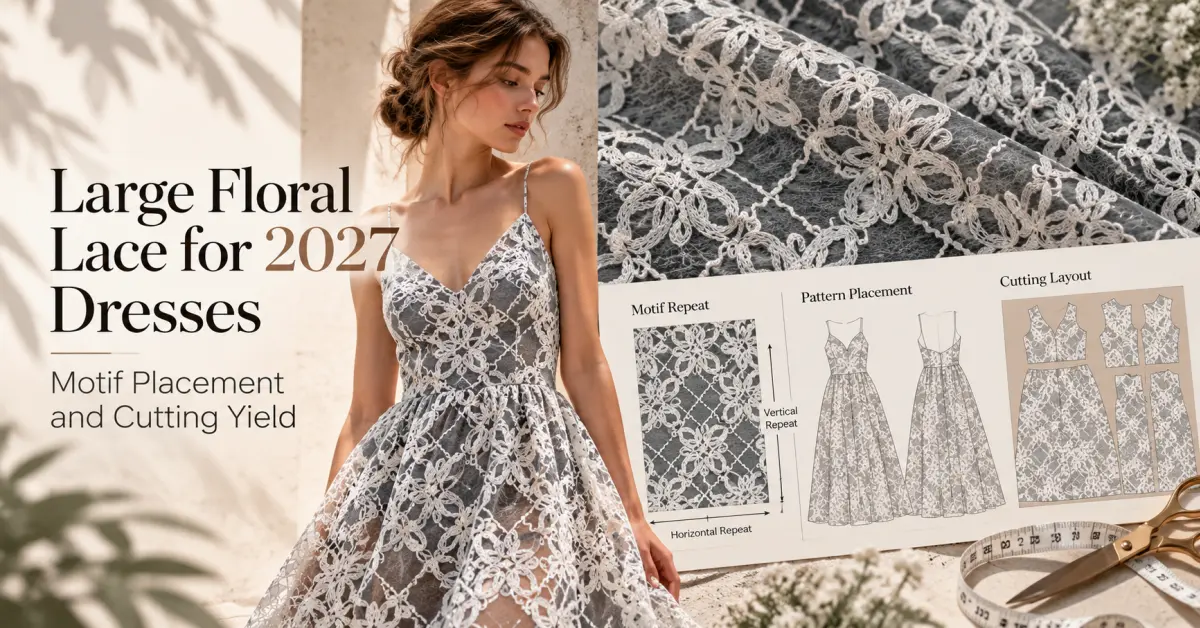

Large floral lace fabric can create a striking dress design, but an attractive fabric sample does not always translate into efficient garment production.
For fashion brands developing 2027 dress collections, the key challenge is deciding where large floral motifs should appear, how patterns should align across garment panels, and how much additional fabric may be needed during cutting.
Unlike small, evenly repeated patterns, oversized floral lace can require deliberate positioning of individual motifs. This affects garment appearance, marker efficiency, fabric consumption and ultimately production cost.
The most practical approach is to evaluate motif repeat, garment pattern dimensions and cutting yield before approving fabric for bulk production.
This guide explains how to assess large floral lace for dresses, plan motif placement, manage pattern matching and reduce avoidable cutting waste.
Why Large Floral Lace Requires More Cutting Planning
Large floral lace is often selected for its visual impact. A prominent flower can become the focal point of a bodice, while a continuous botanical arrangement can create movement across a skirt.
However, large motifs introduce several production considerations.
A flower may fall awkwardly across a neckline, disappear into a seam or become unbalanced between the left and right sides of a garment.
The pattern may also require additional fabric to position important motifs correctly.
Large vs. Small Floral Lace
| Factor | Large floral lace | Small floral lace |
|---|---|---|
| Visual impact | Strong focal motifs | More uniform decoration |
| Placement planning | Often requires individual positioning | Usually more flexible |
| Pattern matching | Can be visually demanding | Generally less noticeable |
| Cutting flexibility | May be restricted by motif location | Often allows more layout options |
| Fabric consumption | May increase with placement requirements | Often easier to optimize |
These differences are not absolute. The actual cutting result depends on motif distribution, usable fabric width, garment dimensions and approved placement rules.
Understanding Floral Motif Repeat
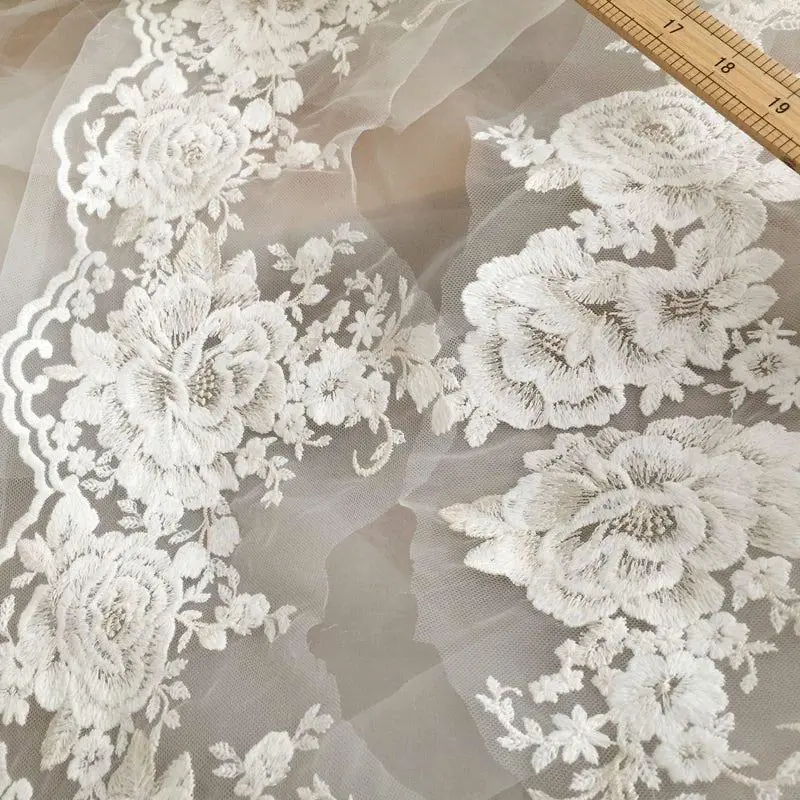
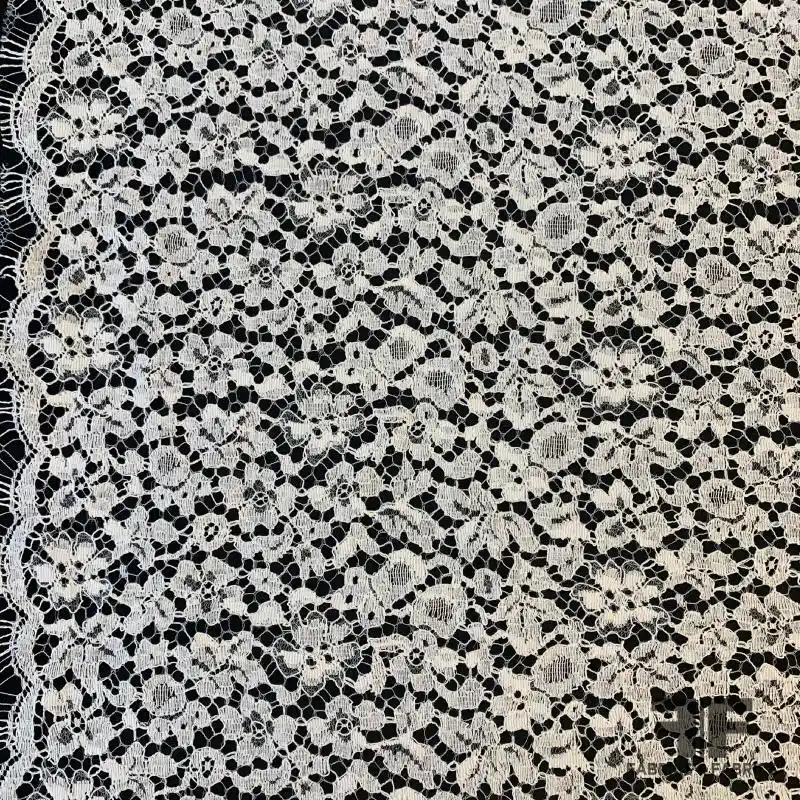
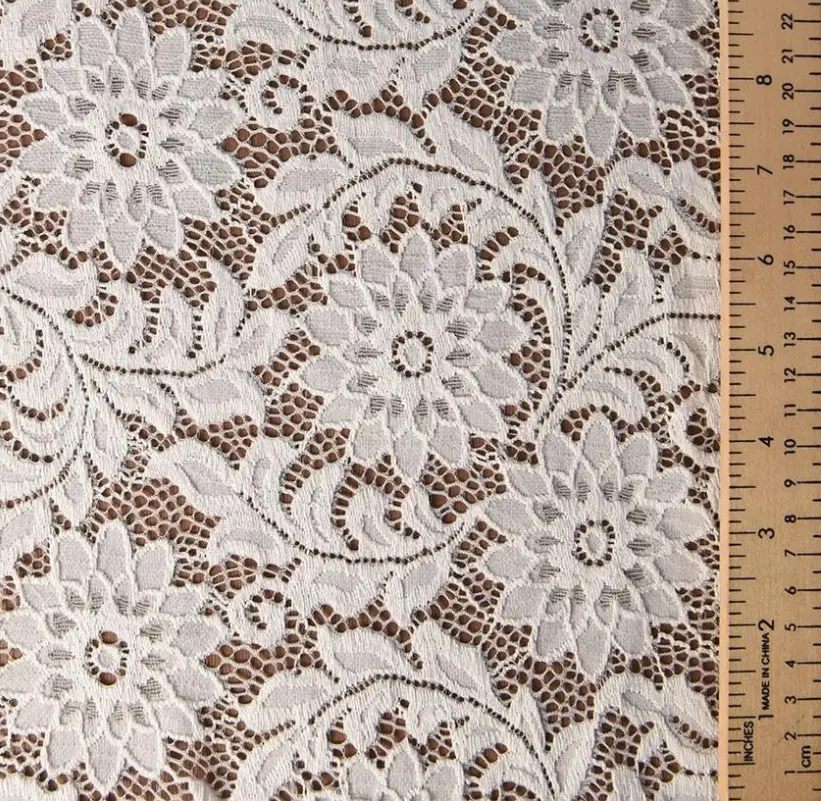
Before developing a dress from large floral lace, buyers should understand the fabric's pattern repeat.
A repeat is the distance over which the decorative pattern returns to the same arrangement.
Horizontal and Vertical Repeat
Two measurements are particularly useful:
Horizontal repeat: The distance between equivalent pattern positions across the fabric width.
Vertical repeat: The distance between equivalent pattern positions along the fabric length.
For example, a hypothetical lace design may have a 30 cm horizontal repeat and a 40 cm vertical repeat.
These dimensions are illustrative, not standard measurements for large floral lace.
A large repeat can restrict how closely garment pieces are positioned during cutting, especially when the design requires specific flowers to appear at particular locations.
Why Repeat Size Matters
Consider a dress bodice that requires a flower centered on the front panel.
If the flower appears only once within a large repeat, the cutter may need to shift the garment pattern along the fabric to achieve the intended position.
This adjustment can leave unused areas that cannot easily accommodate other garment pieces.
The result may be lower cutting efficiency.
Information Buyers Should Request
Before confirming a large floral lace, ask the supplier for:
-
Horizontal and vertical pattern repeat
-
Usable fabric width
-
Motif orientation
-
Border or scalloped-edge details, if applicable
-
Clear photographs showing a complete repeat
-
A representative physical sample
For complex patterns, a full-width sample is often more useful than a small swatch.
Planning Motif Placement on Dress Patterns
Motif placement determines how the floral design appears on the finished garment.
For large floral lace, placement should be considered during pattern development rather than left entirely to the cutting stage.
Front Bodice Placement
The front bodice is often the most visually important area.
A large flower may be positioned at the center front, across the waist or asymmetrically near the shoulder.
However, a motif that looks balanced on a flat fabric may not remain balanced after darts, seams or shaping are introduced.
The development team should evaluate the motif on the actual garment pattern.
Back Bodice Placement
Back panels may require alignment at a center-back seam or zipper.
If a prominent motif crosses the seam, mismatched placement can become highly visible.
Buyers should decide whether exact matching is required or whether a visually balanced arrangement is acceptable.
Sleeve Placement
Sleeves present additional challenges because their curved shapes may interrupt large motifs.
A flower positioned near the sleeve cap could become distorted or partially removed during assembly.
For short sleeves, the available panel area may be too small to display an entire oversized motif.
Skirt Placement
Large floral motifs can be used to emphasize the lower portion of a dress.
However, skirt fullness, panel shape and seam positions affect how the pattern appears.
For an A-line skirt, motifs near the hem may be easier to display than motifs positioned across narrow upper panels.
For a multi-panel skirt, repeating floral elements may require careful alignment between adjacent sections.
Pattern Matching: Where Is It Necessary?
Pattern matching means aligning decorative elements across seams or between garment components.
With large floral lace, matching can significantly influence the finished appearance.
However, exact matching at every seam is not always practical or necessary.
Priority Areas for Matching
| Garment area | Matching priority | Reason |
|---|---|---|
| Center front | High | Strong visual focus |
| Center back | Medium to high | Visible seam or closure |
| Side seams | Design-dependent | Pattern continuity |
| Waist seam | Design-dependent | Transition between bodice and skirt |
| Sleeve seams | Usually selective | Curved construction |
| Skirt panel seams | Medium to high | Large motifs may be interrupted |
Symmetrical vs. Asymmetrical Placement
Symmetrical placement can create a balanced appearance, particularly for fitted dresses.
However, asymmetrical floral arrangements may be equally appropriate when they are intentional.
The important point is consistency between the approved sample and bulk production.
A brand should define which motifs must align and which areas allow placement variation.
This avoids unnecessary cutting restrictions while protecting the intended design.
Cutting Layout: How Motif Placement Affects Fabric Yield
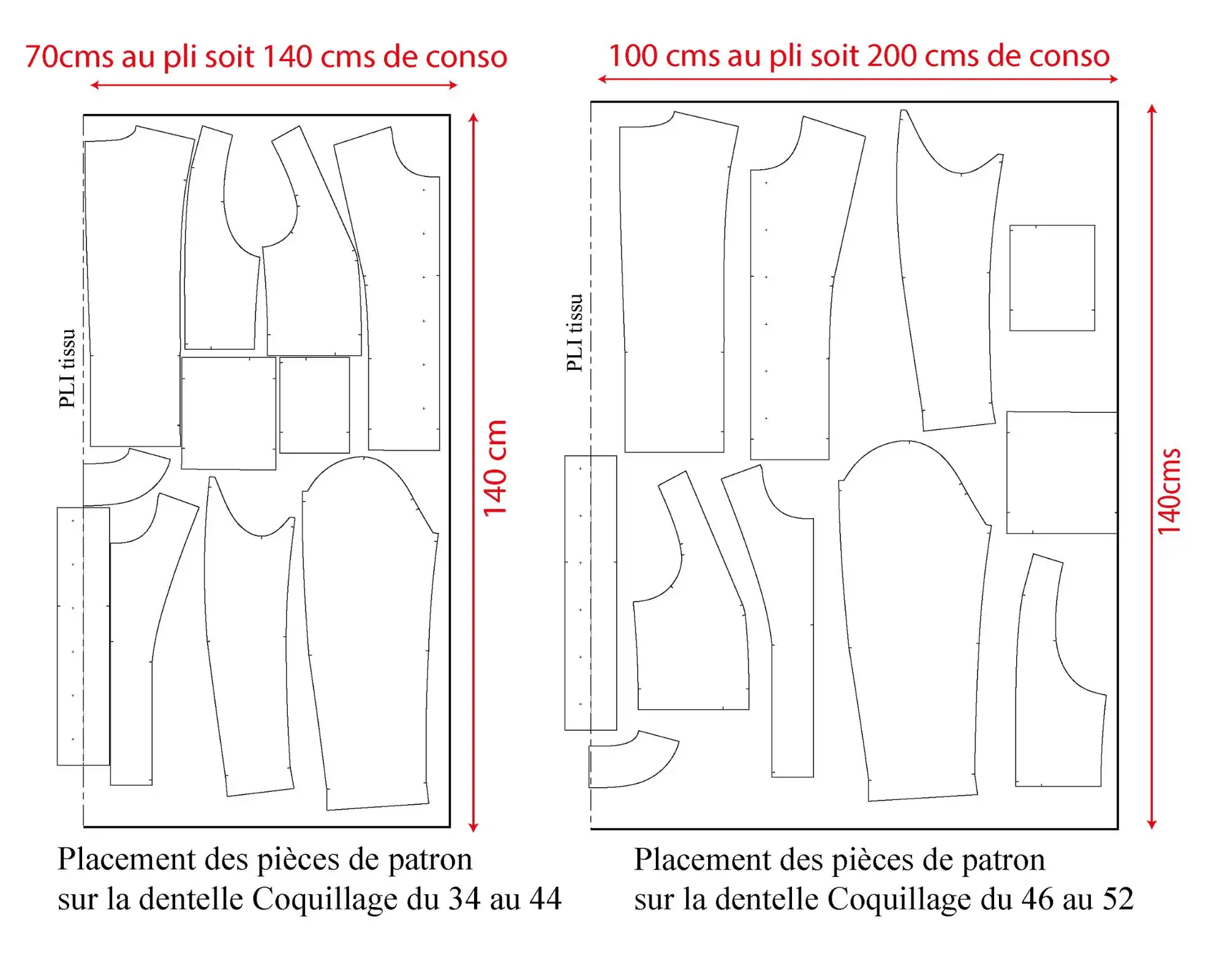
Cutting yield describes how efficiently fabric is converted into usable garment components.
In apparel manufacturing, marker efficiency is commonly used to evaluate the proportion of a cutting layout occupied by garment pattern pieces.
For large floral lace, the most compact layout is not always the most suitable layout.
A tightly arranged marker may save fabric but position important flowers incorrectly.
Standard Layout vs. Placement-Controlled Layout
Standard layout
Pattern pieces are arranged to use the available fabric efficiently while respecting grain, direction and construction requirements.
Placement-controlled layout
Pattern pieces are positioned according to approved floral motif locations.
This can require additional spacing or movement of pieces along the fabric.
Why Fabric Consumption May Increase
Additional consumption may result from:
-
Aligning large flowers across seams
-
Centering motifs on bodice panels
-
Maintaining a consistent pattern direction
-
Preserving decorative borders
-
Cutting around unsuitable motif positions
-
Accommodating different garment sizes
The impact varies by fabric and garment design.
Large floral motifs do not automatically produce high waste. A well-planned design may achieve good cutting efficiency when garment dimensions and motif repeat are compatible.
How to Calculate Cutting Yield and Fabric Consumption
Brands should compare fabric usage using an approved cutting layout rather than estimating consumption from a small sample.
Marker Efficiency
A simplified marker efficiency calculation is:
Marker Efficiency (%) = Total Pattern Piece Area ÷ Marker Area × 100
For example, if garment pattern pieces occupy 8.4 m² within a 10 m² marker:
Marker Efficiency = 8.4 ÷ 10 × 100 = 84%
The remaining 16% represents unoccupied marker area in this simplified example.
This does not necessarily equal total factory waste, because actual material loss may also involve fabric defects, edge allowances, end losses and other production factors.
Comparing Two Cutting Layouts
Consider a hypothetical dress production project.
| Item | Standard placement | Controlled floral placement |
|---|---|---|
| Marker area | 10 m² | 11 m² |
| Pattern piece area | 8.4 m² | 8.4 m² |
| Marker efficiency | 84% | 76.4% |
| Main objective | Efficient nesting | Approved motif positioning |
In this illustration, controlled placement uses a larger marker area for the same garment pieces.
The additional fabric may be justified if the visual result is essential to the garment design.
However, these figures are only examples. They are not measured results from MJ Lace production.
Estimate Fabric Cost Per Garment
A basic material cost calculation is:
Lace Cost per Garment = Fabric Consumption per Garment × Fabric Price per Meter
Suppose a dress requires 2.2 meters under one cutting layout and 2.5 meters under a placement-controlled layout.
At a hypothetical price of US$8 per meter:
-
Standard layout: US$17.60
-
Placement-controlled layout: US$20.00
-
Difference: US$2.40 per garment
For a production order of 1,000 dresses, the illustrative difference would be US$2,400 in lace material cost.
Actual costing should also account for usable width, fabric defects, size ratios, cutting method and other agreed production allowances.
How to Improve Cutting Yield Without Compromising Design
The objective is not always to achieve the highest possible marker efficiency.
It is to balance visual quality, material consumption and production feasibility.
Establish Motif Placement Priorities
Identify the garment areas where floral placement matters most.
For example, the front bodice may require a centered flower, while side panels may allow greater flexibility.
This can reduce unnecessary restrictions during marker planning.
Review Pattern Repeat Before Finalizing the Design
If a floral repeat is significantly larger than the intended garment panel, some motifs may be difficult to position effectively.
Reviewing the repeat early allows designers to adjust panel dimensions or select a more suitable fabric.
Compare Multiple Cutting Layouts
Prepare alternative layouts that respect the approved placement rules.
A slightly different pattern arrangement may reduce unused fabric without changing the garment's appearance.
Evaluate Size Ratios
A layout that works efficiently for one size may not perform equally well across an entire size range.
Bulk production planning should consider the actual order size distribution.
Consider Custom Motif Adjustments
When commercially feasible, adjusting motif scale, spacing or repeat dimensions may improve compatibility with the garment pattern.
Such changes require sampling and technical confirmation.
Brands considering exclusive lace development can review the MJ Lace customized process.
Choosing Large Floral Lace for Different Dress Silhouettes
Different silhouettes create different placement requirements.
| Dress silhouette | Motif placement recommendation | Main cutting consideration |
|---|---|---|
| Fitted sheath dress | Center important motifs on front panels | Darts and seam alignment |
| A-line dress | Balance motifs across bodice and skirt | Increasing panel width |
| Maxi dress | Use large motifs to create vertical movement | Long panels and fabric consumption |
| Panelled dress | Plan continuity across adjacent panels | Multiple seam intersections |
| Slip-style dress | Keep focal motifs away from awkward seam positions | Narrow panels and bias cutting |
| Dress with statement sleeves | Position motifs around sleeve shape | Curved pattern pieces |
Fitted Dresses
Fitted dresses require particular attention to darts, shaping seams and motif distortion.
A large flower crossing a dart may change appearance after sewing.
A-Line and Maxi Dresses
These silhouettes can provide more surface area for large floral patterns.
However, longer panels may increase the importance of vertical repeat and fabric direction.
Panelled Dresses
Multi-panel construction can create more opportunities for decorative placement, but it also introduces additional seams.
The design team should determine whether continuous pattern matching is necessary across all panels.
From Lace Sample to Bulk Cutting Approval
For B2B sourcing, the most important step is confirming that the selected floral lace works with the actual garment pattern before placing a bulk order.
Recommended Approval Process
Step 1: Review the fabric repeat
Confirm usable width, motif size, orientation and any decorative border.
Step 2: Prepare garment patterns
Use the intended production patterns rather than approximate garment dimensions.
Step 3: Create a preliminary placement layout
Identify important motif positions and potential matching requirements.
Step 4: Develop a garment sample
Check how the motifs appear after sewing, shaping and fitting.
Step 5: Evaluate cutting consumption
Compare alternative layouts and calculate estimated material requirements.
Step 6: Approve production standards
Document motif placement tolerances, matching priorities and acceptable appearance variations.
Step 7: Confirm bulk production feasibility
Review fabric consistency, order quantities, delivery requirements and quality expectations with the manufacturer.
At MJ Lace, fashion brands can discuss large floral lace selection and custom development according to their garment requirements.
Buyers can explore the lace fabric collection and provide reference artwork or garment patterns for further technical discussion.
Common Questions About Large Floral Lace
Does large floral lace always create more cutting waste?
No. Cutting yield depends on repeat dimensions, garment patterns, usable fabric width and placement requirements. Large motifs may increase consumption when strict matching is necessary, but this is not inevitable.
Should floral motifs match at every seam?
Not necessarily. Matching priorities should reflect the garment design. Center-front and other prominent areas may require closer control than less visible seams.
Can large floral lace be used for fitted dresses?
Yes, but motif placement should account for darts, shaping seams and panel dimensions. A garment prototype is recommended before bulk production.
Can manufacturers customize floral motif size or spacing?
Depending on the lace construction and manufacturing process, motif scale or repeat dimensions may be adjustable. Feasibility, sampling requirements and minimum order quantities must be confirmed with the supplier.
Conclusion
Large floral lace can be an effective choice for 2027 dress collections, but successful production depends on more than the appearance of the fabric.
Motif repeat determines placement flexibility. Garment patterns influence where flowers can appear. Matching requirements affect cutting layouts, and cutting efficiency contributes directly to material cost.
For fashion brands and apparel manufacturers, the best approach is to evaluate floral placement and fabric consumption before bulk production.
By combining design priorities with accurate pattern planning and supplier communication, brands can achieve distinctive floral lace garments while keeping material usage under control.