

Why Custom Lace Fabric Development Matters for Fashion Brands
In today's competitive fashion industry, fabric selection is no longer only about appearance or price. For brands that want to create unique collections, the ability to develop custom lace fabric has become an important factor in product differentiation.
Lace is widely used in modern apparel, including dresses, blouses, skirts, lingerie, evening wear, resort collections, and premium ready-to-wear garments. However, many fashion brands are no longer satisfied with standard lace patterns available from the market. They need exclusive designs, customized patterns, specific colors, special textures, and production solutions that match their brand identity.
This is where custom lace fabric development plays a critical role.
From the initial design concept to final bulk production, professional lace development requires cooperation between fashion designers, textile engineers, pattern developers, and experienced lace manufacturers. A successful development process combines creativity with technical expertise to ensure that the final lace fabric meets both aesthetic requirements and production standards.
For international fashion brands, working with an experienced lace fabric manufacturer provides advantages such as:
-
Exclusive lace pattern development
-
Flexible customization options
-
Stable bulk production quality
-
Professional technical support
-
Better control over production timelines
-
Scalable manufacturing capability
As a professional lace manufacturer with years of experience in lace textile development, Meijara Textile supports global customers with customized lace solutions, from concept development to finished production.
What Is Custom Lace Fabric Development?
Custom lace fabric development refers to the process of creating lace textiles according to a customer's specific design requirements, including pattern, structure, material, color, width, elasticity, and finishing effects.
Unlike selecting existing lace products from a supplier catalog, custom development allows fashion brands to create fabrics that are unique to their collections.
A customized lace project usually includes:
| Development Stage | Main Activities |
|---|---|
| Design Concept | Analyze artwork, sketches, inspiration images |
| Pattern Development | Create lace structures and motifs |
| Material Selection | Choose yarns, fibers, elasticity |
| Sampling | Produce prototypes for evaluation |
| Color Matching | Develop customized colors |
| Production | Manufacture bulk quantities |
| Quality Control | Inspect finished lace fabric |
For fashion companies, custom lace development is not simply a manufacturing process. It is a creative collaboration between designers and textile specialists.
A professional lace manufacturer needs to understand both fashion trends and production technology to transform creative ideas into commercially viable fabrics.
Why Fashion Brands Choose Custom Lace Fabric
1. Create Unique Brand Identity
The fashion market is becoming increasingly competitive. Many brands use similar fabrics and designs, making differentiation more difficult.
Custom lace fabric allows brands to develop exclusive visual identities through:
-
Unique floral motifs
-
Customized geometric patterns
-
Special textures
-
Signature lace structures
-
Exclusive color combinations
For premium fashion labels, a distinctive lace pattern can become part of the brand's recognizable design language.
For example, a contemporary womenswear brand may require lightweight floral lace with a soft transparent effect, while a luxury eveningwear brand may prefer heavy embroidered lace with dimensional texture.
Different market positioning requires different lace solutions.
2. Better Control Over Product Design
When purchasing standard lace fabrics, designers often need to adjust their designs according to existing materials.
Custom development reverses this process.
The designer's original concept becomes the starting point, allowing:
-
More freedom in garment design
-
Better fabric performance
-
Improved visual consistency
-
Stronger collection storytelling
This is especially important for seasonal fashion collections where brands need exclusive materials to support their creative direction.
3. Support Brand-Level Production Requirements
Large fashion brands usually have strict requirements for:
-
Fabric consistency
-
Color accuracy
-
Width stability
-
Stretch recovery
-
Surface quality
-
Production capacity
A professional OEM lace fabric manufacturer can provide technical solutions based on the brand's production needs.
For example:
| Brand Requirement | Lace Development Solution |
|---|---|
| Lightweight summer collection | Fine yarn lace with breathable structure |
| Body-fitting garments | Stretch lace with elastane |
| Premium garments | Embroidered or jacquard lace |
| Sustainable collection | Recycled fiber lace options |
| Large production orders | Stable bulk manufacturing |
The Complete Custom Lace Fabric Development Process
Developing custom lace fabric involves multiple technical stages. Each step affects the final appearance, quality, and production efficiency.
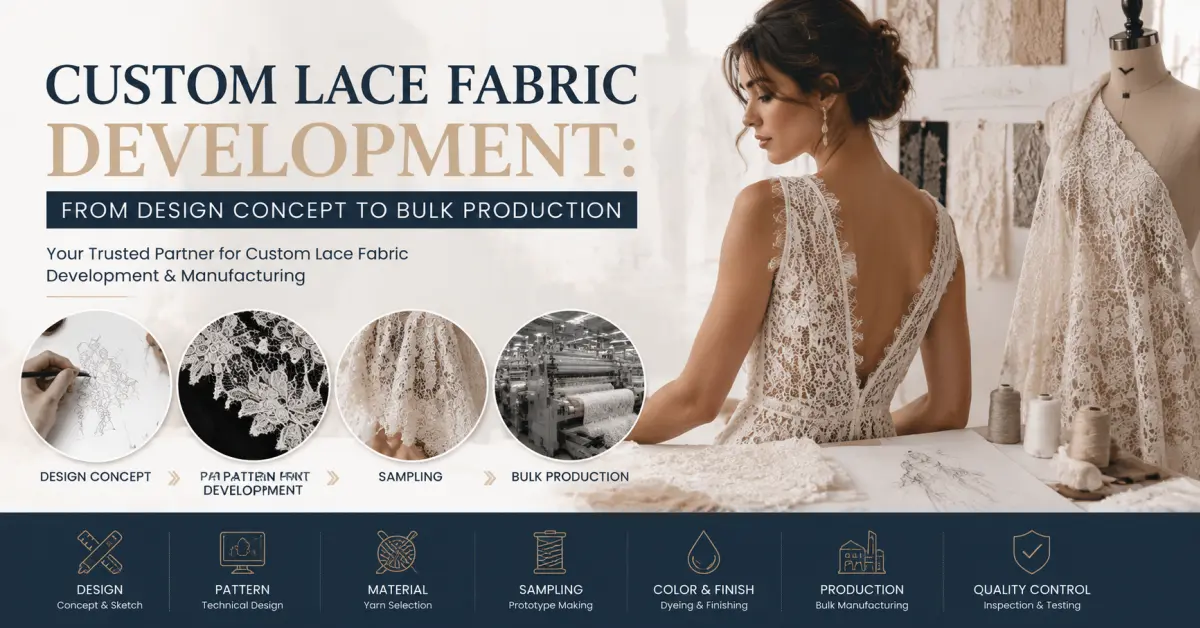
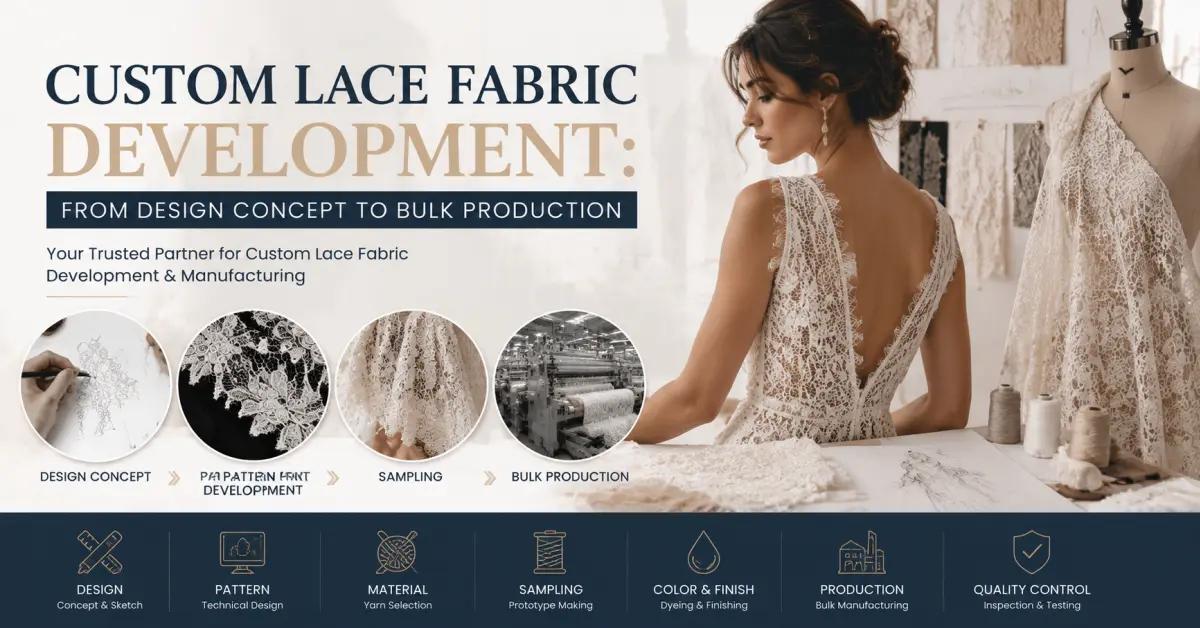
A professional development process normally follows:
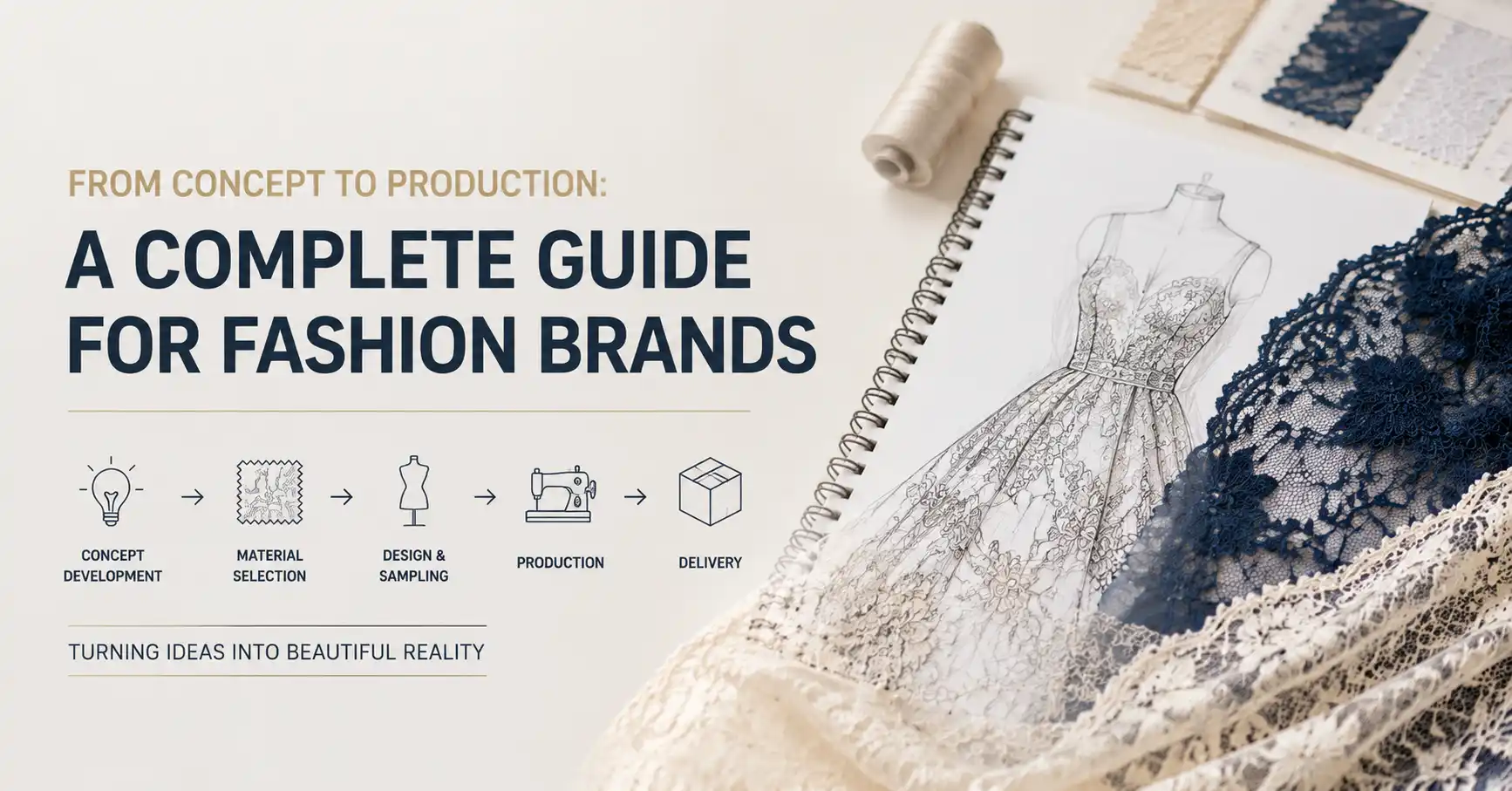
Design → Pattern Development → Material Selection → Sampling → Modification → Approval → Bulk Production → Quality Inspection → Delivery
Step 1: Design Concept and Market Research
Turning Fashion Inspiration Into a Technical Direction
Every custom lace project starts with a creative concept.
Fashion brands usually provide:
-
Design sketches
-
Reference images
-
Mood boards
-
Existing fabric samples
-
Seasonal trend information
-
Color inspiration
The lace manufacturer then evaluates whether the concept can be achieved through existing lace technology.
During this stage, technical teams analyze:
Pattern Complexity
Some designs require:
-
Large floral motifs
-
Fine geometric structures
-
Repeated patterns
-
Embroidery effects
-
3D surface textures
The complexity of the pattern affects:
-
Machine settings
-
Development time
-
Sampling cost
-
Production difficulty
Fabric Application
The intended garment application also influences development decisions.
For example:
| Application | Recommended Lace Characteristics |
|---|---|
| Blouses | Lightweight and soft handle |
| Dresses | Good drape and dimensional appearance |
| Skirts | Stable structure |
| Lingerie | Soft stretch performance |
| Outerwear | Stronger texture and durability |
Understanding the final application helps manufacturers create lace fabrics that are beautiful and functional.
Step 2: Lace Pattern Development and Technical Design
Creating the Structure Behind the Design
After confirming the design concept, the next stage is lace pattern development.
This process requires experienced textile engineers who understand how artistic patterns translate into machine-readable structures.
The development team adjusts:
-
Pattern size
-
Repeat distance
-
Motif arrangement
-
Mesh structure
-
Edge design
-
Fabric density
Digital Pattern Development
Modern lace production uses advanced design systems to convert creative concepts into production patterns. Learn about pattern design development.
During development, engineers consider:
Pattern Balance
A good lace pattern must maintain visual balance across the fabric width.
Production Feasibility
Not every artistic design can be directly manufactured.
Technical adjustments may include:
-
Simplifying extremely fine details
-
Adjusting connecting areas
-
Improving fabric strength
-
Optimizing repeat structures
The goal is to maintain the designer's vision while ensuring stable production.
Step 3: Material Selection and Yarn Development
Choosing the Right Materials for Custom Lace Fabric
After the lace pattern has been developed, selecting suitable raw materials becomes one of the most important stages in custom lace fabric development.
The same lace pattern can create completely different visual effects depending on the yarn composition, thickness, elasticity, and finishing process.
For fashion brands, material selection directly influences:
-
Fabric hand feel
-
Garment comfort
-
Stretch performance
-
Visual appearance
-
Durability
-
Production cost
-
Final product positioning
A professional custom lace fabric manufacturer needs to balance design requirements with technical feasibility.
Common Materials Used in Custom Lace Fabric Production
Different fashion applications require different fiber combinations.
| Material | Characteristics | Common Applications |
|---|---|---|
| Polyester | Strong durability, stable shape, cost-effective | Fashion garments, accessories |
| Nylon | Soft touch, lightweight, good elasticity | Lingerie, fitted garments |
| Spandex / Elastane | Stretch recovery and flexibility | Stretch lace fabric, body-fit clothing |
| Cotton | Natural feeling, breathable, soft texture | Casual fashion, premium garments |
| Recycled Polyester | Sustainable option, lower environmental impact | Eco fashion collections |
Stretch Lace Fabric Development
Stretch lace is one of the most widely used lace categories in modern fashion.
By adding elastane or spandex into the yarn structure, manufacturers can create fabrics with:
-
Better body adaptation
-
Improved wearing comfort
-
Enhanced garment fitting
-
Higher movement flexibility
Stretch lace is commonly used for:
-
Women's tops
-
Dresses
-
Skirts
-
Fashion lingerie
-
Layered garments
-
Contemporary ready-to-wear collections
For brands developing fitted fashion products, selecting the correct stretch ratio is essential.
Too much elasticity may affect pattern stability, while insufficient stretch may reduce wearing comfort.
Professional lace manufacturers evaluate:
-
Stretch direction
-
Recovery ability
-
Fabric weight
-
Pattern density
-
Garment construction
to achieve the right balance.
Step 4: Custom Lace Fabric Sampling Process
From Concept to Physical Sample
Sampling is the stage where creative ideas become a real fabric product.
For fashion brands, the first sample is not always the final version. Lace development usually requires several rounds of adjustment before approval.
A typical custom lace fabric sampling process includes:
1. First Prototype Development
The manufacturer creates an initial sample based on:
-
Customer artwork
-
Pattern requirements
-
Material selection
-
Technical specifications
The purpose of the first sample is to evaluate:
-
Overall appearance
-
Pattern accuracy
-
Fabric structure
-
Surface effect
2. Sample Review and Modification
After receiving the sample, brands usually provide feedback regarding:
-
Pattern size
-
Motif placement
-
Fabric transparency
-
Softness
-
Stretch level
-
Color direction
The manufacturer then adjusts the design.
Common modifications include:
| Customer Feedback | Possible Adjustment |
|---|---|
| Pattern looks too dense | Reduce motif size or spacing |
| Fabric feels too stiff | Change yarn composition |
| Color difference | Adjust dye formula |
| Insufficient stretch | Increase elastane ratio |
| Weak structure | Modify knitting parameters |
3. Final Approval Sample
Once all requirements are confirmed, the final sample becomes the production standard.
The approved sample normally defines:
-
Fabric construction
-
Color standard
-
Pattern specification
-
Width
-
Weight
-
Finishing requirements
This approved version is used as the reference during bulk production.
How Long Does Custom Lace Fabric Development Take?
Development time depends on the complexity of the project.
Typical timelines:
| Development Stage | Estimated Time |
|---|---|
| Design evaluation | 3–7 days |
| Pattern development | 7–15 days |
| First sample | 15–25 days |
| Modification process | 7–15 days |
| Final approval | Depends on customer feedback |
For complex lace structures, embroidery lace, or special finishing effects, development may require additional time.
For Meijara Textile, new lace fabric development generally requires around 20–25 days for sampling, depending on design complexity.
Step 5: Color Development and Finishing Techniques
Creating the Right Color for Fashion Collections
Color is a critical element in fashion fabric development.
Even a perfect lace pattern can fail if the color does not match the brand's collection concept.
Professional lace suppliers usually provide customized color development based on:
-
Pantone references
-
Customer color samples
-
Seasonal trend colors
-
Designer requirements
Color Matching Process
The color development process usually includes:
Step 1: Color Reference Confirmation
Customers provide:
-
Pantone code
-
Fabric sample
-
Digital color reference
The manufacturer evaluates the closest achievable result.
Step 2: Laboratory Dye Development
Technicians test different dye formulas to achieve:
-
Color accuracy
-
Shade stability
-
Batch consistency
Step 3: Color Approval
Before bulk production, customers confirm:
-
Shade
-
Brightness
-
Color depth
-
Overall appearance. Learn about dyeing and color matching.
Special Finishing Techniques for Custom Lace Fabric
Modern fashion brands increasingly request additional surface effects to create unique fabrics.
Common lace finishing techniques include:
1. Printing
Printing allows brands to add:
-
Gradient effects
-
Artistic patterns
-
Multi-color designs
-
Seasonal graphics
Printed lace is popular in:
-
Resort wear
-
Contemporary fashion
-
Designer collections
2. Hot Stamping
Hot stamping creates metallic or special visual effects.
Applications include:
-
Luxury fashion
-
Eveningwear
-
Decorative garments
Common effects:
-
Gold
-
Silver
-
Metallic textures
3. Flocking
Flocking adds a raised velvet-like surface.
Advantages:
-
Rich texture
-
Soft touch
-
Premium appearance
Often used for:
-
High-end dresses
-
Fashion jackets
-
Statement garments
4. Embroidery and Sequin Effects
Embroidery lace adds three-dimensional decoration through:
-
Thread embroidery. Explore cord embroidery.
-
Sequins. See sequins and beads embroidery.
-
Beads. See crystal elegance bead sequin fabric.
-
Appliqué effects
This type of lace is widely used by fashion brands looking for premium visual impact. Explore multi-color embroidery.
Step 6: Bulk Lace Fabric Production
Moving from Sample Approval to Mass Manufacturing
After the final sample is approved, the project enters bulk production.
For international fashion brands, stable production capability is one of the most important factors when choosing a lace supplier.
Bulk production includes several key stages:
1. Production Planning
Before manufacturing begins, factories confirm:
-
Order quantity
-
Delivery schedule
-
Raw material availability
-
Machine allocation
-
Quality requirements
Professional factories prepare production plans to ensure consistent output.
2. Lace Manufacturing Process
Although different lace types use different technologies, the general production process includes:
Yarn Preparation
Raw yarns are prepared according to:
-
Composition requirements
-
Color requirements
-
Production specifications
Machine Production
Advanced lace machines create the fabric structure according to the developed pattern.
Production parameters include:
-
Machine settings
-
Yarn tension
-
Pattern accuracy
-
Fabric density
Finishing Process
After production, lace fabric may go through:
-
Dyeing
-
Washing
-
Heat setting
-
Softening
-
Surface treatment
These processes improve:
-
Fabric stability
-
Appearance
-
Hand feel
Bulk Production Lead Time
Production time depends on:
-
Order quantity
-
Fabric complexity
-
Finishing requirements
-
Customer approval schedule
Typical production timeline:
| Product Type | Production Time |
|---|---|
| Standard lace fabric | 20–30 days |
| Custom lace fabric | 35–40 days |
| Embroidery lace | 18–20 days after approval |
For customized lace development, early communication between brands and manufacturers is essential to avoid delays.
Quality Control During Custom Lace Production
Ensuring Consistent Quality from Sample to Bulk
One of the biggest concerns for fashion brands is whether bulk production will match the approved sample.
A professional lace manufacturer uses strict quality control procedures throughout production. Learn about quality control standards.
Key Quality Inspection Points
| Inspection Item | Purpose |
|---|---|
| Pattern Accuracy | Ensure design consistency |
| Fabric Width | Maintain garment production requirements |
| Color Matching | Avoid shade differences |
| Stretch Recovery | Confirm performance |
| Surface Defects | Detect production issues |
| Roll Inspection | Ensure delivery quality |
Common Lace Fabric Quality Problems
1. Pattern Distortion
Causes:
-
Incorrect machine adjustment
-
Fabric tension issues
-
Improper finishing
Solutions:
-
Production parameter adjustment
-
Process monitoring
2. Color Variation Between Batches
Causes:
-
Dyeing differences
-
Raw material variation
Solutions:
-
Standardized color approval
-
Laboratory testing
3. Fabric Shrinkage
Causes:
-
Incorrect finishing process
-
Material characteristics
Solutions:
-
Pre-production testing
-
Heat setting control
Why Experienced Lace Manufacturers Matter
Custom lace development requires more than production equipment.
A reliable supplier needs:
Technical Experience
Understanding:
-
Lace structures
-
Yarn behavior
-
Fashion applications
-
Production limitations
Development Capability
Ability to transform:
Designer concepts → Technical patterns → Production fabrics
Manufacturing Stability
Including:
-
Advanced machinery
-
Skilled operators
-
Quality management
-
Production capacity
For fashion brands, choosing the right supplier can significantly reduce development risks and improve product competitiveness.
How to Choose the Right Custom Lace Fabric Manufacturer
Finding a Reliable Partner for Long-Term Fashion Production
For fashion brands, selecting a custom lace fabric manufacturer is not only a sourcing decision but also a strategic partnership decision.
A supplier may be able to provide attractive samples, but successful long-term cooperation requires much more:
-
Strong product development capability
-
Stable production capacity
-
Consistent quality control
-
Professional communication
-
Understanding of fashion market requirements
Especially for international buyers, choosing the wrong lace supplier can lead to:
-
Delayed collection launches
-
Unstable fabric quality
-
Increased development costs
-
Production problems during bulk orders
Therefore, brands should evaluate manufacturers based on several key factors.
1. Evaluate Lace Development Capability
A professional lace manufacturer should not only produce existing designs but also help brands create new fabrics.
Important capabilities include:
Pattern Development
The supplier should be able to develop:
-
Floral lace patterns
-
Geometric lace structures
-
Abstract designs
-
Jacquard lace
-
Embroidered lace
-
Custom logo or signature patterns
A strong development team can transform creative concepts into manufacturable fabrics.
Technical Problem-Solving Ability
During development, challenges often appear:
-
The pattern cannot be produced exactly as designed
-
The fabric lacks stability
-
The texture does not meet expectations
-
The production cost exceeds the target
Experienced manufacturers should provide technical suggestions instead of simply producing according to instructions.
For example:
A designer may request an extremely delicate transparent lace structure.
A professional supplier may recommend:
-
Adjusting yarn thickness
-
Modifying mesh density
-
Changing pattern repeat
-
Adding reinforcement areas
to maintain both beauty and production stability.
2. Check Manufacturing Equipment and Production Capacity
Why Factory Capability Matters
Custom lace fabric production depends heavily on machinery and technical expertise.
Modern lace factories use advanced equipment to achieve:
-
Precise patterns
-
Stable fabric quality
-
Efficient production
-
Large-scale manufacturing
When evaluating a lace supplier, buyers should consider:
| Evaluation Area | Questions Buyers Should Ask |
|---|---|
| Machinery | What type of lace machines are available? |
| Production Capacity | Can the factory support bulk orders? |
| Technology | Can they develop customized structures? |
| Experience | How many years in lace manufacturing? |
| Quality System | How are fabrics inspected? |
Meijara Textile Manufacturing Advantage
As a professional lace fabric manufacturer, Meijara Textile has focused on lace development and production for many years.
The company provides:
-
Custom lace fabric development
-
OEM lace manufacturing
-
Stretch lace production
-
Jacquard lace development
-
Embroidery lace solutions. Explore laser embroidery.
-
Fashion lace applications. Explore lace trim.
With experienced technical teams and professional production equipment, Meijara supports global fashion brands from initial concept to final production.
3. Understand MOQ and Production Requirements
Minimum Order Quantity for Custom Lace Fabric
MOQ is an important consideration for fashion brands, especially emerging designers and growing labels.
Custom lace usually requires more development work compared with standard fabrics.
Typical requirements:
| Product Type | Typical MOQ |
|---|---|
| Standard lace fabric | Lower MOQ depending on stock availability |
| New custom lace development | 3000–5000 meters |
| Custom embroidery lace | 300–500 meters per color |
MOQ depends on:
-
Pattern complexity
-
Material selection
-
Production process
-
Dyeing requirements
4. Review Previous Customer Applications
A reliable lace supplier should understand different fashion categories.
Custom lace fabric is widely used in:
-
Women's dresses
-
Designer tops
-
Skirts
-
Resort wear
-
Eveningwear
-
Contemporary fashion
-
Luxury ready-to-wear collections. Explore bridal lace.
Manufacturers with experience across different applications can provide better recommendations.
For example:
A lace fabric designed for a summer dress requires:
-
Lightweight structure
-
Breathability
-
Soft touch
while lace for structured fashion garments requires:
-
Better stability
-
Higher density
-
Stronger shape retention
OEM Lace Fabric Development for Fashion Brands
Building Exclusive Fabrics Through OEM Partnership
OEM lace fabric development allows brands to create exclusive materials without establishing their own textile production facilities.
The manufacturer provides:
-
Design support
-
Technical development
-
Sampling
-
Production
-
Quality control
-
Delivery management
This model is widely used by:
-
Fashion brands
-
Clothing manufacturers
-
Apparel sourcing companies
-
Designer labels
Benefits of OEM Lace Fabric Manufacturing
1. Exclusive Product Differentiation
Instead of purchasing common lace designs from the market, brands can create unique fabrics that match their collections.
Advantages include:
-
Stronger brand identity
-
Less product similarity
-
Better market positioning
2. Reduced Development Risk
Working with an experienced manufacturer helps brands avoid:
-
Incorrect material selection
-
Production problems
-
Quality inconsistencies
Professional suppliers provide technical advice throughout development.
3. Flexible Fashion Collection Development
Fashion trends change quickly.
OEM development allows brands to create:
-
Seasonal lace collections
-
Limited edition fabrics
-
Trend-based designs
-
Special collaboration materials
Common Mistakes Buyers Make When Developing Custom Lace Fabric
Mistake 1: Focusing Only on Price
Price is important, but it should not be the only factor.
Low-cost suppliers may create problems such as:
-
Poor pattern accuracy
-
Unstable quality
-
Delayed delivery
-
Difficult communication
For fashion brands, fabric quality directly affects the final garment value.
Mistake 2: Providing Only Visual References
Many buyers send only images and expect identical results.
However, lace development requires technical information.
Better communication includes:
-
Intended application
-
Fabric weight requirement
-
Stretch requirement
-
Color expectation
-
Production quantity
The more information provided, the closer the final result will be.
Mistake 3: Ignoring Production Feasibility
Some designs look attractive but may be difficult to manufacture.
Experienced manufacturers can help adjust:
-
Pattern structure
-
Fabric density
-
Material selection
while maintaining the original design concept.
Mistake 4: Starting Development Too Late
Custom lace development requires time.
Brands should consider:
-
Sampling period
-
Modification time
-
Production schedule
-
Shipping time. Learn about importing logistics.
Starting early helps ensure products are launched according to seasonal calendars.
Applications of Custom Lace Fabric in Fashion Industry
1. Fashion Dresses
Custom lace is widely used in:
-
Casual dresses
-
Summer dresses
-
Cocktail dresses
-
Premium collections
Popular lace characteristics:
-
Floral motifs
-
Soft texture
-
Lightweight construction
-
Elegant transparency
2. Designer Tops and Blouses
Lace adds:
-
Feminine details
-
Decorative texture
-
Premium appearance
Common designs include:
-
Lace sleeves
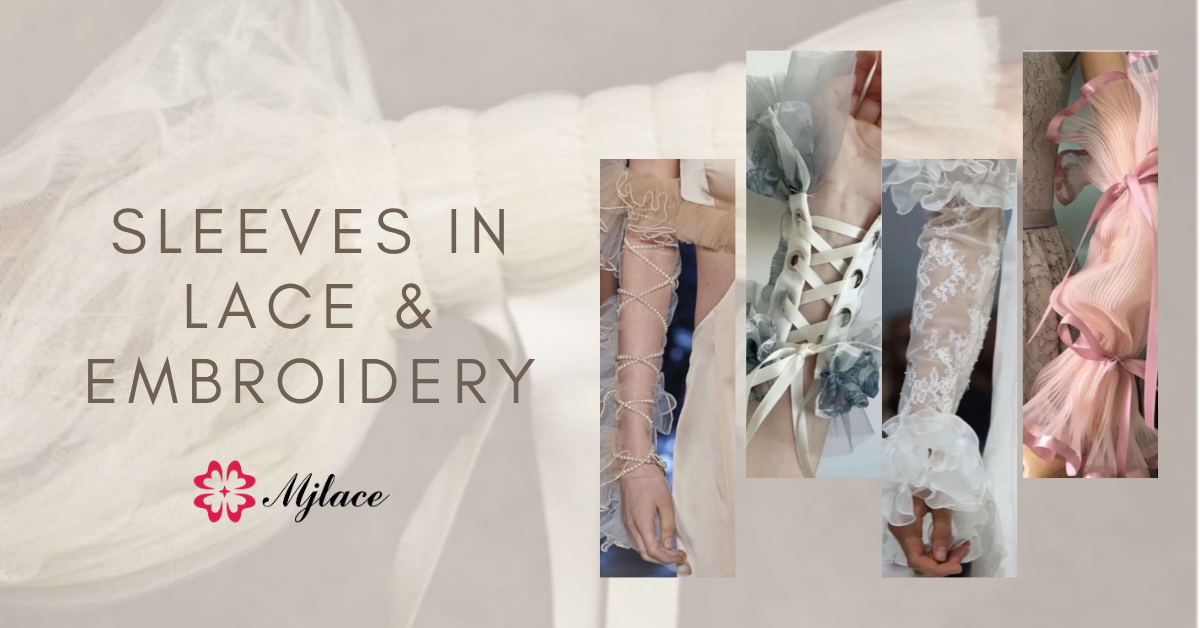
-
Lace panels
-
Full lace garments
-
Layered lace construction
3. Resort Wear and Vacation Collections
Lightweight lace fabrics are increasingly popular in resort fashion.
Applications:
-
Beach dresses
-
Cover-ups
-
Summer skirts
-
Lightweight outer layers
Important requirements:
-
Breathability
-
Comfort
-
Soft hand feel
4. Contemporary Ready-to-Wear Fashion
Modern designers use lace beyond traditional applications.
Examples include:
-
Lace jackets
-
Lace shirts
-
Lace streetwear details
-
Mixed-material garments
This shows how lace continues evolving as a versatile fashion material.
Custom Lace Fabric Development Checklist for Buyers
Before starting a project, brands should prepare:
| Information Required | Details |
|---|---|
| Design Reference | Artwork, sketches, samples |
| Fabric Type | Stretch, non-stretch, embroidery, jacquard |
| Application | Garment category |
| Color | Pantone or sample reference |
| Quantity | Estimated order volume |
| Timeline | Launch date requirement |
| Quality Standard | Testing requirements |
A complete brief helps manufacturers provide accurate solutions.
FAQ: Custom Lace Fabric Development
1. What is custom lace fabric development?
Custom lace fabric development is the process of creating lace textiles according to a brand's specific requirements, including pattern, material, color, structure, and finishing effects.
It allows fashion brands to develop exclusive fabrics instead of selecting standard market designs.
2. How long does custom lace fabric development take?
The development timeline depends on design complexity.
Generally:
-
Design evaluation: 3–7 days
-
Sample development: 20–25 days
-
Modification and approval: Depends on feedback
-
Bulk production: Around 35–40 days
3. What information should brands provide for custom lace development?
Brands should provide:
-
Design inspiration
-
Fabric application
-
Reference samples
-
Color requirements
-
Quantity
-
Delivery schedule
Detailed information helps manufacturers create accurate samples.
4. What is the MOQ for custom lace fabric?
MOQ depends on product type.
For new lace fabric development, MOQ is usually around 3,000–5,000 meters.
For embroidery lace: 300–500 meters per color.
5. Can lace fabric manufacturers create exclusive designs?
Yes.
Professional manufacturers can develop exclusive lace patterns according to:
-
Brand concepts
-
Artwork
-
Seasonal collections
-
Fashion trends
6. What types of fashion products use custom lace fabric?
Custom lace fabric is widely used in:
-
Dresses
-
Tops
-
Skirts
-
Resort wear
-
Eveningwear
-
Designer fashion collections
7. How can brands choose a reliable lace supplier?
Brands should evaluate:
-
Development capability
-
Production equipment
-
Quality control
-
Communication ability
-
Previous experience
A good supplier should provide solutions throughout the entire development process.
Turning Creative Ideas Into Commercial Lace Fabrics
Custom lace fabric development connects fashion creativity with textile manufacturing expertise.
From the first design concept to pattern development, sampling, color matching, and bulk production, every stage influences the final quality of the fabric.
For fashion brands, working with an experienced lace fabric manufacturer provides the technical support needed to create unique, reliable, and commercially successful products.
As fashion continues moving toward personalization and exclusive materials, custom lace development will remain an important solution for brands seeking differentiation in global markets.
With professional development capabilities, advanced manufacturing technology, and experience serving international customers, Meijara Textile helps fashion brands transform creative ideas into high-quality lace fabrics ready for production.
Ready to start your custom lace development project? Visit our homepage to learn more or contact us for inquiries. You may also submit an inquiry for custom pricing.