

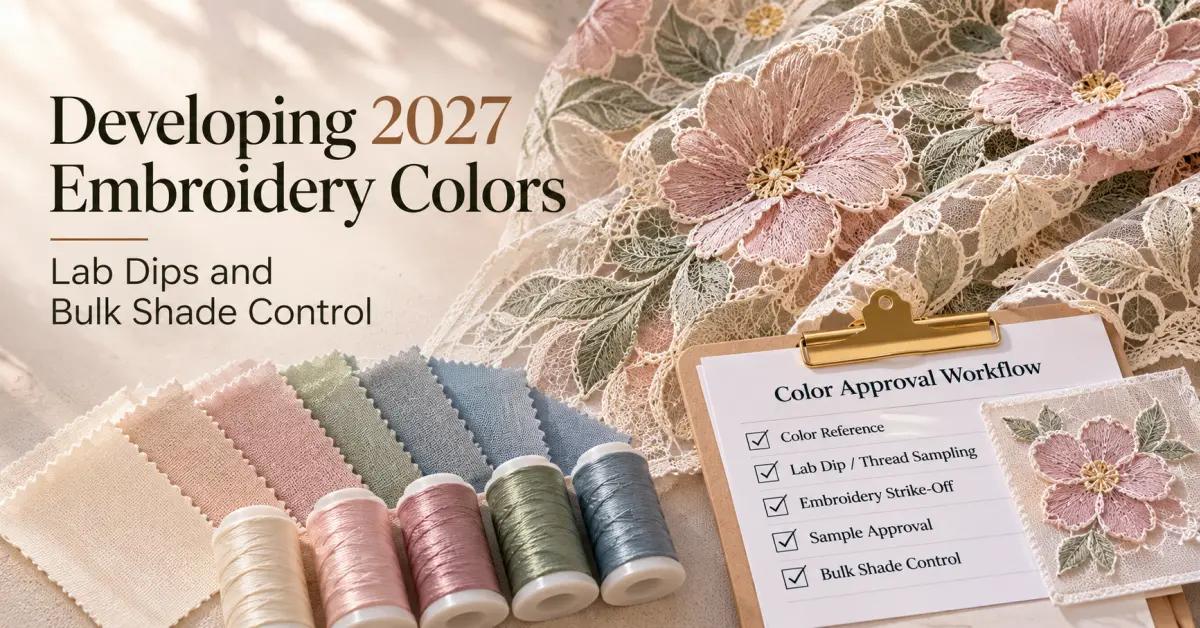
A color approved on a design board does not always look the same on finished embroidered fabric. The base material, embroidery thread, stitch density and finishing process can all change how a shade appears.
For fashion brands developing 2027 collections, the challenge is not simply selecting custom embroidery colors. It is creating a reliable approval process that allows the manufacturer to reproduce the intended appearance across sampling and bulk production.
A successful color development program should establish three references: an approved color target, a finished embroidery sample and a clearly defined bulk shade standard.
This guide explains how lab dip approval, thread matching, fabric evaluation and production controls work together to reduce color disputes and improve consistency.
Why Embroidery Color Matching Is More Complex Than Fabric Dyeing
A conventional dyed fabric may be evaluated primarily as one textile surface. Embroidered fabric often combines multiple materials and different optical characteristics.
The base fabric and embroidery threads may have different fiber compositions, dyeing histories, textures and surface finishes.
For example, a matte cotton base and a glossy polyester embroidery thread can appear different even when their nominal color references are similar.
Three factors are particularly important.
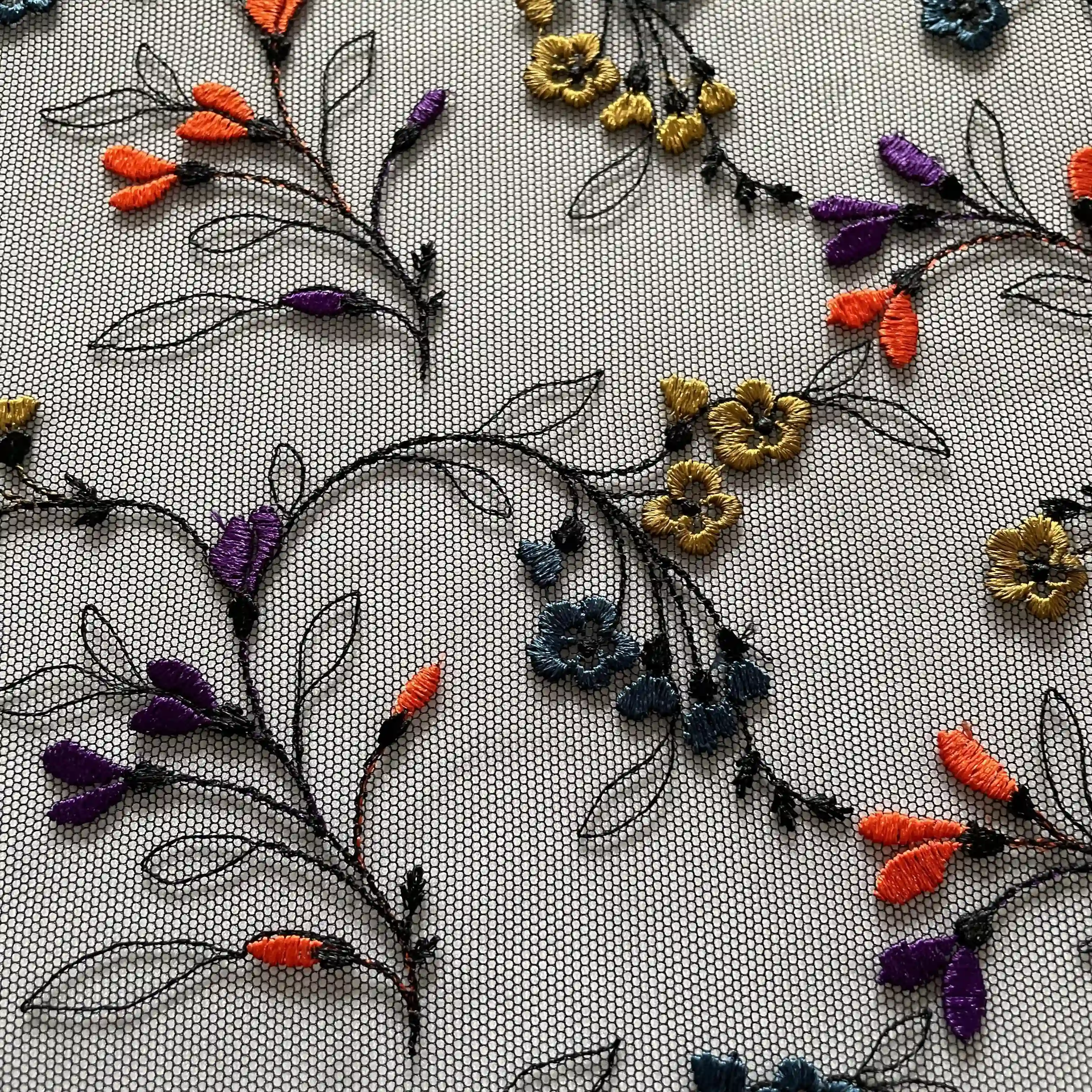
Base Fabric Color
The base material forms the visual background of the embroidery.
A thread color approved against white fabric may appear warmer, cooler or less distinct when placed on beige, navy or black.
For sheer bases such as mesh or tulle, the color of the material underneath can also affect the finished appearance.
Embroidery Thread Characteristics
Thread composition, luster and construction influence how light reflects from embroidered surfaces.
The direction of stitches can create visible highlights and shadows, especially with lustrous threads.
As a result, matching a thread to a printed color card does not guarantee that the completed embroidery will have the same visual appearance.
Stitch Density and Coverage
Dense embroidery covers more of the base material, while open stitching allows more background color to remain visible.
A shade that appears balanced in a small thread sample may look stronger when used across a large embroidered motif.
Buyer takeaway: Approve the complete embroidery construction, not only the individual thread color.
What Is a Lab Dip in Textile Color Development?
A lab dip is a small dyed material sample prepared to assess how closely a proposed dyeing result matches a specified color target.
Lab dips are commonly used when developing dyed base fabrics or other components that require custom dyeing.
However, not every embroidery project requires a lab dip for the thread itself.
If the design uses an existing stock thread shade, a physical thread card and an embroidered strike-off may be more relevant. If a custom-dyed thread is required, the supplier should confirm whether a suitable thread dyeing sample or equivalent approval procedure is available.
Lab Dip vs. Thread Card vs. Embroidery Strike-Off
| Approval material | What it confirms | Main limitation |
|---|---|---|
| Lab dip | Proposed dyed material shade | Does not show the full embroidered appearance |
| Thread shade card | Available thread colors | May not represent stitched surface effects |
| Embroidery strike-off | Thread and base fabric interaction in a stitched sample | May not represent all bulk finishing conditions |
| Finished production sample | Overall appearance after relevant production processes | Requires comparison with the approved reference |
These samples serve different purposes and should not be treated as interchangeable.
For multi-color embroidery, buyers may need to approve individual component shades and the complete stitched design.
Establishing a Reliable Color Standard
Color development becomes difficult when the buyer and supplier use different references.
Terms such as "soft ivory," "dusty rose" or "deep green" may describe a design intention, but they are not precise production standards.
Use an Identifiable Reference
A useful color submission may include:
A physical fabric swatch A recognized color-system reference, with edition and material type identified An approved previous production sample A documented custom color standard
A digital image may support communication, but it should not be the sole basis for final color approval.
Define the Viewing Conditions
Color can appear different under daylight, store lighting and other artificial light sources.
Two materials may appear similar under one light source but noticeably different under another. This effect is known as metamerism.
Buyers and manufacturers should agree on the viewing conditions used for color assessment, including the light source where appropriate.
Record the Reference Version
Every color submission should have an identifiable reference.
For example:
Style: EM-2027-014
Color: C03
Base fabric: Approved ivory mesh
Embroidery thread: Approved thread reference
Approval sample: Strike-off V2
Status: Approved for production
This is an illustrative record, not an MJ Lace production number.
Version control is particularly useful when several color revisions are exchanged during development.
A Practical Lab Dip Approval Process
Lab dip approval should be treated as a controlled decision rather than an informal comparison of photographs.
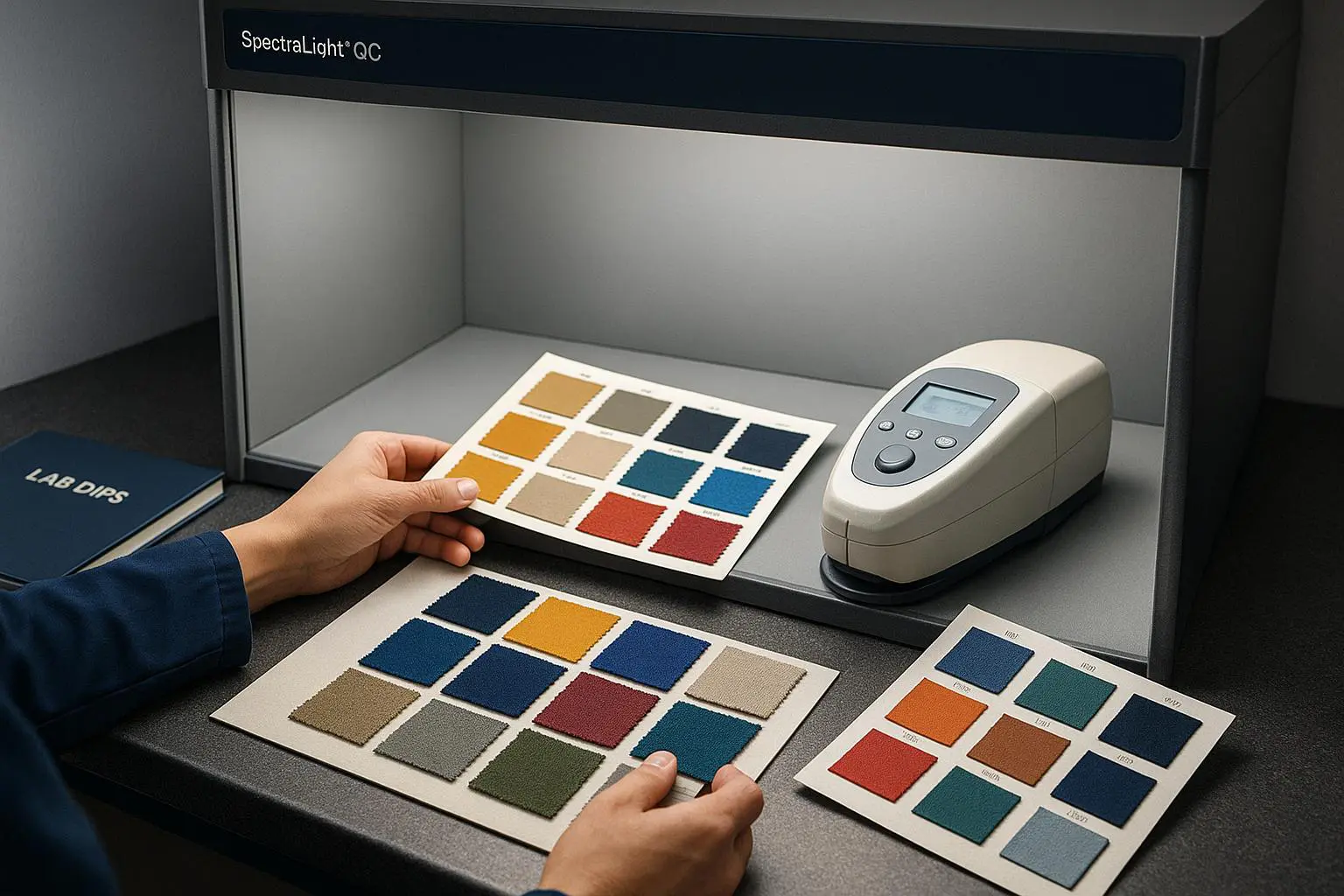
Step 1: Submit the Target Color
The buyer provides a physical or standardized color reference, along with the intended material and product requirements.
Step 2: Confirm the Material
The supplier confirms which component is being colored and whether a lab dip is appropriate.
A dyed mesh base, a cotton fabric and a synthetic embroidery thread may require different color development methods.
Step 3: Prepare Candidate Shades
Where lab dips are used, the supplier prepares one or more candidate shades.
Each submission should be clearly identified so the buyer can distinguish between alternatives.
Step 4: Evaluate the Samples
The buyer compares the candidate against the target under agreed viewing conditions.
The review should consider overall shade, lightness, chroma and any visible undertone difference.
Where suitable, instrumental measurements may supplement visual assessment.
Step 5: Approve or Request Revision
The buyer records a clear decision:
Approved: Accept the submitted shade as the production reference. Revise and resubmit: Request a corrected sample before production approval. Rejected: Do not proceed with the submitted shade.
A conditional approval should specify exactly what is permitted and should not be interpreted as unrestricted production approval.
Why the Finished Embroidery Sample Still Needs Approval
A successful lab dip does not automatically guarantee a successful embroidered fabric.
The final result depends on how the approved components interact after stitching and finishing.
For example, a pale blue thread may match its target accurately, but the completed embroidery may look too strong when stitched densely over a light-colored mesh.
Likewise, a tonal embroidery design may lose definition if the thread and base fabric become too similar under certain lighting conditions.
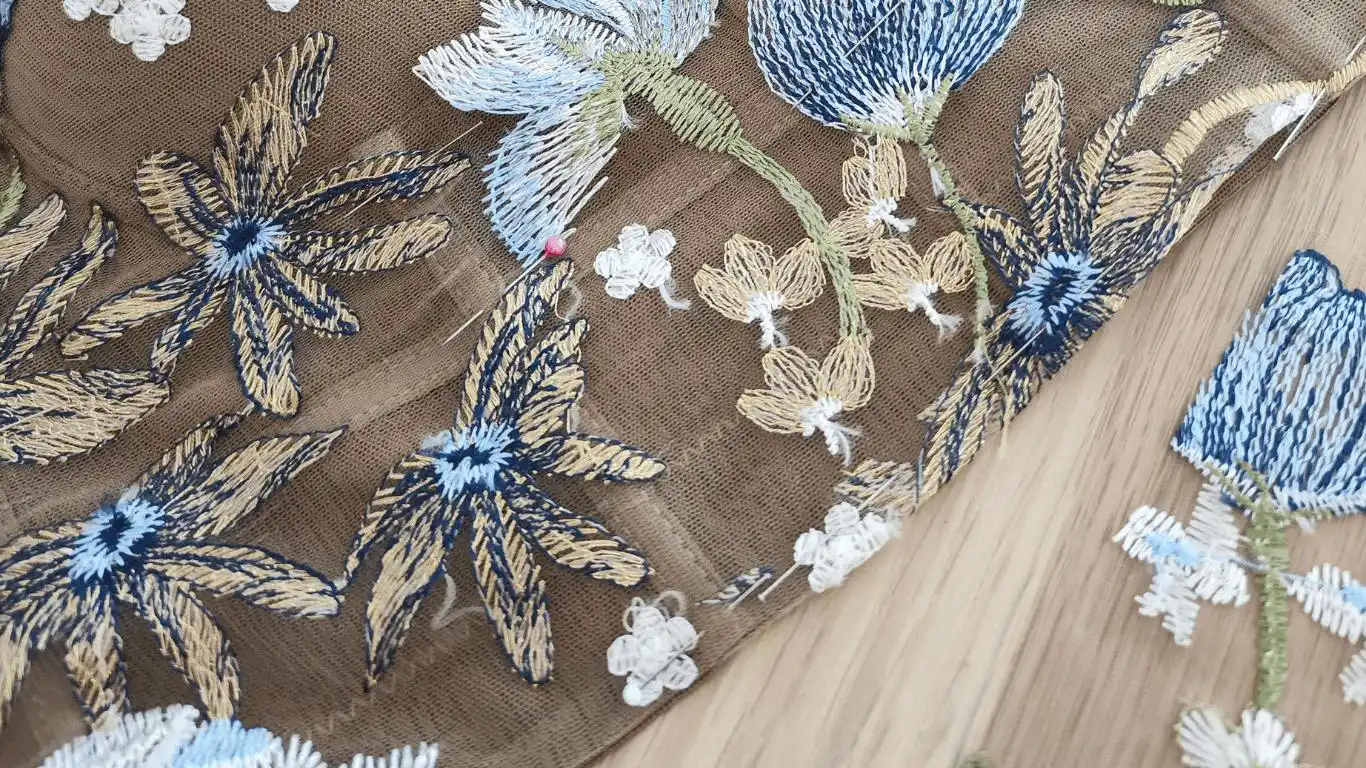
What to Check on an Embroidery Strike-Off
| Checkpoint | Approval question |
|---|---|
| Base fabric shade | Does the background match the approved reference? |
| Thread colors | Are the intended shades used in the correct locations? |
| Pattern visibility | Is the contrast appropriate for the design? |
| Stitch density | Does coverage affect the perceived shade? |
| Thread luster | Does the surface appearance match expectations? |
| Finishing | Has the appearance changed after finishing? |
| Overall coordination | Does the fabric work with the intended garment materials? |
For multi-color designs, inspect both individual colors and the combined pattern.
An embroidered strike-off is particularly important when the design includes subtle tonal differences or several similar shades.
Controlling Shade Consistency During Bulk Production
Bulk shade control begins before production starts.
The buyer and manufacturer should agree on the approved reference, inspection conditions and acceptance criteria.
Without these requirements, two parties may reach different conclusions about whether a production batch matches the sample.

Confirm the Production Standard
The bulk standard should identify the approved base fabric shade, thread references and finished embroidery sample.
If several production lots are involved, each lot should be traceable to the relevant material and color records.
Check Incoming Materials
Where appropriate, incoming base fabrics and embroidery threads should be compared with their approved references.
A change in material supplier, dye lot or thread specification may affect the finished appearance.
Any substitution should be reviewed before it is used in production.
6.3 Evaluate the First Production Output
The first representative bulk sample should be checked against the approved embroidery standard.
This helps identify differences before a large quantity has been produced.
The review should include the completed stitched appearance rather than only loose thread or unfinished base fabric.
6.4 Monitor Shade Variation Between Lots
If a bulk order includes several material or production lots, the supplier should assess whether visible shade differences exist.
For garments requiring multiple panels from the same embroidered fabric, shade consistency can be especially important.
Where practical, production and cutting teams should maintain appropriate lot identification to reduce the risk of mixing visibly different shades within one garment.
6.5 Define Acceptance Criteria
Color acceptance can involve visual comparison and, when appropriate, instrumental color measurements.
However, a single universal numerical tolerance should not be assumed suitable for every embroidered fabric.
Complex embroidery surfaces, metallic or lustrous threads, open mesh and multi-color patterns may require product-specific assessment methods.
The buyer and supplier should agree on the method, sampling approach and acceptable variation before bulk production.
7. Visual Shade Assessment vs. Instrumental Color Measurement
Both visual assessment and instrumental measurement can contribute to textile color control, but they answer different questions.
Visual Assessment
Visual inspection evaluates how the material appears under specified viewing conditions.
It is especially important for embroidered fabrics because texture, sheen and pattern distribution influence the overall result.
The assessment should be performed consistently, using agreed lighting and reference materials.
Instrumental Measurement
A spectrophotometer can measure color characteristics and calculate color differences using an agreed color-difference method.
Instrumental measurement may be useful for relatively uniform, measurable material surfaces.
However, open or heavily textured embroidery can be difficult to measure consistently. Measurement aperture, sample backing, surface orientation and other conditions may influence results.
For these products, the measurement method should be validated for the specific material.
Important Distinction: Shade Difference vs. Colorfastness
A production sample may match the approved shade initially but still perform poorly during washing, rubbing or exposure to light.
Shade matching and colorfastness are separate quality requirements.
Where relevant, buyers should specify suitable colorfastness testing in addition to initial shade approval.
8. Common Causes of Bulk Embroidery Shade Problems
Even when the initial sample is approved, differences can arise during production.
| Potential issue | Possible cause | Recommended response |
|---|---|---|
| Embroidery looks different from thread card | Stitch density, luster or base contrast | Review finished strike-off |
| Base fabric appears inconsistent | Different dye lots or finishing conditions | Check lot records and approved standards |
| Same thread looks different on two bases | Background color and optical interaction | Approve each relevant combination |
| Bulk output differs from sample | Material substitution or process variation | Review first bulk output and traceability |
| Color matches in one light but not another | Metamerism | Agree on viewing conditions |
| Garment panels show shade variation | Mixed material or production lots | Improve lot identification and cutting controls |
The appropriate corrective action depends on the root cause. Replacing a thread is not always the solution if the difference originates from the base fabric or finishing process.
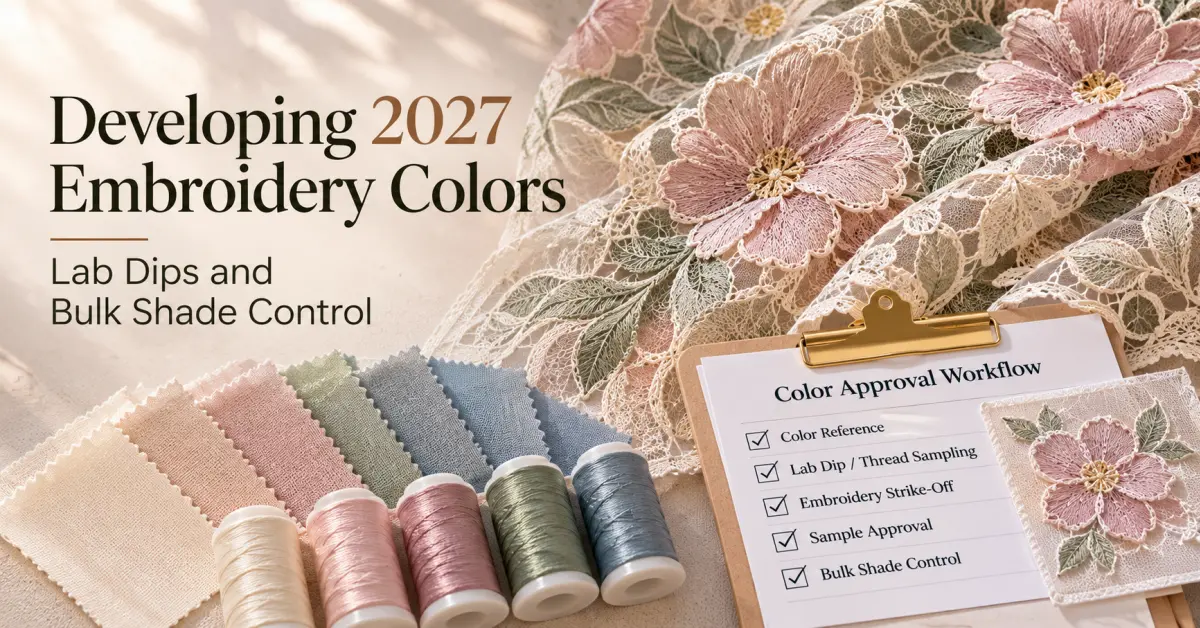
9. Color Approval Workflow for Fashion Brands
A clear approval workflow helps buyers and suppliers understand when a color is ready for production.
| Stage | Buyer responsibility | Supplier responsibility | Required outcome |
|---|---|---|---|
| 1. Color brief | Provide target and application | Confirm material and feasibility | Defined color request |
| 2. Component sampling | Review candidate shades | Prepare lab dip or thread references | Approved component colors |
| 3. Embroidery design | Evaluate finished strike-off | Produce representative stitched sample | Approved embroidery appearance |
| 4. Production standard | Confirm reference and tolerance | Document approved specifications | Controlled bulk standard |
| 5. First bulk | Review if required | Compare first output with standard | Authorization to continue |
| 6. Lot monitoring | Confirm acceptance requirements | Inspect and record variation | Consistent bulk production |
| 7. Final release | Resolve outstanding deviations | Complete agreed quality checks | Accepted production lot |
Handling a Failed Color Approval
If a sample fails, the supplier and buyer should first identify the source of the difference.
Is the base fabric incorrect? Is the embroidery thread unsuitable? Has the stitch density changed the visual result?
The next submission should address the identified issue and receive a new version number.
A revised sample should not replace the approved standard without documented agreement.
10. Working with MJ Lace on Custom Embroidery Colors
For fashion brands sourcing custom embroidery colors, a clear development brief can reduce unnecessary revisions.
At MJ Lace, buyers can discuss embroidered fabric development based on artwork, material references, intended garment applications and production requirements.
What to Send with a Color Development Inquiry
To support accurate evaluation, buyers should prepare:
-
Color references or physical swatches
-
Embroidery artwork and color placement details
-
Preferred base fabric and thread materials
-
Reference images of the desired finished appearance
-
Required fabric width and garment application
-
Estimated order quantity
-
Target sampling and delivery dates
-
Any agreed colorfastness or shade-control requirements
For multi-color embroidery, a color-by-color artwork specification can help reduce ambiguity.
Actual sampling methods, testing capabilities and approval arrangements should be confirmed for each project.
Frequently Asked Questions
Is a lab dip always required for custom embroidery colors?
No. A lab dip is primarily relevant when developing a custom-dyed material. Existing embroidery thread shades may instead be approved using physical thread references and finished embroidery strike-offs.
Can a Pantone reference guarantee an exact embroidery thread match?
No. A standardized color reference helps communicate the target, but thread material, luster, stitching and background color can affect the final appearance. Physical sample approval remains important.
Why does an approved thread color look different after embroidery?
The stitched surface reflects light differently from loose thread. Stitch direction, density, thread sheen and base fabric color can all influence the perceived shade.
How can buyers prevent shade variation in bulk embroidered fabric?
Approve a representative finished sample, establish clear acceptance criteria, control material substitutions, maintain lot traceability and review production output against the agreed standard.
Conclusion
Developing custom embroidery colors for 2027 collections requires more than selecting a shade from a color card.
Lab dips help confirm custom-dyed components, while embroidery strike-offs show how the base fabric and threads work together in the finished design.
For bulk production, reliable shade control depends on identifiable approval standards, consistent evaluation conditions, material traceability and clear communication between buyers and manufacturers.
By establishing these requirements before production, fashion brands can move from creative color references to embroidered fabrics that are more consistent and commercially practical.