
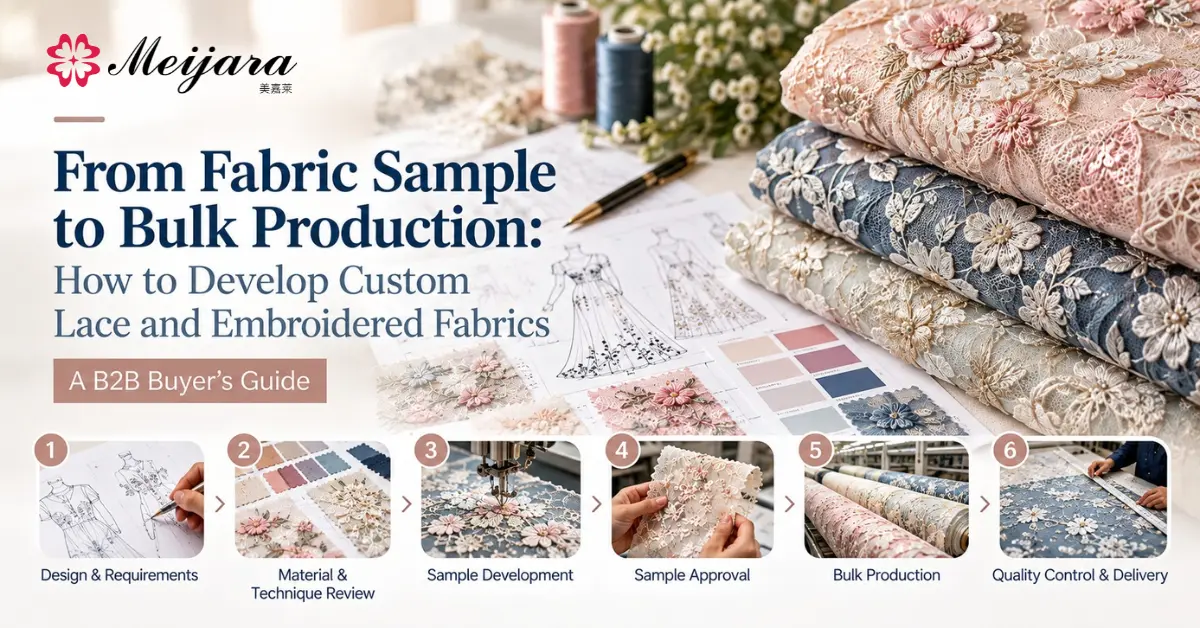

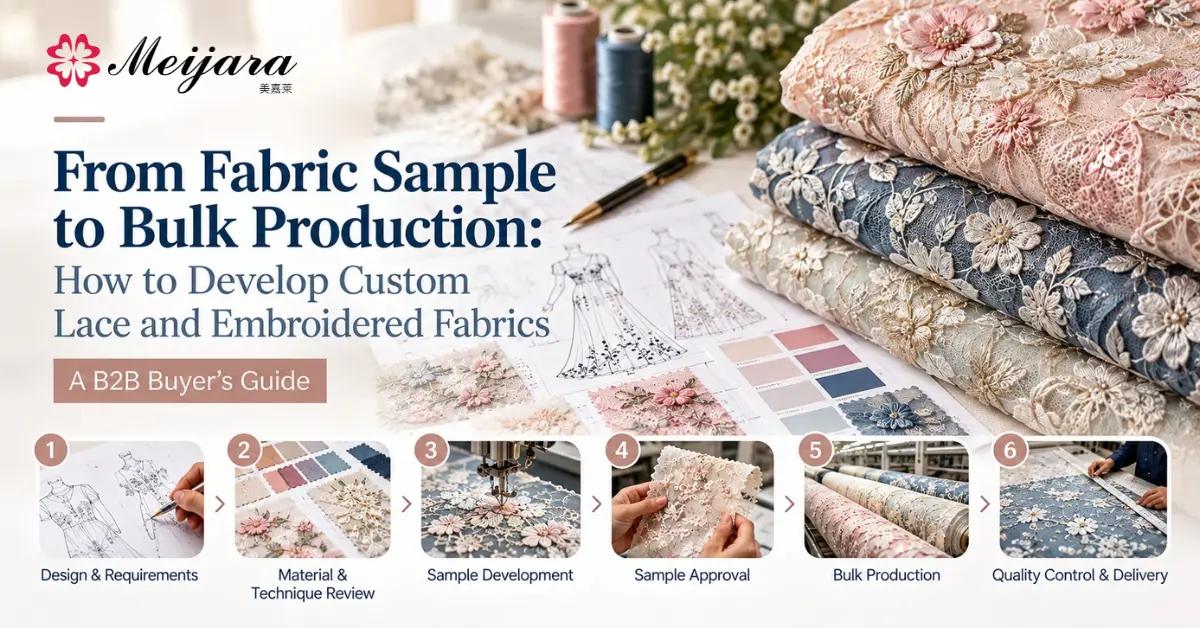
Developing custom lace and embroidered fabrics involves more than reproducing a pattern. For fashion brands, garment manufacturers and fabric buyers, a successful project requires the right combination of design interpretation, fabric construction, embroidery techniques, sample approval and production control.
A design that looks attractive on a digital drawing may need adjustments before it can be manufactured consistently. Thread selection, pattern scale, fabric composition, usable width and embroidery density can all affect the final result. These details become even more important when a project moves from a small development sample to bulk production.
For buyers working with a lace or embroidery manufacturer, understanding the development process helps reduce unnecessary revisions, clarify technical requirements and improve communication between design, sourcing and production teams.
This guide explains the main stages of custom lace and embroidered fabric development, from preparing the initial brief to approving the final sample and managing bulk production.
Define the Product Requirements Before Development
The first step is to establish what the fabric needs to achieve in the finished garment. A manufacturer can assess a project more accurately when the design objective and application are clear.
For example, a lightweight embroidered fabric for a blouse may require soft drape and moderate embroidery density. A decorative fabric for an evening jacket may need more dimensional stitching, stronger surface coverage or a more structured base.
Before requesting development, buyers should define the following requirements:
-
Product type: Lace fabric, embroidered fabric, embroidered lace, lace trim or cut-piece embroidery.
-
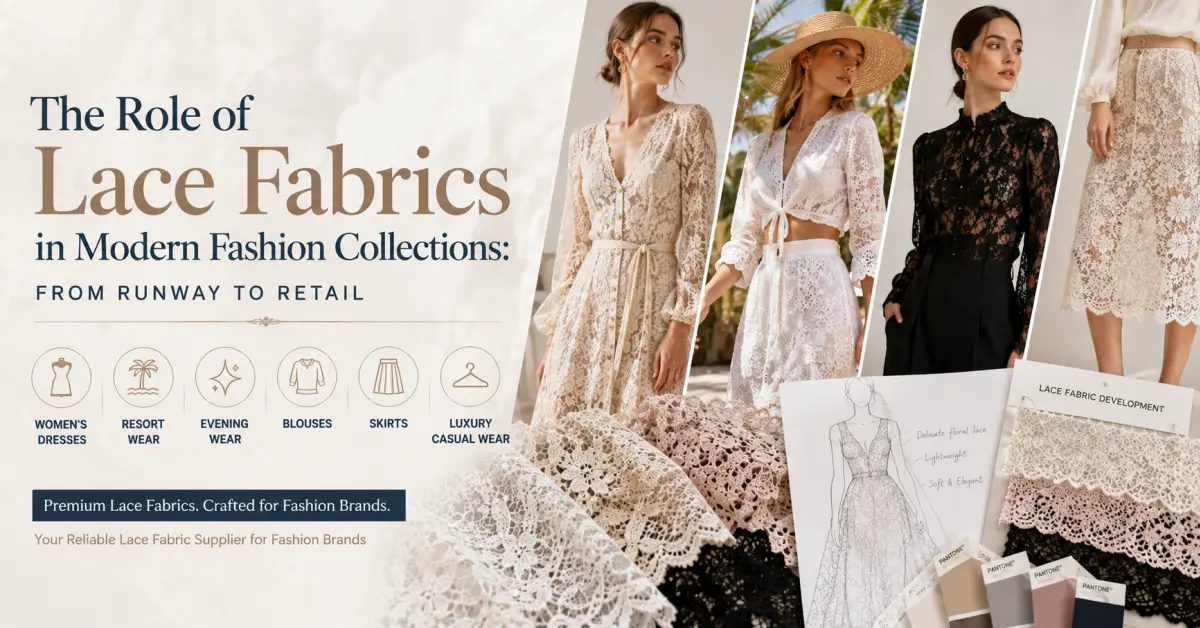
Garment application: Dresses, blouses, skirts, jackets, eveningwear, resortwear or other apparel.
-
Design direction: Floral, geometric, botanical, abstract, logo-based or another motif.
-
Fabric requirements: Preferred composition, weight, width, stretch and transparency.
-
Color requirements: Reference colors, Pantone references or physical samples.
-
Order expectations: Estimated quantity, number of colors and anticipated reorder frequency.
-
Target schedule: Sample review date and required production delivery date.
Not every detail must be finalized at the beginning. However, separating confirmed requirements from open design decisions makes the development process more efficient.
Start With the Intended Garment
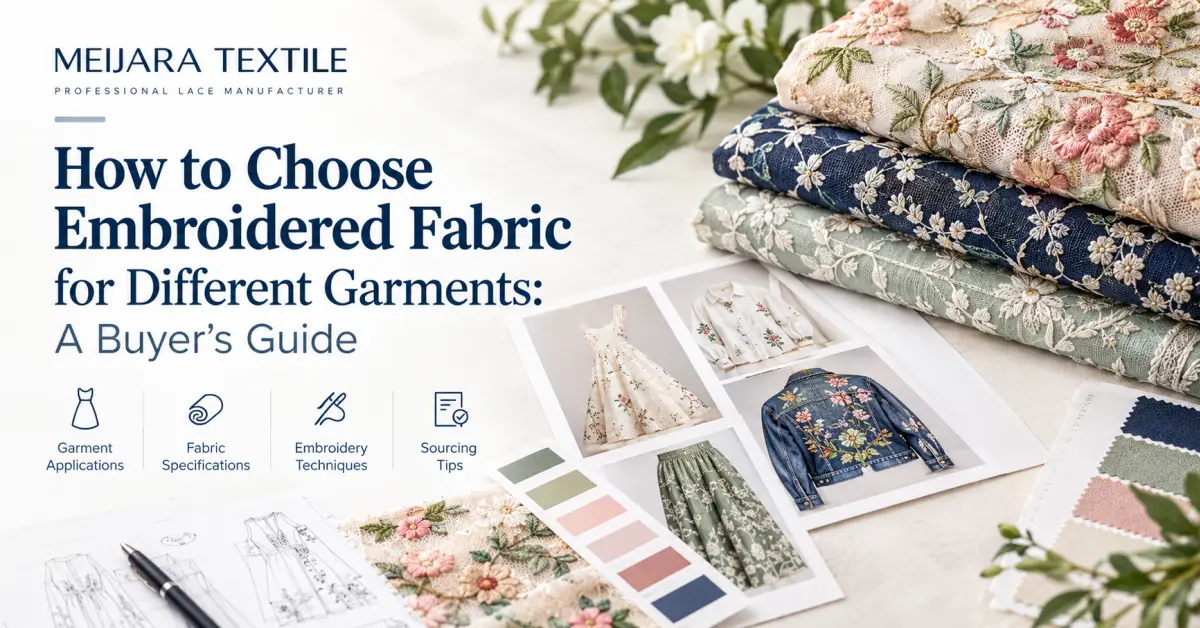
The same decorative pattern can behave differently depending on the base fabric and garment construction. Before selecting an embroidery technique, consider whether the finished material needs to stretch, drape, hold its shape or support additional decorative elements.
For projects that combine embroidery with an openwork structure, Meijara's lace fabric collection provides a starting point for evaluating lace-based constructions. Buyers looking for embroidery as the primary decorative feature can explore the embroidered fabric collection.
Prepare Artwork and Reference Samples
The quality of the initial information has a direct effect on how accurately a manufacturer can interpret the design.
Buyers may begin with a finished fabric sample, a digital illustration, a garment reference, a technical drawing or a new concept developed by their design team. Each source provides different information, so it is useful to explain which elements must be retained and which can be modified.
When You Have an Existing Fabric Sample
A physical reference sample can help communicate details that are difficult to describe in writing, including surface texture, stitch density, transparency, hand feel and dimensional effects.
When sending a sample, identify the most important characteristics to reproduce. For example:
-
Overall pattern and motif arrangement
-
Approximate pattern repeat
-
Base fabric structure
-
Thread colors and decorative materials
-
Embroidery density and surface height
-
Finished width and edge construction
-
Stretch and recovery, where applicable
A reference sample should not automatically be treated as a complete technical specification. Some construction details may require further assessment by the manufacturer.
When You Have Digital Artwork
Digital artwork is useful for communicating motif shape, color placement and overall composition. However, an image alone may not provide enough information for production.
A manufacturer may need to review line thickness, small details, overlapping elements and the relationship between the motif and the base fabric. Some details that look clear on a screen may be difficult to reproduce at the intended scale.
Provide a high-resolution image or editable artwork where available. If the design includes specific colors, identify them separately instead of relying entirely on screen appearance.
When You Are Developing a New Design
For a new project, a mood board or design brief can help establish the direction before detailed pattern development begins.
Include garment references, desired visual effects, approximate dimensions and any important restrictions. If the project has a target price or production quantity, sharing that information early can help the manufacturer evaluate suitable construction options.
Review Fabric Construction and Embroidery Techniques
Once the design requirements are understood, the next step is to assess whether the proposed construction is suitable for the intended product.
Custom lace and embroidered fabrics can involve different base structures, yarns, stitching methods and decorative materials. The most appropriate option depends on the design, the garment and the manufacturing requirements.
Select the Appropriate Base Fabric
The base fabric influences drape, stability, transparency, stretch and surface appearance. Buyers should evaluate it together with the planned embroidery rather than treating the two as separate components.
For example, a soft base may be suitable for a flowing garment but may require careful consideration when paired with dense embroidery. A more stable base may support structured designs, although it could create a firmer hand feel.
Key factors include:
-
Fiber composition
-
Fabric weight and usable width
-
Base structure and transparency
-
Stretch and recovery
-
Compatibility with the selected embroidery
-
Intended garment construction
The best specification is the one that meets the garment's requirements, not necessarily the one with the highest weight or most elaborate surface.
Choose the Right Embroidery Method
Different techniques create different visual and structural effects.
-
Cord embroidery: Suitable when raised outlines and dimensional surface details are required.
-
Water-soluble embroidery: Can support intricate, open decorative structures and lace-like effects.
-
Multi-color embroidery: Useful for motifs that rely on multiple thread colors and detailed color placement.
-
Sequin and bead embroidery: Adds shine, texture and additional weight.
-
Heavy embroidery: Creates more extensive surface coverage and a stronger decorative effect.
-
Cut-piece embroidery: Supports embroidery developed for specific garment panels or individual decorative pieces.
These categories are not interchangeable. A technique that creates the desired appearance may still require adjustments to the base fabric, motif scale or density to work for the final garment.
Develop the First Sample
Sampling turns a design brief into a physical material that can be evaluated. It is also the stage where buyers and manufacturers can identify issues before committing to bulk production.
Depending on the project, the first sample may focus on the pattern, fabric construction, embroidery technique, color or a combination of these elements.
What Should Be Checked During Sampling?
A useful sample review should cover more than visual appearance.
| Evaluation Area | What to Check |
|---|---|
| Pattern | Motif shape, scale, spacing and repeat |
| Color | Thread color, base color and overall color balance |
| Construction | Base structure, stitching and decorative details |
| Weight | Whether the material suits the intended garment |
| Hand feel | Softness, stiffness and surface texture |
| Dimensions | Width, motif size and relevant measurements |
| Performance | Stretch, recovery or other application-specific needs |
| Application | Whether the fabric can be cut and sewn as intended |
The review criteria should reflect the product. Stretch and recovery may be essential for a fitted garment, while dimensional stability and placement accuracy may be more important for a decorative panel.
Why the First Sample May Need Revision
A first sample is part of the development process, not necessarily the final production standard.
Revisions may be needed when a motif is too dense, small details do not reproduce clearly, colors need adjustment or the fabric behaves differently from what the design team expected.
Instead of giving general feedback such as “make it more delicate,” buyers should identify the specific issue. For example, they may request smaller motifs, more space between elements, reduced embroidery density or a change to the base fabric.
Specific feedback gives the manufacturer a clearer basis for the next revision.
Evaluate and Approve the Sample
Sample approval is a critical decision point. It establishes the agreed reference for the subsequent production stage.
Before approval, buyers should confirm which characteristics are essential and ensure that the relevant stakeholders have reviewed the material.
Establish Clear Approval Criteria
The approved sample should be checked against the project requirements, including:
-
Design and pattern arrangement
-
Color references
-
Fabric composition, where specified
-
Width and other agreed dimensions
-
Embroidery construction and density
-
Hand feel and intended application
-
Any required performance or inspection criteria
For color-sensitive projects, a physical reference and clearly documented color expectations can help reduce ambiguity. Screen images alone are not a reliable substitute for evaluating the actual material.
Record the Final Decisions
Once the sample is approved, retain a clearly identified reference and record the agreed specifications.
The approval record should make it clear which version is authorized for production. If artwork, colors or construction details change later, those changes should be reviewed and confirmed rather than assumed to be included in the original approval.
This is particularly important when several sample revisions have been exchanged between the buyer and manufacturer.
Confirm Specifications Before Bulk Production
Before production begins, the approved sample needs to be translated into a clear set of manufacturing requirements.
A visually approved sample is not enough if important technical details remain unresolved. Both parties should understand which specifications must be maintained throughout production.
Confirm the Main Production Parameters
Depending on the product, the specification record may include:
-
Product code and approved sample reference
-
Fabric composition and construction
-
Finished width and relevant tolerances
-
Pattern repeat and orientation
-
Thread colors and color references
-
Embroidery technique and density
-
Decorative materials, if applicable
-
Order quantity and color breakdown
-
Inspection requirements
-
Packaging and delivery requirements
Not every project needs the same level of documentation. The aim is to record the details that materially affect the finished product and the buyer's acceptance criteria.
Check Material and Production Feasibility
Some design choices may need to be reconsidered when the project moves from sampling to bulk production. Material availability, construction complexity, order quantity and production scheduling can all affect feasibility.
Discuss these issues before confirming the production plan. If a proposed change could affect the appearance or performance of the fabric, it should be reviewed and approved by the buyer.
Clear communication at this stage helps prevent avoidable differences between the approved sample and the bulk order.
Maintain Quality Consistency During Bulk Production
Bulk production introduces a different challenge from sample development: the approved characteristics must be maintained across the order.
For buyers, consistency means more than reproducing the overall pattern. Color, width, construction, embroidery density and other agreed characteristics may all affect the suitability of the fabric for garment production.
Monitor the Characteristics That Matter Most
The inspection plan should reflect the product's risks and the buyer's requirements.
For example:
-
Pattern consistency: Check motif shape, spacing and repeat.
-
Color consistency: Compare production material with the approved reference under agreed evaluation conditions.
-
Width control: Confirm the usable width meets the specification.
-
Construction: Review stitching, embroidery density and decorative details.
-
Visible defects: Identify relevant flaws in the base fabric or embroidered surface.
-
Application suitability: Check any agreed stretch, dimensional stability or other performance requirements.
The appropriate inspection method and acceptance limits should be agreed for the project rather than assumed to be identical for every fabric.
Keep the Approved Sample as a Reference
The approved sample gives the buyer and manufacturer a common point of comparison.
Where practical, the sample should be clearly labeled and linked to the product code, specification and approval record. This makes it easier to investigate differences if questions arise during production or after delivery.
A consistent reference system is particularly useful for repeat orders, seasonal collections and products that require several color variations.
Manage Sampling and Production Lead Time
Custom fabric development requires time for both technical work and decision-making. The overall schedule depends on design complexity, material availability, sampling requirements, revision rounds, order quantity and production planning.
Buyers should distinguish between sample development time and bulk production time when establishing a project schedule.
Build a Practical Development Timeline
A typical project plan should identify the following milestones:
-
Design brief and technical information received
-
Artwork and construction reviewed
-
Materials and production method confirmed
-
Sample produced and submitted
-
Buyer feedback received
-
Revisions completed, if required
-
Final sample approved
-
Bulk production scheduled
-
Inspection and delivery arranged
These stages may overlap depending on the project, but the schedule should make responsibilities and decision points clear.
Avoid Delays Caused by Unresolved Decisions
Common causes of delay include incomplete artwork, unclear color references, late sample feedback, repeated specification changes and unconfirmed order details.
Buyers can help keep development on schedule by consolidating feedback, identifying the person responsible for final approval and confirming key requirements before bulk production.
A realistic delivery plan should include the time required for approvals and any necessary revisions, rather than accounting only for manufacturing time.
Common Mistakes in Custom Fabric Development
Several avoidable mistakes can complicate the transition from sample to bulk production.
Mistake 1: Providing Artwork Without Technical Requirements
A design image communicates appearance but may not define fabric composition, width, construction or intended application.
Better approach: Provide a brief that combines visual references with the key technical requirements.
Mistake 2: Choosing Embroidery Before Considering the Base Fabric
A decorative technique may create excessive stiffness or weight when combined with an unsuitable base.
Better approach: Evaluate the base fabric and embroidery as one construction.
Mistake 3: Approving a Sample Without Recording Specifications
Verbal approval or an unlabelled sample can create confusion when several revisions exist.
Better approach: Identify the approved version and document the important production parameters.
Mistake 4: Changing Details After Approval Without Reviewing the Impact
Changes to colors, motif size, density or materials can affect the final product and schedule.
Better approach: Assess and approve significant changes before they are introduced into production.
Mistake 5: Assuming a Successful Sample Guarantees Bulk Consistency
Sampling and bulk production operate at different scales and require different levels of planning and control.
Better approach: Establish production specifications, inspection criteria and a clear reference sample before the order begins.
How to Choose a Custom Lace and Embroidery Manufacturer
A suitable manufacturing partner should understand both the design objective and the practical requirements of production.
When evaluating suppliers, buyers should look beyond product images and consider how the supplier handles development, communication and production control.
Assess Development Capability
Can the supplier interpret reference samples, review artwork and recommend suitable construction options? The ability to discuss technical trade-offs is particularly valuable when the design is still being developed.
Review Sampling and Communication
The supplier should be able to explain what information is needed, what can be confirmed during sampling and which decisions remain open. Clear feedback helps reduce unnecessary revisions.
Confirm Bulk Production Capability
Buyers should understand how the supplier translates an approved sample into production specifications and checks the finished order against the agreed requirements.
Check Product and Technique Range
A supplier with relevant lace and embroidery capabilities may be able to support different constructions as a project evolves. However, the important factor is whether the supplier can meet the specific requirements of the order.
Discuss the Complete Project, Not Just the Sample
Before proceeding, confirm the expected quantity, production schedule, inspection requirements, packaging and delivery arrangements.
Frequently Asked Questions
How long does custom lace or embroidered fabric development take?
The timeline depends on design complexity, material availability, sampling requirements and the number of revisions. Buyers should confirm sample lead time and bulk production lead time separately with the manufacturer.
What information should I provide when requesting a custom fabric sample?
Provide artwork or a reference sample, intended garment application, preferred composition, width, color references, estimated quantity and target schedule. If some requirements are not yet decided, identify them as open questions.
Can a manufacturer reproduce a fabric from a physical reference sample?
A reference sample can help communicate the design and construction, but exact reproduction depends on the information available, material compatibility and manufacturing feasibility. The manufacturer should review the sample and clarify any limitations before development proceeds.
Why is sample approval important before bulk production?
Approval establishes the agreed reference for design, color, construction and other relevant specifications. It also gives both parties an opportunity to resolve issues before the full order is manufactured.
What is the difference between sample development and bulk production?
Sample development focuses on translating the design into a material that meets the project requirements. Bulk production focuses on manufacturing the approved product at the required quantity while maintaining the agreed specifications.
How can buyers reduce delays during custom fabric development?
Provide complete information, consolidate feedback, confirm colors and specifications early, and appoint a clear decision-maker for sample approval. Significant changes should be reviewed before they affect production.
What should be checked during bulk inspection?
Checks may include color, width, pattern consistency, embroidery density, construction and visible defects. The inspection criteria should be agreed according to the product and the buyer's requirements.
Can custom lace and embroidered fabrics be developed for different garment types?
Yes, subject to the manufacturer's capabilities and the project's technical requirements. The base fabric, embroidery technique, pattern scale and density should be selected according to the intended garment and its construction.
Conclusion
Developing custom lace and embroidered fabrics is a process of turning a design concept into a clearly specified, production-ready material. Each stage—from defining requirements and preparing artwork to sampling, approval and bulk inspection—helps align the buyer's expectations with manufacturing execution.
For B2B buyers, the most important principle is to confirm the construction and specifications before bulk production begins. A clear brief, useful sample feedback, documented approval and agreed inspection criteria can reduce uncertainty and make the transition from product development to bulk manufacturing more manageable.
When selecting a manufacturing partner, look for the ability to discuss design feasibility, support sampling, communicate technical requirements and manage production against an approved reference. These capabilities help establish a more reliable process for developing custom lace and embroidered fabrics for fashion collections.