

Lace Is No Longer Limited to Occasionwear
Lace has always had a strong presence in fashion, but its role has changed significantly.
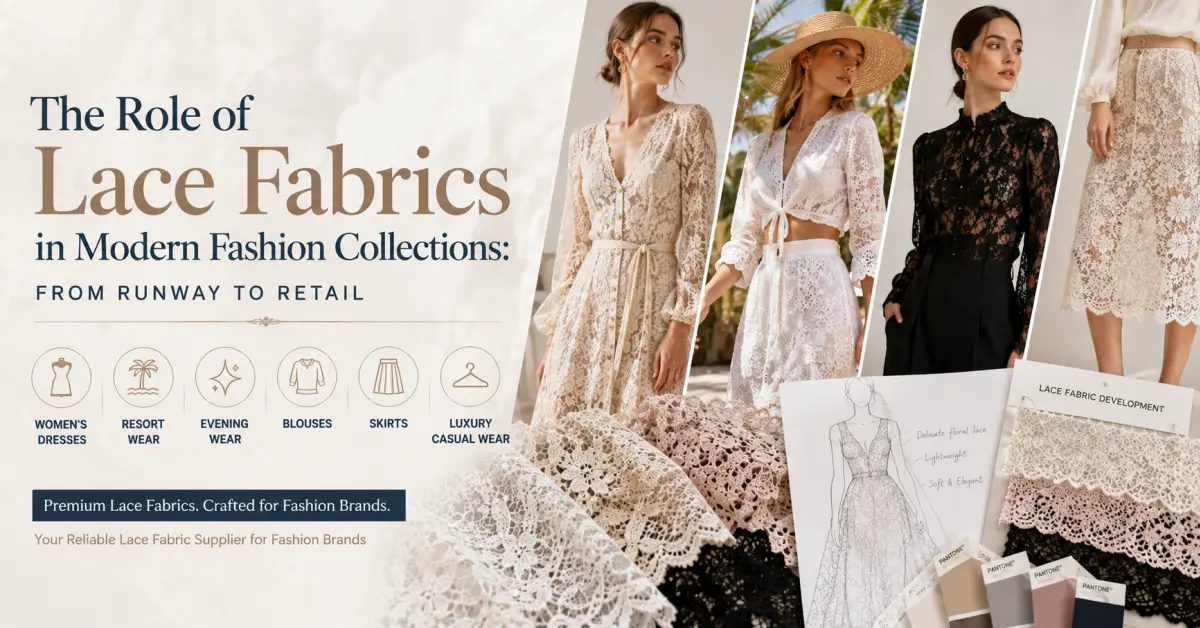
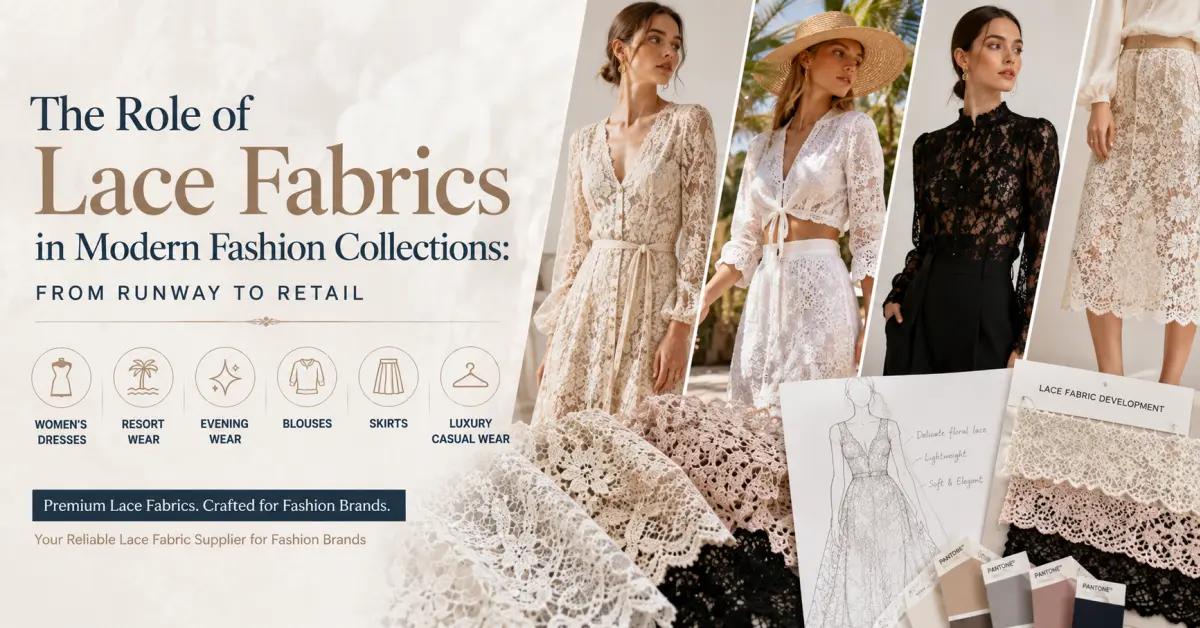
For many years, lace was mainly associated with bridal gowns, lingerie, evening dresses, and highly decorative garments. Today, fashion designers are using lace much more broadly. It appears in ready-to-wear collections, resort collections, contemporary womenswear, luxury casual pieces, statement blouses, layered skirts, lightweight dresses, and even everyday garments where texture and surface design are important.
The change is not simply about using more lace.
It is about how lace is being designed, engineered, and integrated into a garment.
A modern fashion collection may use lace as a complete garment fabric, a transparent overlay, a contrast panel, a sleeve construction, a skirt layer, a decorative insert, or a subtle surface detail. The same collection may combine lightweight embroidered lace with plain woven fabrics, jersey, satin, organza, cotton, or technical materials.
This creates a more demanding role for the lace supplier.
For fashion brands, sourcing lace is no longer simply a matter of selecting an attractive pattern from a catalog. Designers increasingly need a lace fabric supplier for fashion brands that can understand the relationship between fabric construction, garment design, production requirements, color development, repeat size, weight, stretch, transparency, and final retail positioning.
The right lace can change how a garment looks, feels, and performs.
It can make a simple dress appear more sophisticated. It can give a resort collection a handcrafted character. It can turn an ordinary blouse into a statement piece. It can add texture to a minimalist skirt without changing the overall silhouette.
At the manufacturing level, however, achieving these results requires considerably more than a beautiful pattern.
The factory must be able to translate a design concept into a fabric that can actually be cut, sewn, finished, transported, and reproduced consistently at commercial scale.
How Lace Has Changed in Modern Fashion
The most important change in lace usage is the movement from decoration to material design.
Traditional fashion applications often treated lace as an additional decorative layer. Designers selected a finished lace fabric and applied it to a garment that had already been designed.
Modern collections increasingly work in the opposite direction.
The fabric itself becomes part of the design concept.
A designer may start with:
-
a particular floral motif
-
a specific transparency level
-
a structured embroidery effect
-
a lightweight surface
-
a particular drape
-
an irregular border
-
a geometric repeat
-
a combination of different thread densities
-
or a specific color and texture relationship
The garment is then developed around those material characteristics.
This approach requires much closer cooperation between the designer, garment manufacturer, and lace factory.
From decorative fabric to design material
| Traditional Lace Application | Modern Fashion Application |
|---|---|
| Bridal gowns | Ready-to-wear dresses |
| Evening dresses | Resort collections |
| Lingerie | Contemporary blouses |
| Decorative panels | Full garment construction |
| Fixed patterns | Custom-developed patterns |
| Standard colors | Brand-specific color development |
| Simple overlays | Multi-layer garment construction |
| Seasonal decoration | Core collection material |
The result is a much broader market for lace.
A fashion brand may use lace across several product categories in the same season, with different fabric weights and constructions for each application.
That is why supplier selection matters.
Lace Fabric Begins With the Collection Concept
Before a lace fabric is manufactured, designers normally need to define what role the material will play in the collection.
This sounds straightforward, but it has a direct effect on manufacturing specifications.
A lace fabric designed for a loose resort dress does not necessarily work for a fitted evening blouse.
Likewise, a dense embroidered lace suitable for a structured skirt may be too heavy for a lightweight summer top.
The supplier therefore needs to understand the intended garment application before recommending or developing the fabric.
Questions that should be answered during development
A professional lace supplier may need to know:
-
What type of garment will use the fabric?
-
Is the garment fitted or loose?
-
Will the fabric be used as the main material or as an overlay?
-
Does the garment require stretch?
-
How transparent should the finished fabric be?
-
What type of lining will be used?
-
What is the target fabric weight?
-
Does the design require a directional motif?
-
Will the fabric need scalloped or eyelash edges?
-
Will the fabric be cut into panels or used continuously?
-
What quantity is required?
-
Is the product seasonal or intended as a repeat item?
These questions help the factory determine the appropriate construction.
This is one reason a professional lace fabric supplier for fashion brands should be involved early in the development process rather than only after the garment has already been designed.
Women's Dresses: One of the Most Versatile Lace Applications
Women's dresses remain one of the largest applications for fashion lace, but today's use is considerably broader than traditional formalwear.
Lace can be used across:
-
mini dresses
-
midi dresses
-
maxi dresses
-
slip dresses
-
shirt dresses
-
summer dresses
-
layered dresses
-
cocktail dresses
-
resort dresses
-
contemporary evening dresses
The construction of the lace determines how it behaves within each silhouette.
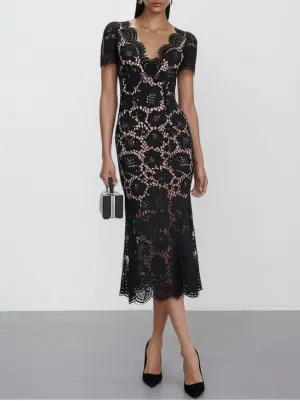
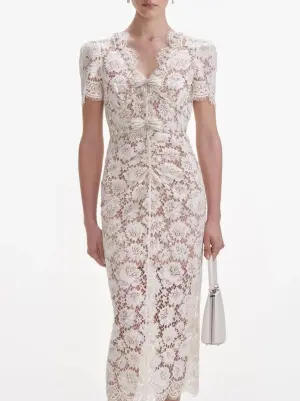
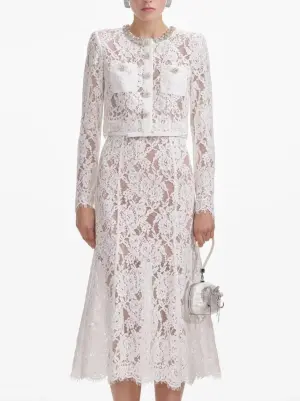
Lightweight lace for fluid dresses
For loose or flowing dresses, designers often look for a fabric with:
-
relatively low weight
-
soft hand feel
-
good drape
-
controlled transparency
-
flexible embroidery
-
comfortable movement
A lightweight floral embroidered lace can create visual volume without adding substantial physical weight.
This is particularly useful in spring and summer collections.
Structured lace for fitted dresses
A fitted dress requires different characteristics.
The fabric may need:
-
greater dimensional stability
-
controlled stretch
-
stronger embroidery structures
-
better recovery
-
higher abrasion resistance
-
consistent motif placement
The factory must consider not only how the fabric looks on a sample hanger but how it behaves after cutting and sewing.
This distinction is often overlooked during sourcing.
A lace fabric can look excellent as a one-meter sample but perform poorly during garment production if the structure is too unstable.
Resort Wear: Where Lace Becomes Lightweight and Relaxed
Resort wear has become an important application for lace because the category naturally suits lightweight, breathable, visually textured materials.
Lace can be used for:
-
cover-up dresses
-
beach dresses
-
relaxed shirts
-
kaftans
-
lightweight skirts
-
coordinated sets
-
cropped tops
-
semi-transparent outer layers
Unlike formalwear, resort fashion often benefits from a more relaxed interpretation of lace.
The goal is not necessarily maximum embroidery density.
Instead, designers may prefer:
-
open structures
-
botanical motifs
-
large-scale floral patterns
-
lightweight constructions
-
natural color palettes
-
irregular borders
-
breathable mesh structures
A good resort lace should retain visual richness while remaining comfortable in warm environments. Explore ethereal bloom sheer lace.
Manufacturing considerations for resort lace
| Requirement | Why It Matters |
|---|---|
| Lightweight construction | Improves comfort |
| Breathable structure | Important for warm climates |
| Soft hand feel | Prevents stiffness |
| Controlled transparency | Supports layering |
| Color stability | Important for repeated washing |
| Flexible construction | Supports relaxed silhouettes |
| Consistent width | Simplifies garment cutting |
For fashion brands selling internationally, the supplier should also understand that resort collections can require different color directions depending on the target market.
Soft ivory, natural beige, sand, pale blue, muted green, black, and seasonal fashion colors may all be developed from the same basic design.
Evening Wear: Using Lace to Build Texture and Depth
Eveningwear is one area where lace continues to have strong commercial value.
However, contemporary eveningwear does not always rely on traditional heavy lace.
Designers are increasingly combining lace with:
-
satin
-
silk-like fabrics
-
crepe
-
mesh
-
organza
-
velvet
-
jersey
-
technical fabrics
The contrast between materials can create depth without requiring excessive embellishment.
For example, a relatively simple black dress can become visually sophisticated when a transparent embroidered lace panel is introduced at the sleeves, neckline, waist, or skirt.
This approach is especially effective for brands that want a premium appearance without turning every garment into a highly embellished piece.
The importance of motif scale
Motif scale becomes particularly important in eveningwear.
A small floral repeat may create a delicate, continuous surface.
A large botanical motif can create a stronger statement.
An irregular motif can make the garment appear more artisanal.
The factory therefore needs to control embroidery density and repeat dimensions accurately.
A small change in motif scale can significantly alter the visual balance of the finished garment.
Blouses: Where Fine Lace Can Create High Perceived Value
Blouses are one of the strongest applications for lightweight lace because the garment structure is relatively simple.
This allows the fabric to become the primary visual feature.
Lace can be used for:
-
full-body blouse construction
-
sleeves
-
collars
-
cuffs
-
yokes
-
front panels
-
back panels
-
inserts
-
shoulder details
For commercial fashion, lace blouses are particularly interesting because they can occupy different price levels.
A simple lightweight embroidered lace can work in contemporary ready-to-wear.
A denser custom lace with special yarns, dimensional embroidery, or additional embellishment can support a luxury positioning.
The difference is not only the appearance of the lace.
It is the combination of:
fabric construction + garment design + finishing + branding + positioning.
Skirts: Working With Borders, Repeats and Direction
Skirts create a unique challenge for lace manufacturers because designers often want the fabric to interact with the garment's shape.
For example, a lace skirt may require:
-
a decorative bottom border
-
directional motifs
-
symmetrical placement
-
engineered panels
-
scalloped edges
-
varying motif density
A standard repeating lace pattern may not provide the desired result.
This is where factory development capability becomes important.
Why border design matters
The lower edge of a skirt is one of the most visible areas of the garment.
A carefully developed lace border can create a finished appearance without requiring additional trimming.
For example:
Main body → transition area → decorative border → scalloped edge
This can be developed directly into the textile structure.
For a fashion brand, that may reduce the need for additional sewing operations and create a more integrated appearance.
Luxury Casual Wear: The New Opportunity for Lace
Perhaps one of the most interesting developments is the use of lace in luxury casual fashion.
Lace is no longer restricted to garments that are obviously "special occasion."
It can now appear in:
-
relaxed tops
-
casual dresses
-
lightweight jackets
-
layering pieces
-
premium T-shirts
-
knit-and-lace combinations
-
casual skirts
-
coordinated sets
The design philosophy is different.
Instead of using lace to communicate formal elegance, designers may use it to communicate:
-
craftsmanship
-
texture
-
individuality
-
softness
-
femininity
-
material quality
This creates opportunities for fashion brands that want a recognizable material signature.
Lace as a Layering Material
One of the reasons lace works so well in modern fashion is its ability to create visual depth.
A designer can layer lace over:
-
cotton
-
satin
-
jersey
-
silk
-
mesh
-
organza
-
woven fabrics
The underlying material changes the appearance of the lace.
A white embroidered lace over nude fabric creates a completely different effect from the same lace over black.
This makes color and layering important parts of the fabric development process.
A factory may therefore provide the same lace construction in several colors so the designer can evaluate the final visual effect. Explore lace trim.
What a Fashion Brand Should Look for in a Lace Fabric Supplier
Choosing a lace supplier based solely on catalog size or price can create problems later in the production process.
A professional fashion brand should evaluate the supplier from several perspectives.
Key supplier evaluation criteria
| Factor | What to Check |
|---|---|
| Product development | Can the supplier develop new designs? |
| Manufacturing | Does the supplier have its own production capability? |
| Customization | Can patterns, colors and materials be modified? |
| Sampling | Is sample development efficient? |
| Quality control | Are production standards consistent? |
| MOQ | Does the supplier match the brand's volume? |
| Capacity | Can production scale with demand? |
| Lead time | Can the factory support seasonal deadlines? |
| Communication | Are technical details clearly understood? |
| Export experience | Can the supplier support international orders? |
The most important point is that a supplier should be evaluated as a production partner, not simply as a fabric seller.
Factory Capability Makes a Difference
From a buyer's perspective, two lace suppliers can show very similar samples.
Yet their production performance may be completely different.
The difference often becomes visible only after the order moves into bulk production.
A capable factory needs to control several variables simultaneously:
-
yarn quality
-
base fabric structure
-
embroidery density
-
machine settings
-
motif alignment
-
fabric width
-
tension
-
finishing
-
dyeing
-
color consistency. Learn about dyeing and color matching.
-
inspection
-
packaging
This is why factory infrastructure matters.
A modern lace manufacturing operation can combine computerized embroidery systems, knitting equipment, pattern development, finishing equipment, inspection systems, and skilled technical staff.
For brands ordering hundreds or thousands of meters, production consistency is often more important than the appearance of the initial sample. Learn about quality control standards.
From Design File to Physical Lace
Custom lace development normally begins with a visual concept.
This may be:
-
a hand-drawn sketch
-
a CAD file
-
an existing fabric sample
-
a photograph
-
a motif
-
a textile reference
-
or a combination of several ideas
The factory then needs to convert that concept into a technically manufacturable structure.
This process can involve:
Step 1: Design interpretation
The supplier evaluates the motif and determines whether it can be reproduced using the selected technique.
Step 2: Pattern development
The artwork is converted into a repeat structure suitable for the production equipment. Learn about pattern design development.
Step 3: Material selection
The factory determines suitable yarns, base fabrics, threads, and supporting materials.
Step 4: Sampling
A physical sample is produced.
Step 5: Technical adjustment
The design may be modified for:
-
density
-
size
-
spacing
-
transparency
-
weight
-
edge structure
-
color
Step 6: Approval
The brand reviews the physical sample.
Step 7: Bulk production
Once approved, the factory moves into commercial production.
This workflow is particularly important for brands developing exclusive collections.
Why Fabric Weight Matters in Fashion Design
Fabric weight is often discussed in technical terms, but its impact on garment design is substantial.
A heavier lace may:
-
create structure
-
hold a silhouette
-
provide stronger visual impact
-
work well for statement garments
A lightweight lace may:
-
drape more naturally
-
feel softer
-
support layering
-
work better for summer collections
There is no universally "best" weight.
The right weight depends on the garment.
Example
| Garment | Typical Design Priority |
|---|---|
| Resort dress | Lightweight + breathable |
| Evening dress | Visual depth + structure |
| Blouse | Softness + drape |
| Skirt | Stability + border definition |
| Luxury casual top | Comfort + texture |
| Fitted dress | Stability + controlled stretch |
The supplier should therefore recommend the fabric based on application rather than simply offering the lightest or most decorative option.
Color Development Is More Than Choosing a Pantone Number
Color development is another area where brands should work closely with the factory.
Lace behaves differently from solid woven fabric because the pattern contains:
-
open spaces
-
embroidered sections
-
different thread densities
-
mesh areas
-
sometimes multiple materials
The perceived color may therefore change depending on:
-
background fabric
-
lighting
-
thread type
-
embroidery density
-
garment lining
-
layering
For this reason, physical color samples remain important.
A fashion brand should evaluate the final lace against the intended garment material rather than relying entirely on a digital screen.
Custom Lace Helps Fashion Brands Build a Distinctive Collection
One of the biggest advantages of working directly with a lace manufacturer is the ability to develop a more exclusive material.
A brand may customize:
-
motif
-
repeat size
-
width
-
color
-
embroidery density
-
thread type
-
border
-
scallop
-
material combination
-
embellishment. Explore sequins and beads embroidery.
-
finishing. Explore customized processes.
This can create a fabric that is much harder for competitors to reproduce using standard wholesale lace.
For brands operating in a crowded fashion market, that distinction can have commercial value.
Lace Development for Different Fashion Categories
A professional lace supplier should not approach every category in the same way.
Women's dresses
Focus on:
-
drape
-
transparency
-
motif scale
-
fabric width
-
comfort
Resort wear
Focus on:
-
lightweight structure
-
breathability
-
softness
-
open motifs
-
color versatility
Evening wear
Focus on:
-
visual depth
-
dimensional texture
-
embroidery density
-
premium appearance
Blouses
Focus on:
-
softness
-
drape
-
lightweight construction
-
skin comfort
Skirts
Focus on:
-
stability
-
border construction
-
repeat direction
-
cutting efficiency
Luxury casual
Focus on:
-
subtle texture
-
comfort
-
durability
-
understated design
This application-based approach is more useful than simply classifying lace by name.
Production Consistency: The Real Test of a Supplier
A sample can look perfect.
The real question is whether the factory can reproduce it consistently.
For commercial fashion production, buyers should pay attention to:
-
width consistency
-
pattern alignment
-
embroidery density
-
color variation
-
thread tension
-
edge quality
-
defects
-
holes
-
stains
-
broken embroidery
-
repeat accuracy
A professional factory should have inspection procedures throughout production rather than relying only on final inspection.
Typical production quality checkpoints
| Production Stage | Quality Focus |
|---|---|
| Raw materials | Yarn and material quality |
| Machine setup | Pattern and tension |
| First production | Sample comparison |
| Mid-production | Consistency |
| Finishing | Width and appearance |
| Final inspection | Defects and packaging |
For large fashion collections, these controls can make the difference between a smooth launch and a costly production problem.
MOQ and Production Flexibility
Not every fashion brand needs the same quantity.
A large international brand may require substantial production volumes.
An independent designer may initially need only a limited quantity.
A growing fashion label may start with a small order and increase volume after the product performs well.
This makes MOQ an important sourcing consideration.
A supplier that can support different production scales gives brands more flexibility when testing new materials.
The ideal MOQ should not be considered independently from the production process.
A very low MOQ may be attractive, but if the factory cannot maintain consistent quality or competitive pricing at that volume, it may not provide the best overall solution.
From Runway Sample to Commercial Production
The transition from runway development to retail production is often where fabric problems become visible.
A runway garment may only require a small amount of specially developed material.
Retail production is different.
The factory needs to consider:
-
production quantity
-
fabric yield
-
cutting efficiency
-
defect tolerance
-
repeat consistency
-
lead time
-
packaging
-
shipping
-
replenishment
A lace fabric that works beautifully for a single runway piece may not be commercially practical.
For this reason, fabric development should consider the complete production chain from the beginning.
How Lace Influences Retail Product Value
Consumers may not know the technical details of lace manufacturing.
But they can see and feel the result.
A high-quality lace can contribute to:
-
visual differentiation
-
texture
-
perceived craftsmanship
-
product identity
-
premium positioning
-
styling versatility
This is particularly important for brands competing in premium and contemporary fashion.
The value of lace is therefore not limited to its cost per meter.
A better way to evaluate it is:
Fabric cost + garment performance + design differentiation + perceived value.
A slightly more expensive lace may produce a substantially more valuable final garment.
Why Supplier-Fashion Brand Communication Matters
Lace development involves many technical details.
Miscommunication can easily lead to:
-
incorrect motif size
-
wrong color
-
unsuitable fabric weight
-
excessive transparency
-
insufficient stretch
-
incorrect border dimensions
-
unsuitable width
A strong supplier relationship therefore depends on clear communication.
Fashion brands should provide as much information as possible during development.
Useful information includes:
-
technical drawings
-
reference samples
-
garment type
-
target market
-
expected quantity
-
color references
-
delivery schedule
-
desired hand feel
-
lining information
The more precise the initial brief, the more efficient the development process can become.
Sustainable Lace Is Becoming Part of Fashion Sourcing
Sustainability is increasingly relevant to fabric sourcing.
For fashion brands, the question is not only whether a lace looks attractive.
They may also need to understand:
-
fiber composition
-
recycled materials
-
certification
-
traceability
-
dyeing
-
finishing
-
production waste
Material selection can therefore become part of a brand's broader sustainability strategy.
Some manufacturers now offer lace made with recycled materials or certified inputs, depending on product requirements.
For buyers, it is important to verify certification and documentation rather than relying only on sustainability claims. Visit our sustainability section.
Why China Remains Important for Fashion Lace Sourcing
China continues to play an important role in global textile manufacturing because the supply chain provides access to:
-
large-scale textile production
-
embroidery technology
-
skilled manufacturing teams
-
raw material networks
-
customization
-
export infrastructure
-
flexible production models
For lace specifically, the combination of textile manufacturing and embroidery capability can be particularly valuable.
A fashion brand can work with a supplier that understands both the aesthetic side of fabric development and the technical requirements of commercial production.
This is especially useful for brands that need to move quickly from concept to sample and then into bulk production.
What Makes a Good Lace Fabric Supplier for Fashion Brands?
The best supplier is not necessarily the one with the largest catalog.
A better supplier is one that can support the brand throughout the development cycle.
That means being able to answer questions such as:
-
Can the design be manufactured?
-
Can the fabric be customized?
-
Can the color be developed?
-
Can the sample be modified quickly?
-
Can the factory reproduce the approved sample?
-
Can the supplier handle the required quantity?
-
Can the production schedule match the collection launch?
-
Can the supplier maintain quality across repeat orders?
For fashion brands, these questions are often more important than simply finding the lowest price.
A Practical Sourcing Checklist for Fashion Brands
Before placing a bulk lace order, brands can use the following checklist.
Design
-
Motif approved
-
Repeat size approved
-
Fabric width confirmed
-
Border approved
-
Transparency confirmed
Material
-
Fiber composition confirmed
-
Thread specification confirmed
-
Weight confirmed
-
Stretch requirement confirmed
-
Hand feel approved
Color
-
Color reference provided
-
Lab dip or sample approved
-
Final color confirmed
Production
-
MOQ confirmed
-
Production lead time confirmed
-
Bulk sample approved
-
Quality standards agreed
-
Packaging requirements confirmed
Logistics
-
Delivery address confirmed
-
Shipping method confirmed. Learn about importing logistics.
-
Required delivery date confirmed
-
Export documentation confirmed
This process may seem detailed, but it can significantly reduce misunderstandings during bulk production.
Lace Should Be Selected Around the Garment---not the Other Way Around
One of the most common sourcing mistakes is choosing lace simply because the pattern looks attractive.
A better approach is to start with the garment.
Ask:
What does this garment need from the fabric?
A resort dress needs movement.
A fitted blouse needs comfort.
An evening dress may need structure.
A skirt may need a strong border.
A luxury casual top may need subtle texture.
Once the garment requirement is clear, the factory can recommend the appropriate construction.
This creates a more efficient relationship between designer and manufacturer.
The Future of Lace in Fashion Collections
Lace is likely to continue expanding beyond traditional occasionwear.
Several directions are particularly relevant to fashion brands.
More engineered lace
Instead of repeating a standard pattern across the entire width, manufacturers can develop more controlled motif placement and borders.
More mixed-material development
Lace can be combined with:
-
mesh
-
organza
-
satin
-
ribbons
-
sequins
-
cords
-
other embroidery structures. Explore cord embroidery.
More lightweight structures
As consumers seek comfortable clothing, lightweight lace will remain important for summer and resort collections.
More customized materials
Brands increasingly want materials that are identifiable with their own design language.
More sustainable sourcing
Certified and recycled materials are becoming increasingly relevant to international fashion buyers.
The role of the factory will therefore become more important rather than less.
From Runway to Retail: The Complete Lace Development Chain
The modern lace supply chain can be understood as a continuous process:
Fashion trend
↓
Collection concept
↓
Garment design
↓
Lace material selection
↓
Factory development
↓
Prototype sample
↓
Technical adjustment
↓
Approved fabric
↓
Garment sampling
↓
Bulk lace production
↓
Garment manufacturing
↓
Quality inspection
↓
Global distribution
↓
Retail collection
This is why the relationship between a fashion brand and its lace supplier should be considered a long-term development partnership.
The fabric is not an isolated component.
It is part of the product development system.
How to Choose the Right Lace Partner for Your Collection
If your brand is sourcing lace for a new collection, start by defining the application.
Instead of simply asking:
"What lace do you have?"
A more productive conversation is:
"We are developing a lightweight resort dress and need a soft embroidered lace with controlled transparency, a large botanical motif, and a custom color."
This gives the factory something specific to work with.
For a blouse, the brief may focus on softness and drape.
For an evening dress, the focus may be dimensional embroidery and visual impact.
For luxury casualwear, the goal may be a subtle lace texture that works with everyday silhouettes.
The supplier's role is then to connect the design objective with a practical manufacturing solution.
Why the Factory Behind the Fabric Matters
For fashion brands, the real value of a lace supplier is not simply the fabric itself.
It is the manufacturing system behind it.
A strong factory can provide:
-
product development
-
technical consultation
-
sampling
-
customization
-
production management
-
quality control
-
material sourcing
-
finishing
-
packaging
-
international logistics support. Explore cut piece and processing.
This reduces the number of separate suppliers involved in the development process.
It can also make communication faster and improve consistency between the approved sample and bulk production.
For brands launching multiple seasonal collections, this relationship can become a significant operational advantage.
FAQ: Lace Fabrics for Modern Fashion Collections
1. What types of lace fabrics are best for fashion brands?
There is no single best type. The appropriate lace depends on the garment. Lightweight embroidered lace works well for resort dresses and blouses, while denser or more structured lace can be suitable for eveningwear, skirts, and statement garments.
2. Can a lace fabric supplier develop custom designs?
Yes. Depending on the factory's capabilities, custom development may include motif design, embroidery structure, width, color, borders, thread selection, and material combinations.
3. What should fashion brands provide when requesting custom lace?
A useful development brief should include the intended garment, reference images or drawings, desired color, approximate quantity, fabric width, hand feel, transparency, and any special construction requirements.
4. Is lace suitable for luxury casualwear?
Yes. Modern lace is increasingly used in luxury casual collections because it can introduce texture and craftsmanship without making a garment overly formal.
5. Can lace be used for resort wear?
Yes. Lightweight and breathable lace structures are particularly suitable for resort dresses, cover-ups, skirts, tops, and coordinated sets.
6. What lace works best for blouses?
Soft, lightweight lace with good drape is generally suitable for blouses. The exact construction depends on whether the blouse is fitted, relaxed, lined, or designed to be semi-transparent.
7. How can brands make their lace fabrics more exclusive?
Brands can develop custom motifs, colors, borders, embroidery structures, or material combinations instead of relying exclusively on standard catalog designs.
8. Why is factory capability important when sourcing lace?
Factory capability affects sampling speed, customization, production consistency, quality control, lead time, and the supplier's ability to reproduce the approved fabric at commercial scale.
9. How early should a fashion brand contact a lace supplier?
Ideally, the supplier should be involved during the early fabric development stage. This allows technical limitations, production requirements, and material options to be considered before the garment design is finalized.
10. Can the same lace design be produced in different colors?
In many cases, yes. However, the final appearance can vary depending on the thread, base material, embroidery density, and dyeing process. Physical samples are recommended for approval.
11. What is more important: lace price or fabric quality?
For commercial fashion, both matter, but the lowest price does not necessarily create the lowest overall product cost. Quality issues, inconsistent bulk production, delays, and poor garment performance can create additional costs.
12. How do I find a reliable lace fabric supplier for fashion brands?
Look for a supplier with proven manufacturing capability, customization experience, quality control systems, suitable MOQ, reliable communication, and the ability to support both sample development and bulk production.
Lace Is Becoming a Core Fashion Material
The role of lace in fashion is changing.
It is no longer limited to bridal gowns, lingerie, or formal occasionwear. Modern designers are using lace across women's dresses, resort wear, eveningwear, blouses, skirts, and luxury casual collections.
What makes lace valuable is not simply its decorative appearance.
It is the combination of pattern, texture, transparency, construction, color, weight, drape, and garment application.
For fashion brands, this means fabric sourcing needs to happen much earlier in the product development process.
A capable lace fabric supplier for fashion brands should be able to participate in that process—from design interpretation and sample development to customization, production, quality control, and bulk delivery.
The most successful lace developments are rarely created by simply selecting a finished fabric from a catalog.
They come from understanding what the garment needs and then engineering the fabric around that requirement.
For a modern fashion brand, that can mean the difference between using lace as another decorative material and turning lace into a recognizable part of the collection's identity.
And ultimately, that is where the real value of a professional lace manufacturing partner lies: not simply supplying fabric, but helping transform a fashion concept into a commercially viable product.
Ready to source lace fabrics for your next fashion collection? Visit our homepage to explore our products or contact us for inquiries. You may also submit an inquiry for custom pricing.