
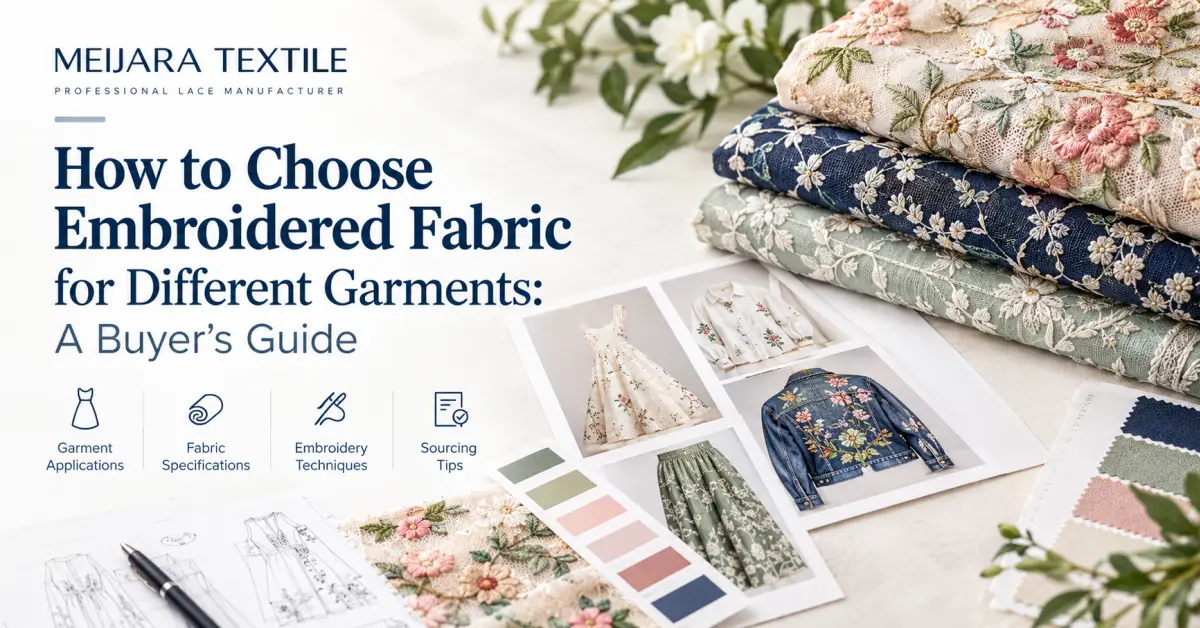

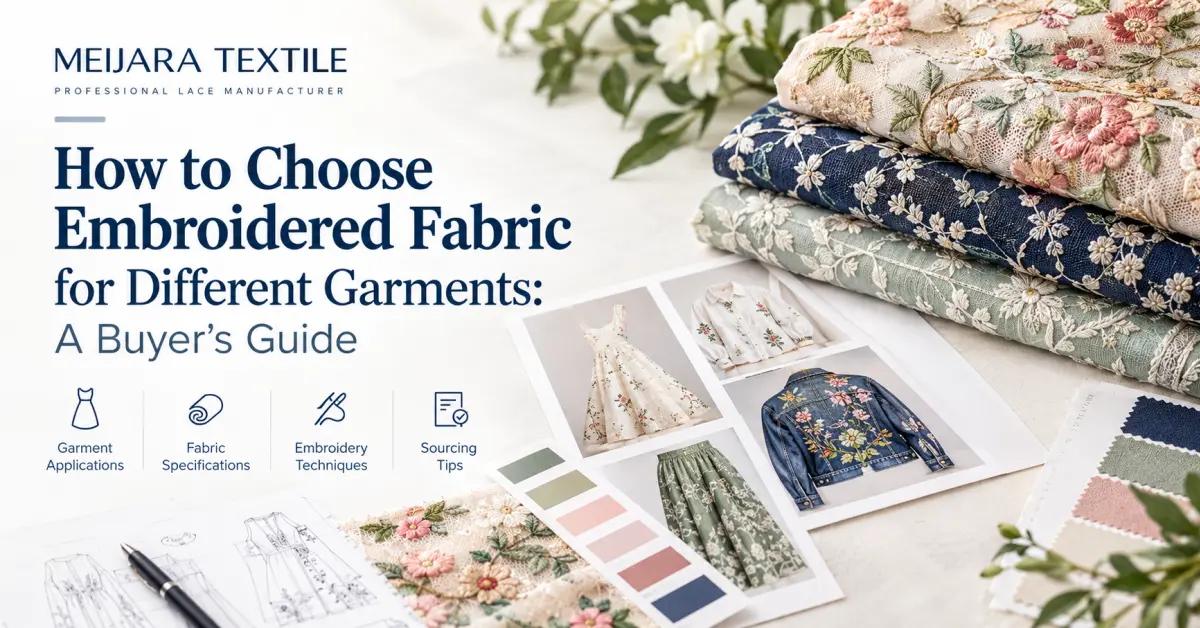
Choosing embroidery fabric is more than just finding a beautiful pattern. The same embroidery pattern will look very different on a shirt, evening gown, skirt or jacket, as fabric structure, weight, available width, pattern proportions and embroidery density all affect the finished garment.
For fashion brands, apparel manufacturers and purchasing teams, the more practical question is not"Does this embroidery look good?" dir="auto" style="vertical-align: inherit;">"Will the fabric and embroidery work effectively for the intended garment?"
This guide explains how to choose embroidery fabrics based on garment type, what specifications buyers should check, how embroidery technology affects garment construction, and what aspects need to be evaluated before moving from sample to mass production.
Why the type of garment matters when choosing embroidery fabrics
An embroidered fabric that works well for a flowing dress may not be suitable for a crisp jacket. Likewise, dense embroidery that looks ornate on an evening gown may add unnecessary weight to a lightweight shirt.
Before selecting fabrics, buyers should consider the following factors:
- Clothing outline
- Fabric composition
- Gram weight and total weight
- Available fabric width
- Pattern repeat
- Embroidery density
- Stretch and restore
- Feel and drape
- Transparency
- Intended seasons and applications
- Production quantity and target cost
Therefore, the design of the garment should precede the fabric structure and embroidery method.
A valid selection sequence is:
Clothing requirements → Fabric specifications → Embroidery technology → Samples → Approval → Mass production
This method helps reduce problems during the production process such as inappropriate fabric weight, difficult cutting layout, excessive fabric or inconsistent embroidery.
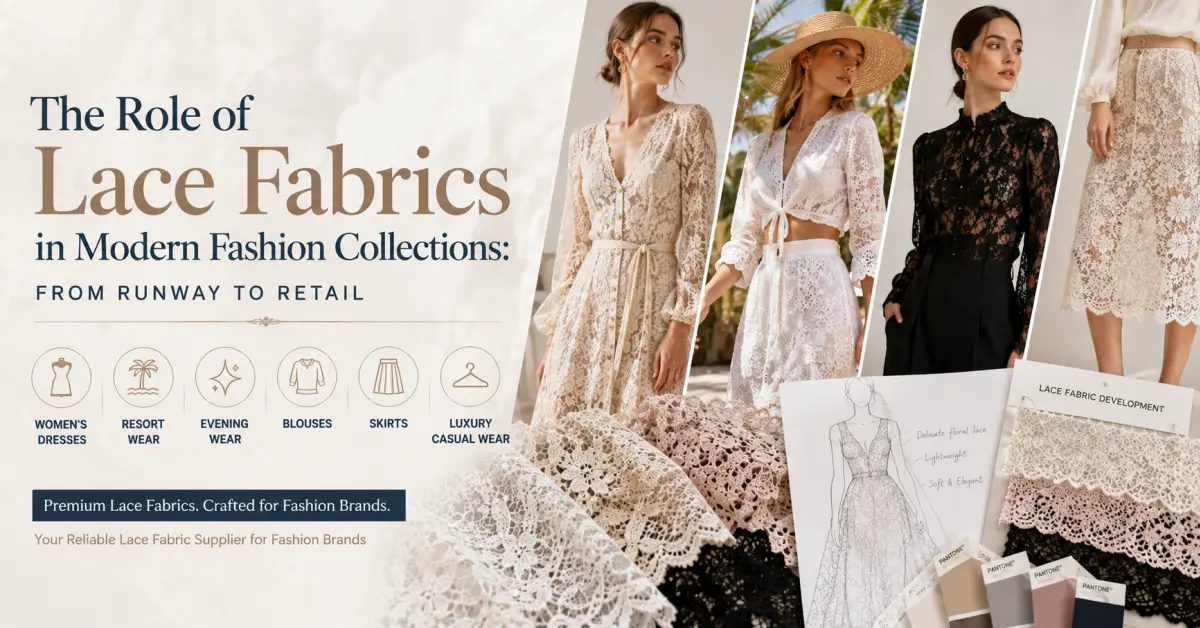
Select embroidery fabrics by garment type
Different garments have different requirements for embroidery fabrics. The table below provides a practical starting point for fabric sourcing and product development.
| Clothing Type | Recommended fabric direction | Embroidery Precautions |
|---|---|---|
| Dress | Lightweight to medium weight with good drape. | Pattern proportion, transparency, weight and movement |
| Women's shirts | Light, soft, flexible | Fine details, feel and seam areas |
| skirt | Stable light to mid-weight fabric | Pattern repeat, border position and cropping |
| Jacket | Medium to heavier stable construction | Embroidery density, hardness and position |
| Vacation wear | Lightweight and comfortable | Open pattern, breathability and transparency |
| Evening dress | Decoration and three-dimensionality | Surface effects, weight and movement |
Embroidered fabrics for dresses and evening gowns
The design of dresses often requires a balance between decorative effects and movement. Sheer or mid-weight embroidered fabrics are ideal for garments that require a soft drape and smooth silhouette.
For evening gowns, designers may choose more three-dimensional embroidery, including raised cord embroidery, sequins, beads, or denser decorative patterns.
The main considerations are:
- How the fabric fits the body
- Does embroidery change the flexibility of the fabric?
- Whether the pattern proportions match the silhouette of the garment
- Whether embroidery will add too much weight
- How to handle transparent areas in the clothing production process
For slim-fitting dresses, the density and elasticity of the embroidery are particularly important. For loose evening gowns, the design allows for greater flexibility in pattern size and surface decoration.
Embroidered fabric for shirts and light tops
Shirts and lightweight tops often require fabrics that are comfortable and easy to sew.
When the design requires a decorative surface but does not want the fabric to be too stiff, delicate floral, botanical or relatively open embroidery patterns are appropriate.
Buyers should pay special attention to:
- Fabric softness
- Drawings
- Embroidery density
- Seam flexibility
- Cuff and collar structure
- Fabric transparency
Embroidered fabric for skirts and matching suits
Skirts offer greater freedom in fabric weight and pattern placement, but pattern repeat size and cutting efficiency become important.
When purchasing skirts and suits, buyers should note:
- Pattern repeat
- Border position
- Fabric width
- Pattern direction
- Cutting efficiency
- Embroidery density
For products with matching tops and skirts, consistency in pattern size and color on the fabric will also affect the appearance of the final garment.
Embroidered fabrics for jackets, denim and silhouettes
Jackets and other structural garments can accommodate embroidery with greater surface weight and dimension.
When a garment requires a stronger visual effect, consider cord embroidery, heavier embroidery and multi-color designs.
However, more embroidery does not necessarily mean better quality.
High embroidery density can be increased:
- Fabric stiffness
- Weight
- Material consumption
- Sewing difficulty
- Production requirements
For jackets and denim garments, buyers should evaluate the embroidery together with the base fabric rather than judging the embroidery separately.
Placement is also important. Large embroidery panels may need to be developed specifically for the front body, back panel, sleeves or pocket areas.
For panel-based applications, cut-piece embroidery can provide a different development approach from traditional full-width embroidered fabric.
Embroidered Fabric for Resortwear and Lightweight Collections
Resortwear and lightweight seasonal collections often require a different balance between decoration and comfort.
Open floral patterns, lightweight embroidery and less dense designs can help maintain fabric flexibility and reduce unnecessary weight.
When selecting fabric for this category, consider:
- Breathability
- Fabric weight
- Transparency
- Hand feel
- Pattern openness
- Comfort during movement
The final choice should reflect the garment's intended use rather than simply the visual complexity of the embroidery.
Embroidered Fabric vs. Embroidered Lace
Embroidered fabric and embroidered lace can look similar in product photography, but their underlying structures are different.
| Feature | Embroidered Fabric | Embroidered Lace |
|---|---|---|
| Base structure | Woven, mesh, net or other textile base | Lace or openwork base |
| Main visual element | Embroidery on the base fabric | Lace structure combined with embroidery |
| Transparency | Depends on the base fabric | Often more open or sheer |
| Pattern focus | Embroidered motif | Lace structure and embroidered motif |
| Typical applications | Dresses, blouses, skirts, jackets | Dresses, overlays, eveningwear, decorative panels |
| Main consideration | Fabric construction + embroidery | Lace construction + embroidery + transparency |
The purchasing decision should therefore depend on the garment requirement.
If the design requires a defined textile base with embroidery as the primary decorative element, embroidered fabric may be more appropriate.
If transparency, openwork structure and lace pattern are themselves important design features, embroidered lace may provide a different construction and visual effect.
Meijara's lace collection and embroidery range cover both directions, allowing buyers to develop materials according to the intended garment construction.
Which Embroidery Technique Is Suitable for Your Garment?
The embroidery technique should be selected according to the garment's structure, desired visual effect and production requirements.
Cord Embroidery
Cord embroidery creates raised outlines and a stronger three-dimensional effect.
It can be considered for:
- Evening dresses
- Structured jackets
- Statement skirts
- Decorative bodices
- Fashion panels
Because the cord creates additional thickness, buyers should check flexibility, seam construction and the weight of the finished material.
See Meijara's cord embroidery collection for examples of this construction.
Water-Soluble Embroidery
Water-soluble embroidery can create intricate and relatively open decorative structures.
It is useful when the design requires:
- Fine motifs
- Detailed floral patterns
- Open decorative effects
- Lace-like visual structures
- Lightweight decorative elements
For garments with complex pattern placement, buyers should confirm the final shape, stability and construction through sampling.
Multi-Color Embroidery
Multi-color embroidery allows designers to combine several thread colors within one motif.
It can be useful for:
- Floral designs
- Botanical patterns
- Resortwear
- Artistic motifs
- Statement fashion collections
Color selection should be evaluated on the actual embroidered fabric rather than artwork alone because thread appearance can change according to the base material and embroidery density.
Sequin and Bead Embroidery
Sequins and beads add shine, texture and dimensionality.
They can be suitable for:
- Eveningwear
- Statement garments
- Stagewear
- Decorative panels
- Special-occasion fashion
However, decorative components also add weight. Buyers should consider how the additional weight will affect garment movement, seams and overall comfort.
Heavy Embroidery
Heavy embroidery creates strong surface coverage and visual impact.
It can be considered for structured or highly decorative garments, but density should always be evaluated against the base fabric.
A heavier embroidered fabric is not automatically a higher-quality fabric. The appropriate density depends on the intended garment.
Cut-Piece Embroidery
Cut-piece embroidery is useful when embroidery needs to be developed for specific garment sections rather than applied across an entire fabric width.
Typical applications include:
- Bodices
- Sleeves
- Collars
- Cuffs
- Skirt panels
- Jacket panels
- Decorative garment sections
This approach places greater emphasis on pattern placement and dimensional accuracy. The development process can include pattern review, cutting, placement development, sampling and approval before bulk production.
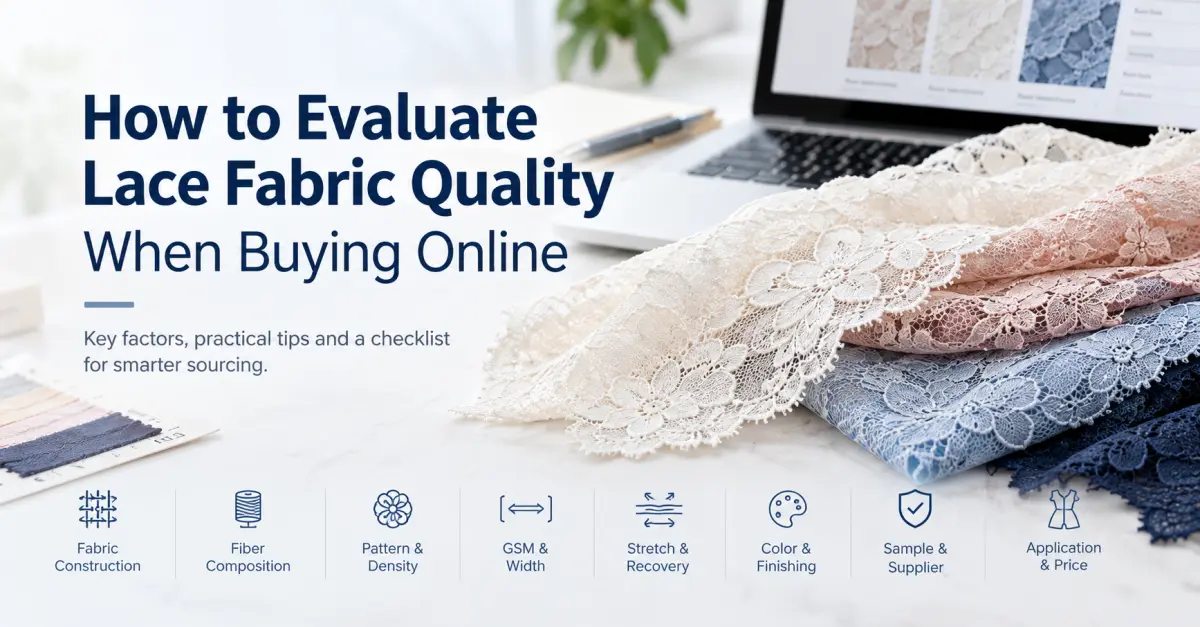
Fabric Specifications Buyers Should Check
Visual appearance is only one part of embroidered fabric selection. Before approving a material, buyers should review its technical specifications.
Fiber Composition
Composition affects hand feel, drape, durability, dyeing behavior and garment performance.
Depending on the product, embroidered fabrics may use polyester, nylon, cotton, rayon/viscose or blended constructions.
The correct composition depends on the garment's intended performance rather than a universal preference for one fiber.
GSM and Fabric Weight
GSM is useful for comparing fabric weight, but it should not be treated as a direct quality score.
Two fabrics with similar GSM can behave differently because of:
- Fiber composition
- Fabric construction
- Embroidery density
- Yarn characteristics
- Finishing
Embroidery itself can also increase the effective weight of the finished material.
Usable Width
Usable width directly affects garment cutting and material consumption.
A fabric may have a stated width, but the practical usable area can be different depending on the edges, embroidery placement and construction.
For larger garments or production at scale, usable width can influence:
- Marker efficiency
- Fabric consumption
- Cutting waste
- Overall material cost
This is why buyers should confirm usable width rather than relying only on nominal width.
Pattern Repeat
Pattern repeat becomes especially important when the embroidery contains large floral or geometric motifs.
A large repeat can affect:
- Cutting efficiency
- Pattern matching
- Garment symmetry
- Motif placement
For fitted garments with multiple panels, repeat size should be reviewed during the sampling stage.
Stretch and Recovery
For fitted dresses, body-conscious garments and other stretch applications, buyers should evaluate both stretch and recovery.
Importantly, the embroidered construction should be tested rather than judging stretch from the base fabric alone.
Dense embroidery can affect how freely the fabric stretches and returns to its original shape.
Hand Feel and Drape
Hand feel is difficult to evaluate accurately through product photographs.
Two fabrics with similar composition and GSM may have noticeably different:
- Softness
- Stiffness
- Surface texture
- Drape
- Flexibility
For this reason, physical sampling remains important for garments where movement and comfort are critical.
How Embroidery Density and Pattern Scale Affect Garment Construction
Embroidery density and motif scale are closely connected to garment construction.
Higher-density embroidery can provide stronger coverage and more dimensional surface effects, but it can also increase fabric weight and stiffness.
Lower-density embroidery generally leaves more of the base fabric visible and can create a lighter visual effect.
Pattern scale also matters.
A large motif may work well on the back of a jacket or a wide skirt panel but may be difficult to position on a narrow sleeve or collar.
Before bulk production, buyers should check whether the embroidery:
- Fits the garment pattern pieces
- Maintains the intended visual scale
- Allows practical cutting
- Works around seams
- Maintains the required flexibility
- Produces consistent placement across production
This is one reason why artwork approval alone is not enough. The embroidery should be evaluated as part of the actual garment development process.
Common Mistakes When Choosing Embroidered Fabric
1. Choosing the Pattern Before Defining the Garment
A beautiful pattern may not work with the intended silhouette, fabric weight or garment construction.
2. Treating Higher GSM as Better Quality
Higher weight does not automatically mean higher quality. The appropriate GSM depends on the application.
3. Ignoring Usable Width
Nominal width does not always represent the most efficient cutting area.
4. Using the Same Embroidery Density for Every Garment
A dense design suitable for an evening garment may be unsuitable for a lightweight blouse.
5. Ignoring Pattern Repeat
Large repeats can create additional cutting and matching requirements.
6. Approving Bulk Production Without a Final Sample
A sample allows buyers to evaluate the actual fabric, embroidery density, color, hand feel, width and construction before committing to production.
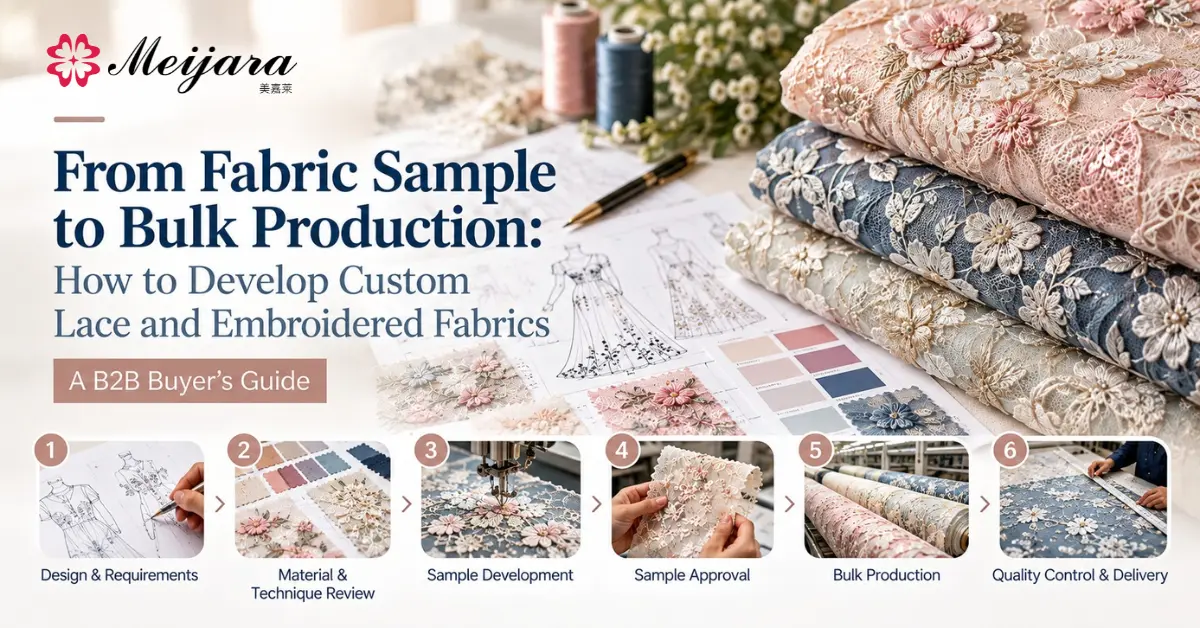
From Garment Concept to Bulk Production
For customized embroidered fabric, product development should connect design requirements with manufacturing considerations from the beginning.
A practical development process is:
Design → Technical Review → Sampling → Approval → Bulk Production
Step 1: Define the Design Requirement
Provide the supplier with:
- Artwork or reference design
- Intended garment
- Preferred colors
- Fabric requirements
- Approximate dimensions
- Expected quantity
- Application details
Step 2: Technical Review
The supplier evaluates the relationship between the artwork and the proposed fabric construction.
This stage may involve reviewing:
- Embroidery technique
- Fabric composition
- Pattern scale
- Density
- Thread selection
- Width
- Placement requirements
Step 3: Sampling
A physical sample allows the buyer to evaluate the actual result rather than relying only on digital artwork.
Step 4: Sample Approval
Before bulk production, confirm the approved sample, color, dimensions, construction and other agreed specifications.
Step 5: Bulk Production
Once the specifications are approved, production can proceed according to the confirmed requirements.
Meijara's customized development process covers the transition from design and material development through sampling and bulk production for OEM lace and embroidery projects.
How to Choose an Embroidered Fabric Supplier
For B2B buyers, product appearance is only one part of supplier evaluation.
A capable supplier should be able to connect design requirements with actual production.
Key questions include:
Can the supplier develop custom designs?
Custom development is important when the required pattern, color, density or construction is not available as a standard product.
Can the supplier provide physical samples?
Sampling allows buyers to confirm the actual material before bulk production.
Can the supplier maintain consistency in bulk?
The key question is not only whether the supplier can produce an attractive sample, but whether the approved sample can be reproduced consistently in bulk.
Does the supplier understand different embroidery techniques?
A broader technical range can make it easier to select a construction appropriate for the garment rather than forcing every project into the same production method.
Can the supplier support OEM production?
For larger projects, buyers may need support from design development through sampling, production and inspection.
Meijara provides lace and embroidery development for customized patterns, colors and garment applications, with capabilities covering both product development and bulk production.
What Information Should You Send When Requesting a Quote?
Providing complete information can make the quotation and development process more efficient.
Ideally, buyers should prepare:
| Information | Example |
|---|---|
| Product type | Embroidered fabric |
| Garment application | Dress, blouse, jacket |
| Artwork | AI, PDF, image or reference |
| Fabric composition | Preferred composition or supplier recommendation |
| Width | Required finished width |
| Color | Pantone or physical reference |
| Embroidery | Cord, water-soluble, multi-color, etc. |
| Quantity | Estimated order volume |
| Sampling | Required sample size |
| Delivery | Target production schedule |
The more clearly the technical requirements are defined, the easier it is for the supplier to assess production feasibility.
FAQ
What type of embroidered fabric is suitable for dresses?
Lightweight to medium-weight fabrics with suitable drape are commonly considered for dresses.The final choice depends on the silhouette, embroidery density, transparency, stretch and desired surface effect.
What embroidered fabric is suitable for blouses?
Lightweight, soft and flexible fabrics are generally easier to use for blouses. Fine or relatively open embroidery can help maintain comfort and flexibility.
Can embroidered fabric be used for jackets?
Yes. Jackets can accommodate medium- to heavier-weight embroidered fabrics, including cord, multi-color and heavier embroidery. Density and stiffness should be evaluated together with the base fabric.
What is the difference between embroidered fabric and embroidered lace?
Embroidered fabric generally uses a textile base with embroidery applied to its surface, while embroidered lace combines embroidery with an openwork lace structure. The appropriate option depends on the garment's construction and transparency requirements.
Does higher GSM mean better embroidered fabric?
No. GSM indicates fabric weight rather than overall quality. The appropriate GSM depends on the garment, fabric construction and embroidery requirements.
Why is usable width important?
Usable width affects cutting efficiency, fabric consumption and material waste. It is especially important for large-scale garment production.
Should I request a sample before placing a bulk order?
Yes. A physical sample allows buyers to evaluate color, hand feel, drape, embroidery density, width, stretch and overall construction before bulk production.
Can embroidered fabric be customized?
Customization may include pattern, color, embroidery technique, density, fabric construction and other specifications depending on the supplier's production capabilities.
Conclusion
Choosing embroidered fabric should begin with the garment requirement, not simply the appearance of the embroidery.
Dresses may require a balance between drape and decorative effect. Blouses often need lighter and softer constructions. Jackets can accommodate more dimensional embroidery, while resortwear may require lightweight and breathable materials.For B2B buyers, the practical selection process is:
For B2B buyers, the practical selection process is:
Apparel Requirements → Fabric Specifications → Embroidery Techniques → Sampling → Approval → Mass Production
The content above is provided by Meijara Textile for informational purposes. Unauthorized reproduction is prohibited. See our full disclaimer hereMeijara Textile:Disclaimer