

For fashion brands, buying lace fabric is not simply a matter of selecting a pattern, color, or price.
The fabric must perform consistently throughout production. Width needs to remain within the agreed tolerance. Color must match the approved standard. Patterns need to remain stable across the roll. Stretch lace needs to recover properly. Embroidered or decorated surfaces need to maintain their appearance after cutting, sewing, pressing, and garment finishing.
These requirements make lace fabric quality testing an important part of the manufacturing process.
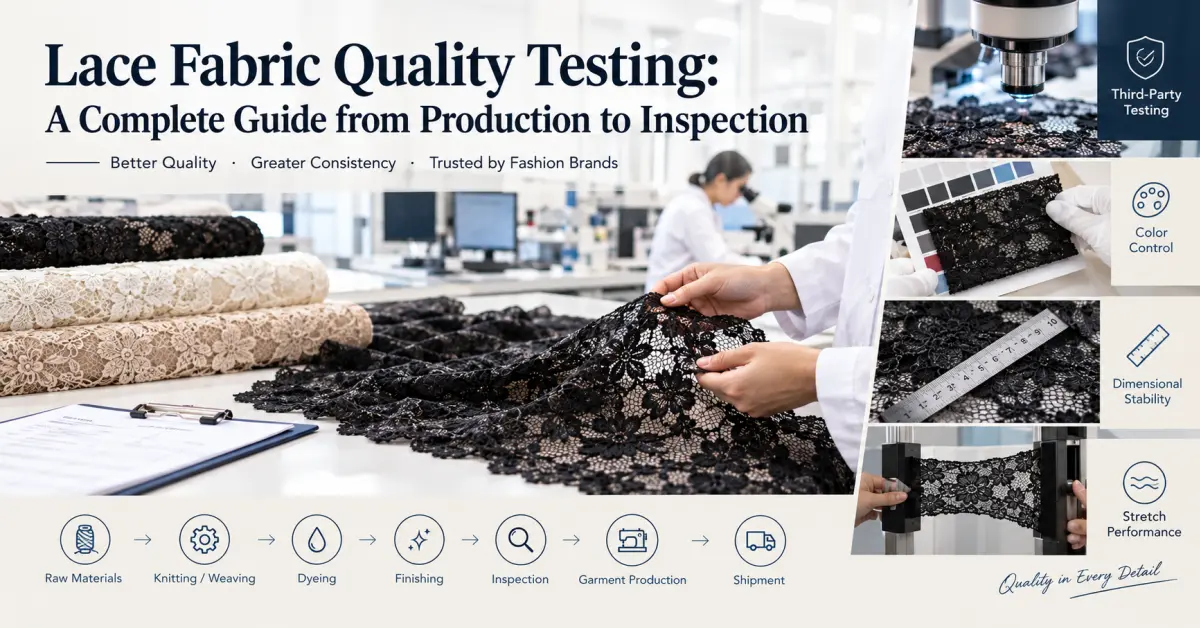
At a professional lace factory, quality control does not begin when a finished roll reaches the inspection table. It starts much earlier, with raw materials and production parameters, and continues through knitting or embroidery, dyeing, finishing, inspection, packing, and shipment.
For B2B buyers, understanding this process is useful for another reason: a factory's testing and inspection system often reveals more about its manufacturing capability than a product catalogue does.
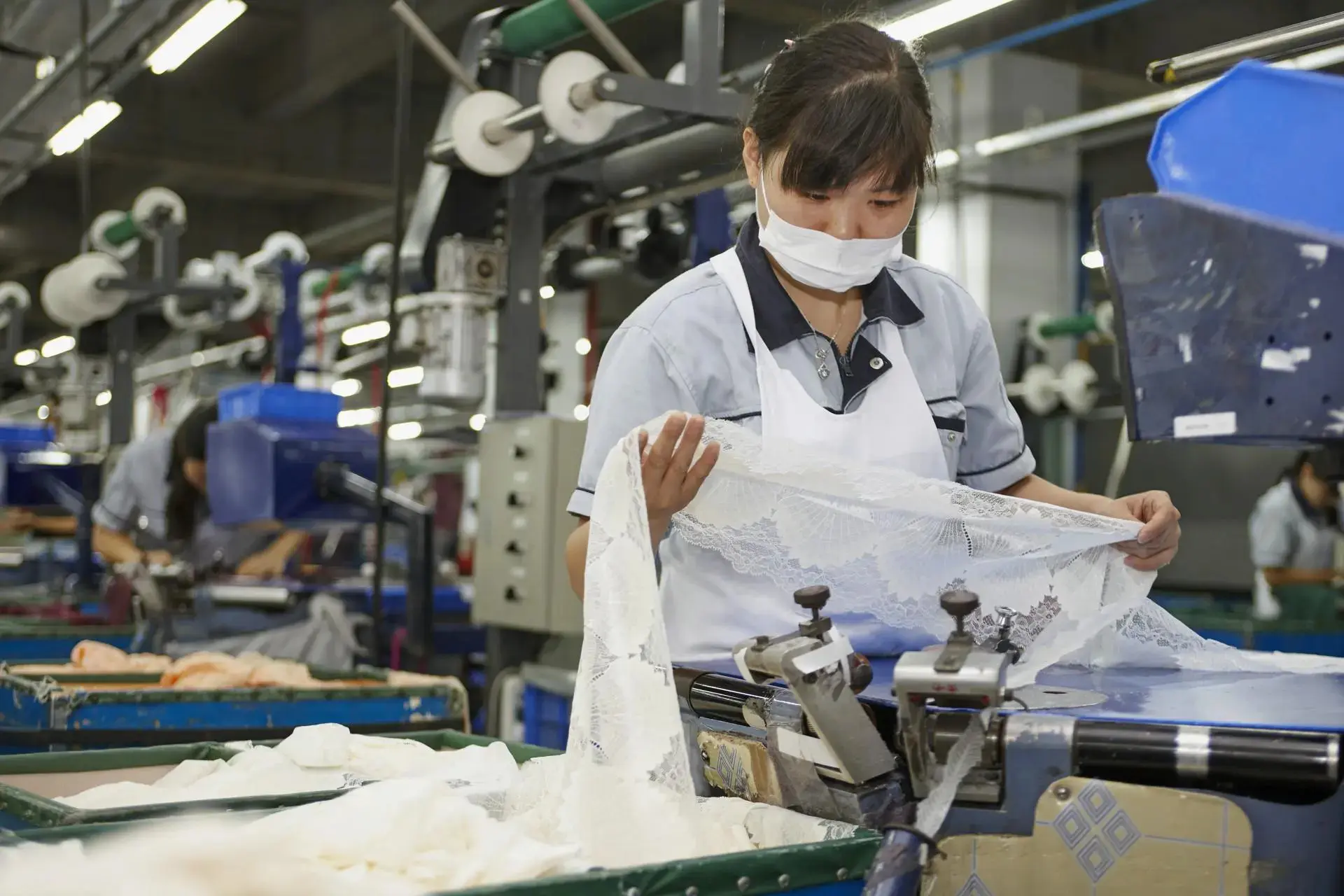
Why Quality Testing Matters in Lace Fabric Production
Lace is more complicated to inspect than many conventional fabrics.
Its construction may include open mesh structures, fine yarns, elastic fibers, embroidered motifs, decorative threads, sequins, beads, scalloped edges, or complex jacquard patterns.
A small production deviation can therefore become visible across a large section of fabric.
For example:
-
A slight change in yarn tension can affect pattern definition.
-
Uneven dye penetration can create shade differences.
-
Incorrect finishing can change fabric width.
-
Excessive heat can affect elastic recovery.
-
Improper handling can distort an open lace structure.
-
Embroidery tension can cause puckering.
-
Incorrect cutting or finishing can damage scalloped edges.
For a fashion manufacturer purchasing hundreds or thousands of meters, these issues are not simply cosmetic.
They can affect:
cutting efficiency → garment appearance → production yield → rework → delivery schedule → final product quality
This is why professional factories normally combine process control, physical testing, visual inspection, and final roll inspection.
Quality Control Starts Before the Fabric Is Produced
A common misunderstanding is that quality inspection means checking finished fabric.
In reality, finished-product inspection is only one stage.
A reliable factory should control several stages of production.
Typical lace quality control flow
| Production Stage | Main Quality Focus |
|---|---|
| Raw material preparation | Yarn specification, fiber composition, color |
| Machine setup | Pattern, width, tension, production parameters |
| Lace knitting / weaving | Pattern accuracy, structure, defects |
| Embroidery | Stitch quality, motif position, thread tension |
| Dyeing | Color matching, shade consistency |
| Finishing | Width, hand feel, appearance, stability |
| Final inspection | Defects, measurements, color, workmanship |
| Packing | Roll identification, protection, quantity |
| Pre-shipment control | Documentation, sampling,buyer requirements |
The purpose is straightforward: identify problems as early as possible.
A defect discovered during machine production can often be corrected immediately.
A defect discovered after several thousand meters have already been dyed and finished can become much more expensive to resolve.
For more on the overall production flow, explore our processing capabilities.
Raw Material Inspection
The first stage of quality control is the raw material.
Depending on the lace construction, raw materials may include:
-
Nylon yarn
-
Polyester yarn
-
Cotton yarn
-
Rayon
-
Spandex
-
Metallic yarn
-
Embroidery thread
-
Decorative yarn
-
Sequins
-
Beads
-
Other surface embellishments
The exact inspection requirements depend on the product.
For stretch lace, for example, spandex content and yarn behavior are particularly important.
For embroidered lace , embroidery thread and base fabric need to be considered together.
What factories may check
| Item | Purpose |
|---|---|
| Yarn specification | Confirm material consistency |
| Fiber composition | Match approved product specification |
| Yarn color | Prevent color variation |
| Yarn appearance | Identify contamination or abnormality |
| Elastic yarn condition | Support stretch and recovery performance |
| Embroidery thread | Ensure consistent color and appearance |
| Decorative materials | Confirm size, color and surface quality |
Raw materials should correspond to the specifications used during product development.
This becomes particularly important for custom lace.
A fashion brand may approve a development sample based on a particular yarn combination.Substituting materials later can change the appearance, weight, elasticity, hand feel, or dyeing behavior of the finished lace.
Pattern and Machine Setup Inspection
Once materials are approved, production moves to machine setup.
This stage is particularly important for lace manufacturers because pattern quality is directly connected to machine settings.
Depending on the construction, factories may use different types of lace machinery, including warp knitting and embroidery equipment.
The factory needs to confirm the production parameters before bulk manufacturing.
Typical setup checks
-
Pattern repeat
-
Fabric width
-
Yarn arrangement
-
Stitch structure
-
Machine tension
-
Pattern positioning
-
Edge construction
-
Elastic yarn behavior
-
Embroidery layout where applicable
For custom lace, the approved artwork or technical specification becomes the reference point.
The objective is not simply to produce a similar-looking pattern.
The bulk production should remain consistent with the approved development sample.
To understand the machinery behind the process, visit our machinery and equipment category.
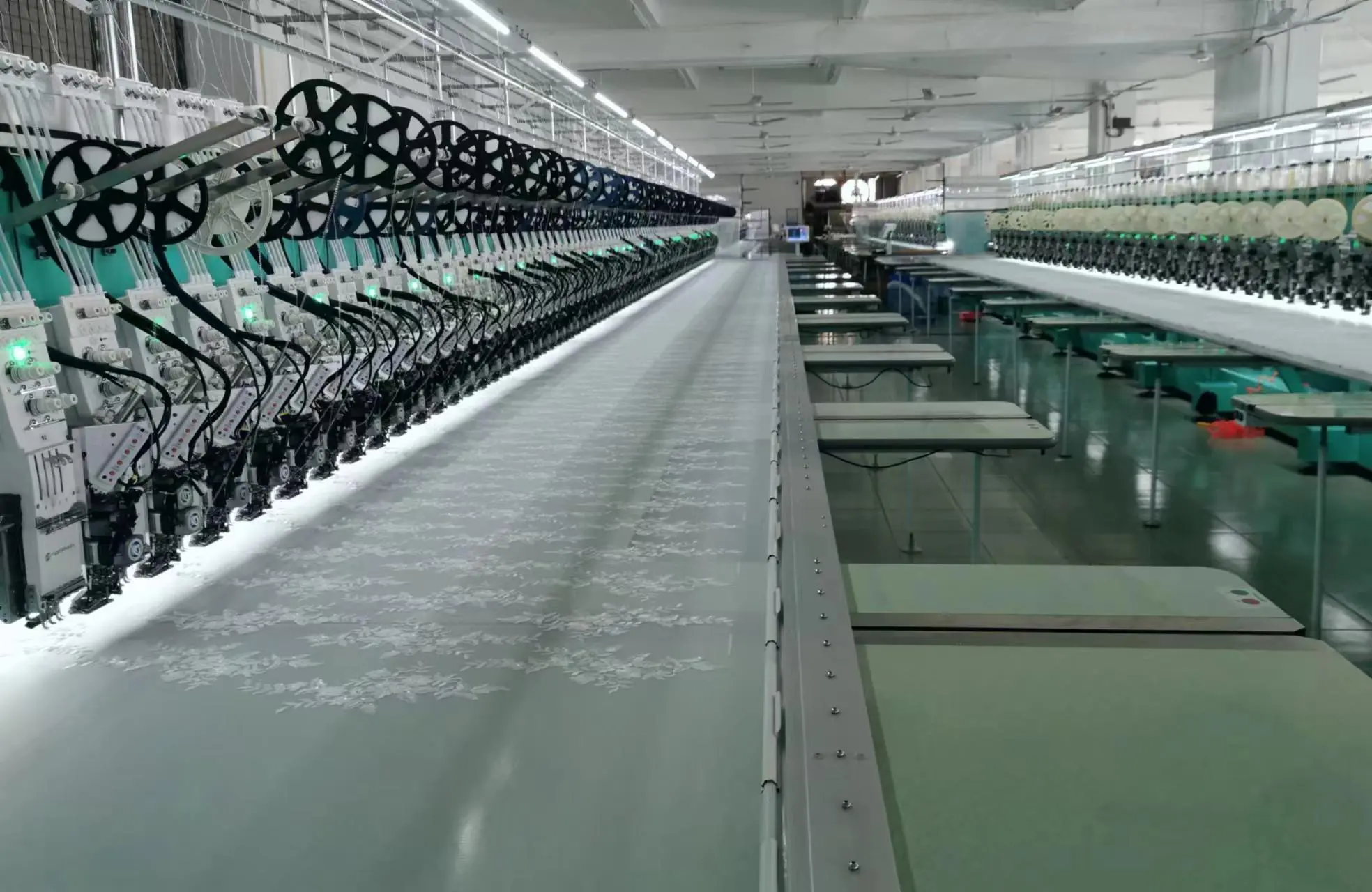
Appearance Inspection During Production
Visual inspection remains one of the most important forms of lace quality control.
Laboratory testing can provide numerical data, but an experienced inspector can identify appearance problems that may not be captured by a single physical measurement.
Common visual defects include:
-
Holes
-
Broken yarns
-
Missing stitches
-
Pattern distortion
-
Uneven mesh
-
Oil marks
-
Stains
-
Loose threads
-
Needle lines
-
Pattern misalignment
-
Uneven edges
-
Embroidery defects
-
Thread breaks
-
Puckering
-
Color contamination
For decorative lace, the inspector also needs to look at the relationship between the motif and the base structure.
A floral design may technically be present, for example, but if the embroidery density changes noticeably from one section to another, the visual result can still be unacceptable.
Width Measurement
Fabric width is one of the most important practical measurements for garment manufacturers.
A lace fabric may look correct visually but still create problems if the usable width is inconsistent.
Width affects:
-
Marker planning
-
Fabric consumption
-
Cutting efficiency
-
Garment panel dimensions
-
Production yield
-
Cost per garment
For this reason, width is normally checked during production and final inspection.
Example of factory width control
| Check | Purpose |
|---|---|
| Overall width | Confirm production specification |
| Usable width | Determine actual cutting area |
| Edge condition | Check whether edges are suitable for cutting |
| Width variation | Monitor consistency along the roll |
| Scalloped edge | Confirm decorative border remains intact |
For lace with decorative selvedges or scalloped edges, usable width can be more meaningful than simply measuring the maximum width.
This distinction is particularly important for fashion brands developing fitted garments.
For more on lace types and their characteristics, read our lace types & categories guide.
GSM and Fabric Weight
Fabric weight is another useful quality indicator.
GSM means grams per square meter.
A change in GSM can indicate changes in yarn consumption, fabric construction, embroidery density, or finishing.
However, GSM should not be considered in isolation.
Two lace fabrics can have similar GSM values but very different:
-
Hand feel
-
Opacity
-
Stretch
-
Pattern density
-
Drape
-
Surface texture
For this reason, GSM is normally used together with visual inspection and other physical measurements.
Why GSM matters to fashion brands
Fabric weight can influence:
-
Garment drape
-
Fabric consumption
-
Transparency
-
Layering requirements
-
Shipping weight
-
Garment construction
-
Retail product positioning
For a custom-developed lace, the approved sample should therefore remain the primary visual reference while numerical specifications provide additional production controls.
Color Matching and Shade Control
Color is one of the most sensitive areas in textile production.
A lace design can be technically perfect but still be rejected if the color is significantly different from the approved standard.
This is particularly challenging with lace because the open structure allows the background fabric or garment lining to influence the perceived color.
Common color control stages
-
Lab dip or color development
-
Buyer color approval
-
Bulk dyeing
-
Shade comparison
-
Production monitoring
-
Final roll inspection
The factory may use approved color standards and instrumental measurements where required.
However, visual assessment remains important because textile color perception can change depending on:
-
Lighting
-
Background
-
Fabric construction
-
Surface texture
-
Transparency
-
Embroidery density
For B2B production, the safest approach is to define the approved color standard before bulk production rather than relying on verbal descriptions such as "off-white," "beige," or "dark green."
For more on color management, visit our dyeing and color matching category.
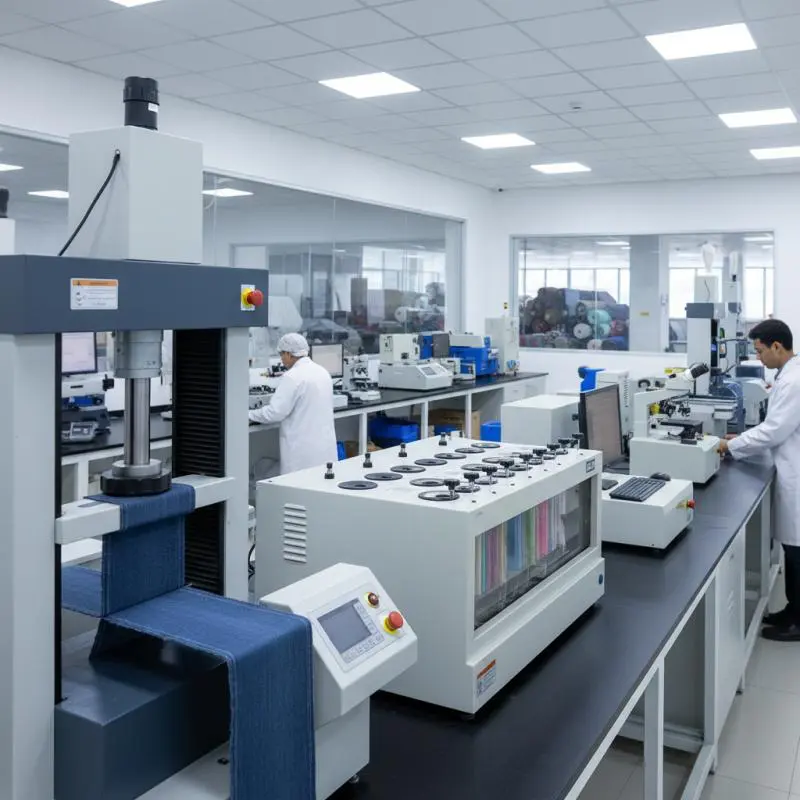
Color Fastness Testing
Color fastness describes how well a dyed textile maintains its color when exposed to different conditions.
Depending on the garment's intended use and buyer requirements, testing may include different forms of color fastness.
Common categories include:
| Test Area | What It Evaluates |
|---|---|
| Washing | Color change after laundering |
| Rubbing | Color transfer through friction |
| Perspiration | Behavior under sweat exposure |
| Light | Resistance to light exposure |
| Water | Color behavior when wet |
| Dry cleaning | Performance under dry-cleaning conditions |
Not every lace product requires every test.
The correct test package should be determined according to the intended garment, fiber composition, care method, destination market, and buyer's technical requirements.
This is an important point for sourcing teams.
Testing should be based on the product's actual end use rather than applying the same checklist to every lace fabric.
Stretch and Recovery Testing for Elastic Lace
Stretch lace requires additional attention.
A lace fabric containing spandex needs to provide the required elasticity while maintaining acceptable recovery.
A fabric that stretches easily but does not recover properly may cause garment deformation.
This can be particularly noticeable in:
-
Bodycon dresses
-
Fitted tops
-
Sleeves
-
Waist sections
-
Close-fitting skirts
-
Lingerie-inspired fashion
-
Stretch panels
Important performance considerations
| Property | Why It Matters |
|---|---|
| Stretch | Determines garment flexibility |
| Recovery | Helps maintain garment shape |
| Stretch direction | Important for pattern placement |
| Extension behavior | Influences fit |
| Repeated stretching | Indicates longer-term performance |
For a custom stretch lace, testing should reflect the actual garment construction.
A fabric intended for a loose blouse does not necessarily require the same stretch characteristics as lace used for a fitted dress.
Dimensional Stability
Dimensional stability refers to how much the fabric changes in size after washing or other treatments.
This can involve:
-
Length change
-
Width change
-
Distortion
-
Shrinkage
-
Shape deformation
Dimensional stability is particularly important when the lace will be cut into garment panels.
If a fabric changes significantly after production or laundering, the final garment dimensions can be affected.
For fashion manufacturers, dimensional stability therefore needs to be considered during product development rather than after garments have already entered mass production.
Tensile and Tear Performance
Although lace is primarily valued for appearance, it still needs adequate physical performance for its intended application.
Tensile strength evaluates how the fabric behaves when subjected to pulling force.
Tear strength evaluates resistance to the propagation of a tear.
The required performance depends on:
-
Fabric construction
-
Fiber type
-
Fabric weight
-
Garment design
-
Seam construction
-
End use
A delicate decorative lace may naturally have different strength characteristics from a heavier structural lace.
Therefore, testing results should always be interpreted in relation to the intended product.
13.Embroidered Lace Requires Additional Inspection
For embroidered lace, the inspection process becomes more detailed because there are two components to control:
the base lace + the embroidery
The embroidery needs to maintain both visual and physical consistency.
Typical embroidery inspection points
| Inspection Point | Common Concern |
|---|---|
| Motif position | Design shifted from approved layout |
| Stitch density | Uneven embroidery appearance |
| Thread tension | Puckering or distortion |
| Thread breakage | Incomplete motif |
| Color | Thread shade inconsistency |
| Edge definition | Blurred or irregular motif |
| Backside condition | Excessive loose threads |
| Repetition | Uneven spacing between motifs |
For high-end fashion, motif placement is especially important.
A flower positioned only a few centimeters away from the approved location may create a visible difference once the fabric is cut into a bodice or sleeve.
This is why embroidery inspection should be considered together with the garment pattern.
For more on embroidery techniques, explore our embroidery and cord embroidery collections.
Cut-Piece Embroidery and Panel Inspection
Cut-piece embroidery requires a different production sequence from embroidery performed on continuous fabric.
The fabric is first developed and approved.
Then, according to the garment pattern and design requirements, the base material is cut into the required panels.
Embroidery is subsequently applied to these individual pieces.
The finished embroidered panels are then inspected before being assembled into garments.
This production method allows brands to control motif placement much more precisely.
Typical cut-piece workflow
Design confirmation → Pattern preparation → Fabric cutting → Panel inspection → Embroidery → Embroidery inspection → Panel sorting → Garment assembly
Quality control is required at each stage.
The cut panels need to match the approved dimensions.
The embroidery needs to remain within the specified area.
The motif needs to be positioned correctly relative to the garment panel.
This is particularly important for:
-
Bodices
-
Sleeves
-
Collars
-
Cuffs
-
Skirt panels
-
Jacket fronts
-
Back panels
For fashion brands, this approach can reduce the need to manipulate large embroidered fabric sections during garment manufacturing.
For more on this production method, explore our cut piece product range.
Lace Edge and Scallop Inspection
Decorative edges are an important feature of many lace products.
They may be used directly at:
-
Garment hems
-
Sleeve cuffs
-
Necklines
-
Shoulder sections
-
Skirt edges
-
Decorative overlays
An edge defect can therefore be highly visible.
Inspectors may check:
-
Scallop consistency
-
Edge width
-
Pattern continuity
-
Missing motifs
-
Loose threads
-
Uneven cutting
-
Distortion
-
Damage during finishing
For lace designed specifically for garment borders, the edge should be treated as a functional design component rather than simply the end of the fabric.
For more on trim applications, browse our lace trim collection.
Defect Classification During Final Inspection
Not every defect has the same importance.
A professional inspection system should distinguish between different levels of defects.
A useful approach is to classify defects into:
Critical defects
Issues that may create serious safety, compliance, or product-use problems.
Major defects
Issues that can materially affect garment appearance, construction, or performance.
Minor defects
Small deviations that may not significantly affect the final garment.
The exact classification should be agreed according to the buyer's quality standard.
Example
| Defect | Possible Classification |
|---|---|
| Large hole | Major |
| Severe pattern distortion | Major |
| Significant shade difference | Major |
| Broken embroidery motif | Major |
| Small loose thread | Minor |
| Slight appearance variation | Minor, depending on specification |
| Serious contamination | Potentially major/critical depending on substance |
The purpose of classification is to make inspection more objective.
Instead of simply saying that a fabric "looks good," the factory can establish measurable acceptance criteria.
For more on quality standards, explore our quality control standards category.
The Importance of Roll Inspection
After production and finishing, lace is commonly inspected roll by roll.
This stage is especially important because a fabric can contain isolated defects even when the overall production lot is acceptable.
The inspector may examine:
-
Surface appearance
-
Pattern consistency
-
Color
-
Width
-
Edge condition
-
Holes
-
Stains
-
Broken yarns
-
Embroidery defects
-
Roll length
-
Identification information
For some products, a fabric inspection system such as a point-based defect evaluation may be used.
The exact inspection method should correspond to the customer's quality requirements and the product category.
Fabric Inspection Records
Inspection is more useful when results are documented.
A factory quality record may include:
-
Product code
-
Article number
-
Color
-
Roll number
-
Production batch
-
Fabric width
-
Fabric length
-
Inspection date
-
Defect information
-
Inspector
-
Inspection result
These records help connect the finished material back to its production information.
For B2B customers, traceability becomes particularly useful when a problem appears during garment production.
Instead of investigating an entire order, the factory can identify the relevant batch or roll and investigate the production history.
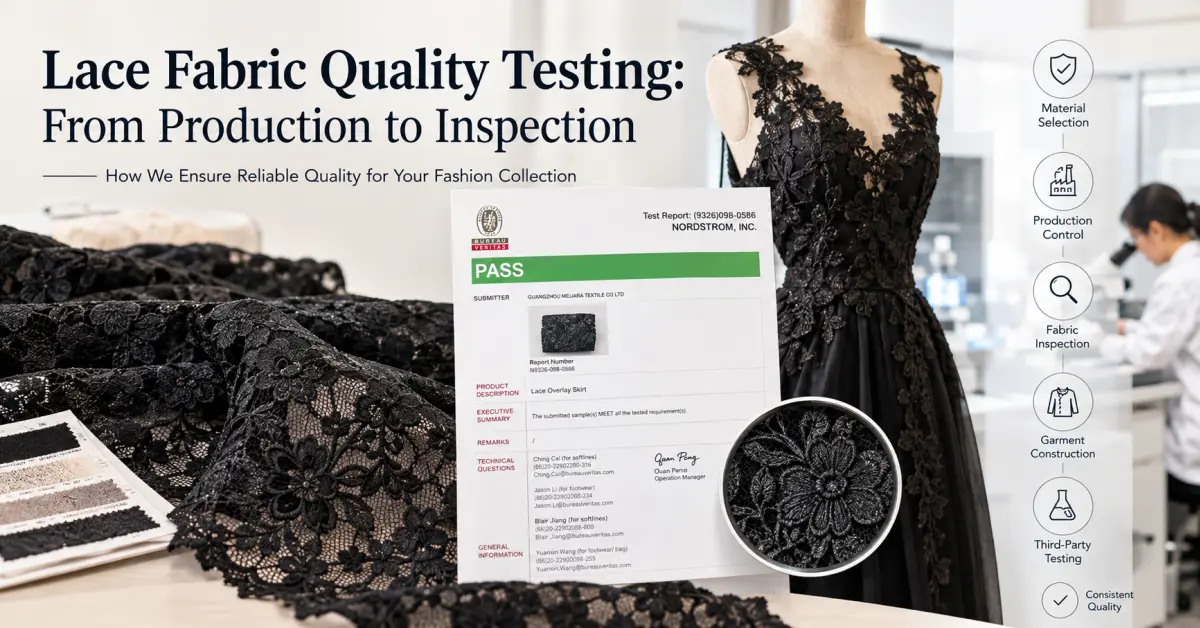
Third-Party Testing and Factory Quality Control Are Different
Fashion buyers sometimes treat a third-party test report as the complete definition of product quality.
It is not.
A third-party laboratory report provides independent test results for specific samples and specific test requirements.
Factory quality control is broader.
It covers the production process itself.
Factory QC vs.laboratory testing
| Factory Quality Control | Laboratory Testing |
|---|---|
| Continuous production monitoring | Sample-based testing |
| Machine and process control | Defined laboratory methods |
| Visual inspection | Instrumental/physical evaluation |
| Width and appearance checks | Specific performance tests |
| Roll inspection | Test report |
| Defect classification | Test result against requirement |
| Production traceability | Independent verification |
The two systems complement each other.
A factory should not rely entirely on laboratory testing to discover manufacturing problems.
Likewise, internal inspection does not replace independent testing when a buyer or market requires third-party verification.
How a Professional Factory Handles a Failed Test
A useful quality system is not defined by never finding a problem.
It is defined by what happens when a problem is found.
A typical corrective process may include:
Problem identification → Lot isolation → Root-cause analysis → Corrective action → Re-inspection → Final decision
For example, if a shade variation is discovered during final inspection, the factory should identify whether the cause came from:
-
Raw material variation
-
Dyeing parameters
-
Batch differences
-
Finishing
-
Incorrect color reference
-
Production handling
Simply removing the visibly defective section may not solve the underlying problem.
For recurring products, root-cause analysis becomes particularly important.
What Fashion Brands Should Request Before Bulk Production
Buyers do not need to ask for dozens of complicated laboratory reports for every lace order.
Instead, the most useful approach is to establish the critical specifications before production begins.
A technical package may include:
-
Approved fabric sample
-
Color standard
-
Fabric composition
-
Width requirement
-
GSM requirement where applicable
-
Stretch requirement where applicable
-
Pattern repeat
-
Embroidery specification
-
Edge specification
-
Finishing requirement
-
Care requirement
-
Applicable testing standards
-
Packaging requirement
Suggested pre-production checklist
| Requirement | Recommended Action |
|---|---|
| Color | Approve physical standard |
| Width | Define target and tolerance |
| Composition | Confirm material specification |
| GSM | Define acceptable range if required |
| Stretch | Define direction and performance |
| Pattern | Approve artwork/sample |
| Embroidery | Confirm placement and density |
| Edge | Approve scallop/border design |
| Testing | Define required tests |
| Inspection | Agree acceptance criteria |
| Packing | Confirm roll identification |
This reduces ambiguity between the buyer and factory.
For practical sourcing strategies, visit our buying guide & sourcing tips category.
Quality Testing Should Match the Garment Application
One of the most important principles in textile quality control is that the correct test depends on the end product.
Consider three examples.
Example 1: Evening dress
The priorities may include:
-
Color consistency
-
Appearance
-
Dimensional stability
-
Embroidery quality
-
Seam performance
-
Surface durability
Example 2: Stretch fashion dress
Additional attention may be given to:
-
Stretch
-
Recovery
-
Dimensional stability
-
Color fastness
-
Fabric structure
Example 3: Decorative lace panel
The focus may shift toward:
-
Motif accuracy
Edge quality
-
Embroidery placement
-
Appearance
-
Panel dimensions
This application-based approach is more useful than applying an identical testing checklist to every lace product.
For more on garment applications, visit our applications & industry use category.
Common Quality Problems Found in Lace Production
From a manufacturing perspective, many lace problems can be grouped into several categories.
Structural defects
These include:
-
Broken yarns
-
Missing stitches
-
Holes
-
Uneven mesh
-
Pattern distortion
Appearance defects
These include:
-
Stains
-
Oil marks
-
Color contamination
-
Uneven pattern
-
Loose threads
Dimensional defects
These include:
-
Incorrect width
-
Excessive shrinkage
-
Distortion
Uneven edges
Embroidery defects
These include:
-
Thread breakage
-
Puckering
-
Missing stitches
-
Motif displacement
-
Uneven density
Dyeing defects
These include:
-
Shade variation
-
Uneven color
-
Color migration
-
Poor fastness
Different defects require different corrective actions.
Why Consistency Is More Important for B2B Production
A fashion brand may approve one sample and assume the bulk order will look identical.
From the factory perspective, this is where production control becomes critical.
A sample represents a small quantity.
Bulk production involves:
-
Multiple machine hours
-
Large quantities of yarn
-
Dyeing batches
-
Finishing processes
-
Multiple rolls
-
Different production stages
The challenge is therefore not simply producing a good sample.
The challenge is reproducing the approved quality consistently at scale.
For B2B customers, this is one of the most important differences between a sample-oriented supplier and an established manufacturer.
Quality Control and Production Efficiency
Quality inspection is sometimes viewed as an additional cost.
In reality, effective quality control can reduce production costs.
Consider a defect discovered after garment cutting.
The factory may already have:
-
Purchased the fabric.
-
Shipped the fabric.
-
Cut garment panels.
-
Used production labor.
-
Started sewing.
-
Discovered the defect.
At this stage, correcting the problem becomes expensive.
If the same defect is detected during fabric inspection, the affected roll can be isolated before cutting.
This is why early-stage inspection is generally more valuable than relying entirely on final inspection.
Building a Reliable Lace Quality Control System
For a lace manufacturer, a practical quality system should connect production and inspection rather than treating them as separate departments.
A useful structure is:
Stage 1 — Development
Confirm:
-
Design
-
Construction
-
Material
-
Color
-
Width
-
Application
Stage 2 — Production preparation
Confirm:
-
Yarn
-
Machine settings
-
Pattern
-
Embroidery parameters
-
Dyeing requirements
Stage 3 — In-process inspection
Monitor:
-
Appearance
Width
-
Pattern
-
Defects
-
Production consistency
Stage 4 — Finishing
Check:
-
Hand feel
-
Width
-
Appearance
-
Stability
-
Color
Stage 5 — Final inspection
Evaluate:
-
Rolls
-
Defects
-
Color
-
Dimensions
-
Packaging
-
Quantity
Stage 6 — Pre-shipment
Confirm:
-
Inspection results
-
Test reports where required
-
Packing information
-
Shipping documentation
This creates a continuous quality loop rather than a single inspection point.
What Makes Lace Quality Testing Different From Ordinary Fabric Inspection?
Lace requires more attention to design structure.
For plain woven or knitted fabric, defects are often relatively easy to identify.
Lace can be more complicated because the pattern itself forms part of the fabric structure.
A change in:
-
Mesh size
-
Motif density
-
Stitch tension
-
Edge shape
-
Pattern repeat
-
Embroidery placement
can affect the visual balance of the material.
For fashion brands, this means that technical inspection and design inspection need to work together.
A fabric may pass a basic physical measurement but still fail the buyer's visual expectations.
Questions Fashion Buyers Should Ask a Lace Supplier
Before placing a significant order, buyers can ask a supplier several practical questions.
1. What quality checks are performed during production?
The answer should cover more than final inspection.
2.How is bulk color controlled?
Ask how the factory compares bulk production with the approved standard.
3. How is fabric width controlled?
This is particularly important for garment cutting.
4. Can the supplier provide testing according to the buyer's requirements?
Testing should be matched to the destination market and end use.
5. How are defects recorded?
A structured inspection record is preferable to a simple "passed" statement.
6. Can the factory provide production samples before bulk shipment?
This allows the buyer to verify actual bulk quality.
7. How are custom lace developments managed?
For OEM products, the supplier should be able to explain how approved designs are translated into production.
Why Factory Capability Matters When Choosing a Lace Supplier
A lace supplier's quality is not determined by inspection alone.
It depends on the entire manufacturing system behind the product.
This includes:
-
Product development
-
Machinery
-
Raw material management
-
Pattern development
-
Dyeing
-
Embroidery
-
Finishing
-
Inspection
-
Documentation
-
Production traceability
For fashion brands sourcing custom lace, supplier selection should therefore focus on manufacturing capability rather than catalogue size alone.
A supplier that understands both design requirements and production controls is better positioned to maintain consistency from sample to bulk order.
For more on our company, visit our about us page.
Internal Quality Control at Meijara
For a professional lace manufacturer, quality control is closely connected with production itself.
Meijara's manufacturing experience covers lace development, production, dyeing, finishing, embroidery and customized lace solutions for fashion applications.
The company works with different lace constructions and decorative techniques, allowing product requirements to be considered from both the design and manufacturing perspectives.
For custom projects, the production process can be organized around the customer's approved design, material requirements, color standard, dimensions, and end-use requirements.
This is particularly important for B2B fashion customers because the objective is not simply to produce one attractive sample.
The objective is to reproduce the required specification consistently in bulk production.
Learn more about Meijara's custom lace fabric manufacturing process .
How Buyers Can Prepare for a More Efficient Inspection Process
Buyers can also make quality control more efficient by providing complete information before production.
Instead of sending only a reference image, provide:
-
Technical drawings
-
Color standards
-
Target composition
-
Finished width
-
Stretch requirements
-
Garment application
-
Embroidery requirements
-
Required testing
-
Packing requirements
The more specific the development information, the less room there is for interpretation.
This is especially important when working on custom lace because visual references alone cannot always communicate production requirements.
A Practical Lace Fabric Inspection Checklist
For sourcing teams, the following checklist can be used as a starting point.
| Category | Inspection Item |
|---|---|
| Appearance | Pattern, surface, stains, holes |
| Construction | Stitching, mesh, yarn condition |
| Dimensions | Width, usable width, roll length |
| Weight | GSM where specified |
| Color | Shade consistency |
| Fastness | According to required test package |
| Stretch | Extension and recovery where applicable |
| Stability | Shrinkage and dimensional change |
| Embroidery | Motif, density, thread, placement |
| Edges | Scallop, border,distortion |
| Packing | Roll protection and identification |
| Documentation | Inspection and test records |
This checklist should be adapted according to the actual lace product.
Frequently Asked Questions About Lace Fabric Quality Testing
What is lace fabric quality testing?
Lace fabric quality testing is the process of evaluating a lace product's physical properties, appearance, dimensions, color performance, construction and other characteristics against an agreed specification.
It can include both factory inspection and laboratory testing.
What does a lace factory inspect during production?
Typical checks include pattern accuracy, fabric width, appearance, yarn condition, defects, color consistency, fabric structure and, where applicable, embroidery quality and stretch performance.
Is every lace fabric tested in the same way?
No.
Testing should depend on the fiber composition, fabric construction, garment application, destination market and buyer's requirements.
What tests are important for stretch lace?
Stretch and recovery, dimensional stability, color fastness and general fabric construction are often important. The exact requirements depend on the intended garment.
How is embroidered lace inspected?
The factory may inspect motif position, stitch density, thread tension, thread breakage, embroidery color, puckering and overall appearance.
What is the difference between factory inspection and third-party testing?
Factory inspection monitors production quality and finished rolls. Third-party testing provides independent test results for specified properties of submitted samples.
They serve different purposes and can be used together.
Why is fabric width important?
Width directly affects pattern making, marker efficiency, fabric consumption and garment cutting.In lace, usable width can be particularly important because decorative edges may not be fully usable for every garment panel.
How does color matching work for lace?
The factory normally works from an approved color standard or sample. Bulk production is then compared against the approved reference, using visual and, where required, instrumental evaluation.
Can a lace fabric pass testing but still be rejected by a fashion brand?
Yes.
A laboratory test evaluates specific properties. A buyer may also have requirements for appearance, pattern placement, hand feel, color, workmanship or design accuracy.
Should buyers request a test report for every lace order?
Not necessarily.
The appropriate testing package depends on the product and buyer requirements. For many projects, it is more useful to establish a clear specification and inspection standard before production.
What should fashion brands provide to a lace supplier?
At minimum, buyers should provide the design reference, color, intended application, required width, composition where specified, performance requirements and any applicable testing or compliance requirements.
For more answers, visit our FAQs page.
Quality Is Built Into the Production Process
Lace fabric quality cannot be reduced to one laboratory report or one final inspection.
For a professional lace manufacturer, quality is built into the entire production process—from raw material selection and machine setup to dyeing, embroidery, finishing, final inspection and shipment.
For fashion brands, this approach provides greater control over one of the most visually sensitive materials in a garment collection.
The most reliable sourcing process is therefore based on three elements:
clear specifications + controlled production + documented inspection
When these three elements work together, the approved sample has a much better chance of becoming a consistent bulk product.
For B2B fashion buyers, this is ultimately what matters most: not only finding a lace supplier capable of producing an attractive design, but finding a manufacturing partner capable of reproducing that quality consistently, at the required scale and according to the garment's actual application.
To discuss your custom lace requirements, contact us or submit an inquiry .