

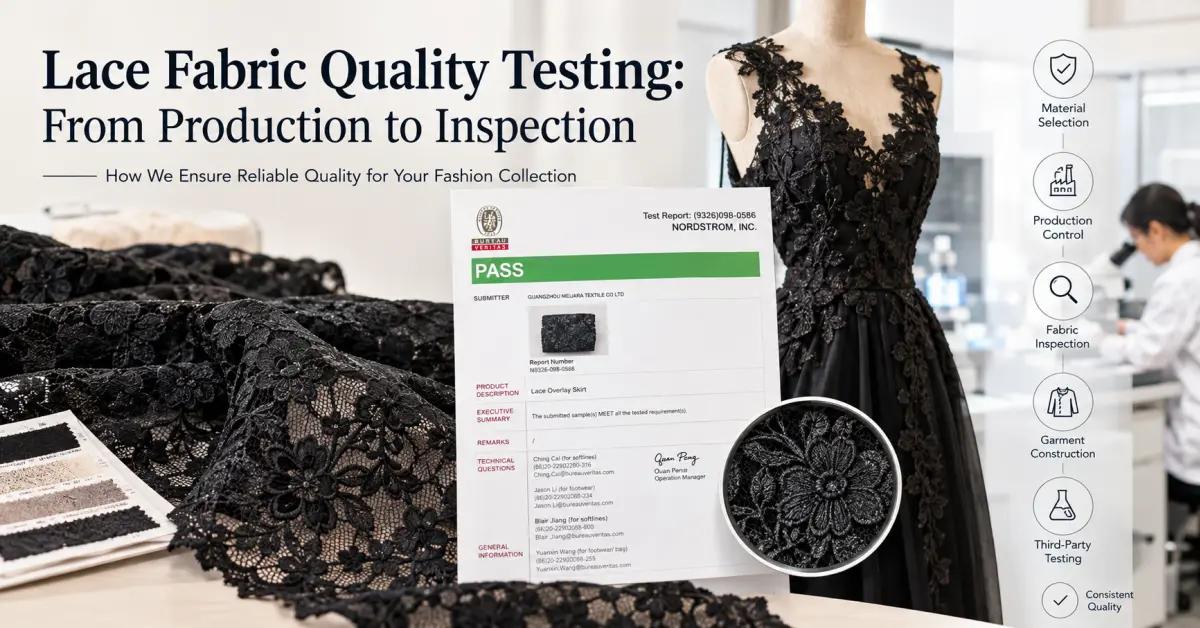
For fashion brands, lace is often evaluated first by appearance.
The pattern needs to be clear. The surface needs to feel right. The fabric needs to have the expected weight, handle and drape. Once developed into a garment, however, visual appearance is only one part of product quality.
A lace fabric can look excellent on a sample table and still create problems during cutting, sewing, finishing or garment testing.
This is particularly important for products such as lace overlay skirts, dresses, blouses and other garments where lace is used as a visible surface material.
For manufacturers and sourcing teams, quality therefore needs to be considered throughout the production process rather than only at the final inspection stage.
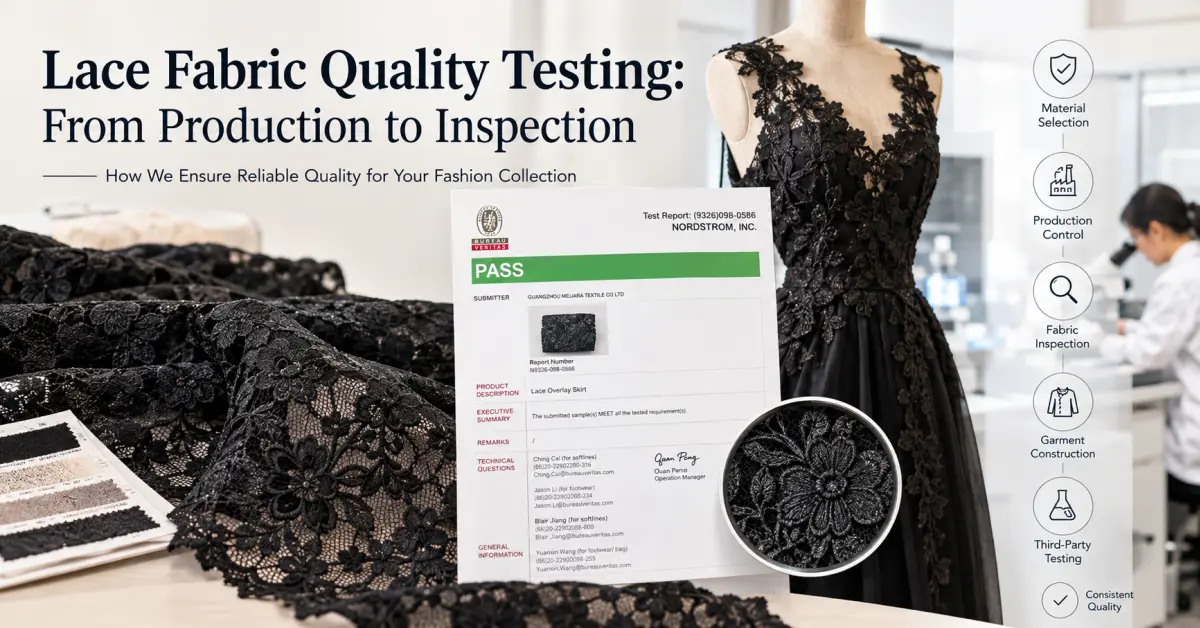
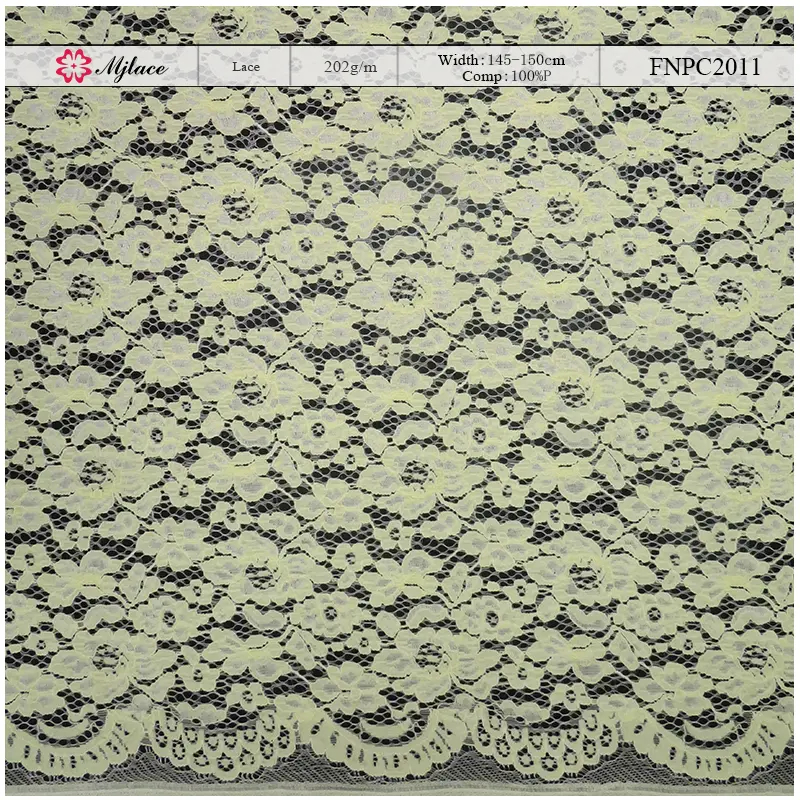
One example from Meijara Textile's production experience is FNPC2011, a lace article used for a lace overlay skirt. The product was submitted for third-party testing through Bureau Veritas Consumer Products Services in Guangzhou. The test report shown for the product records a PASS result for the submitted sample.
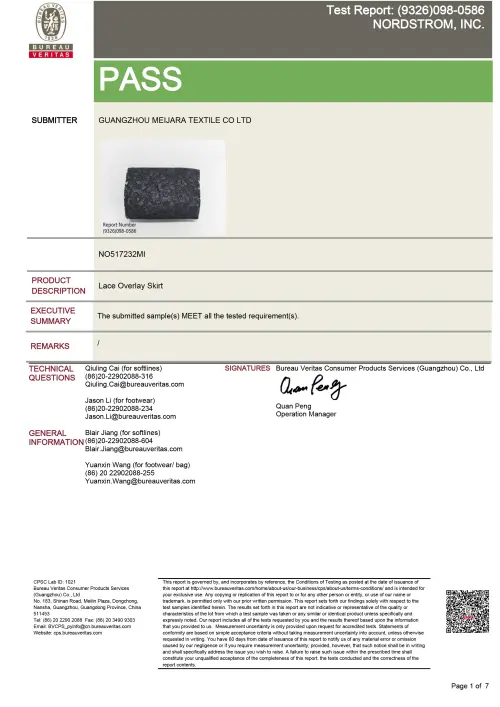
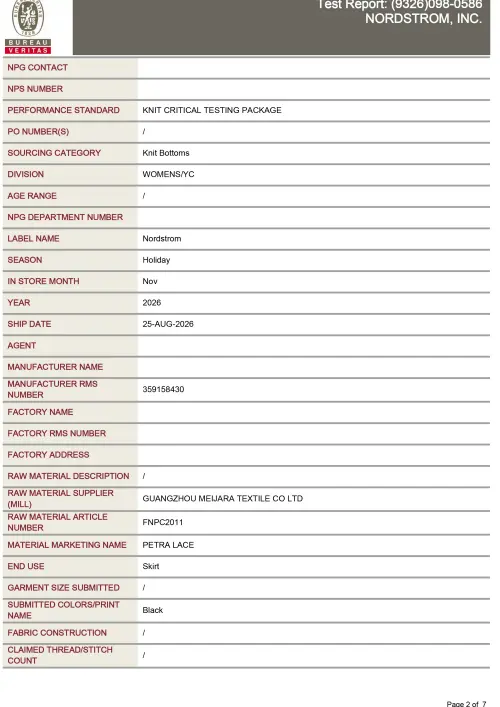
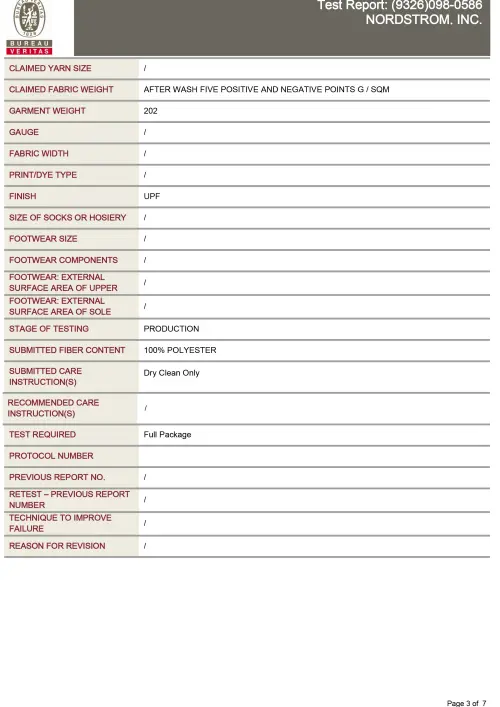
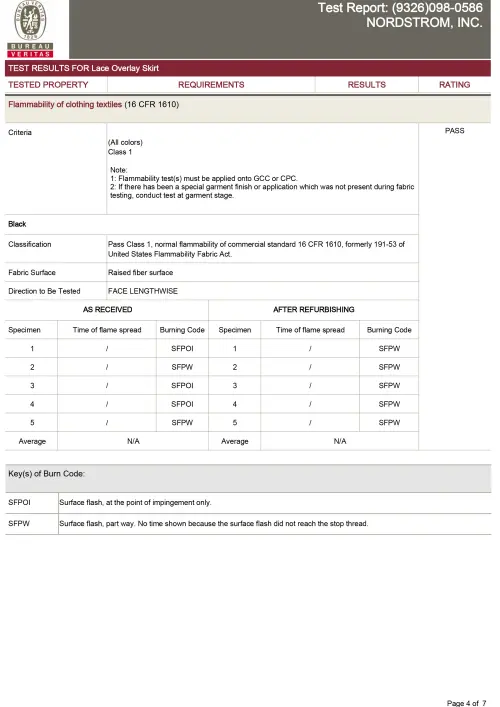
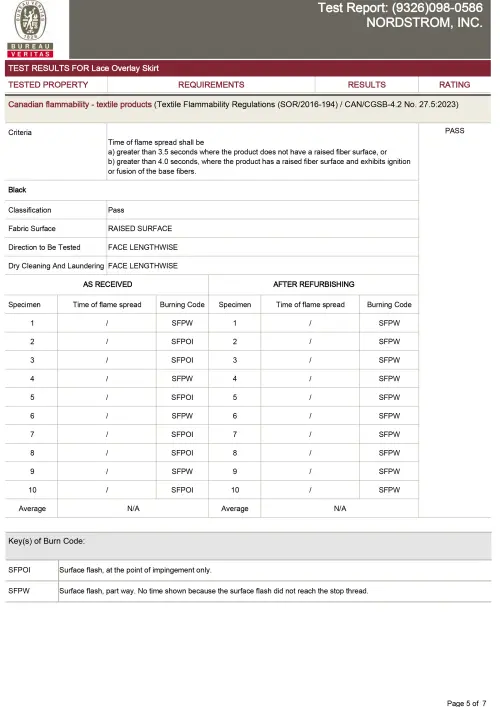
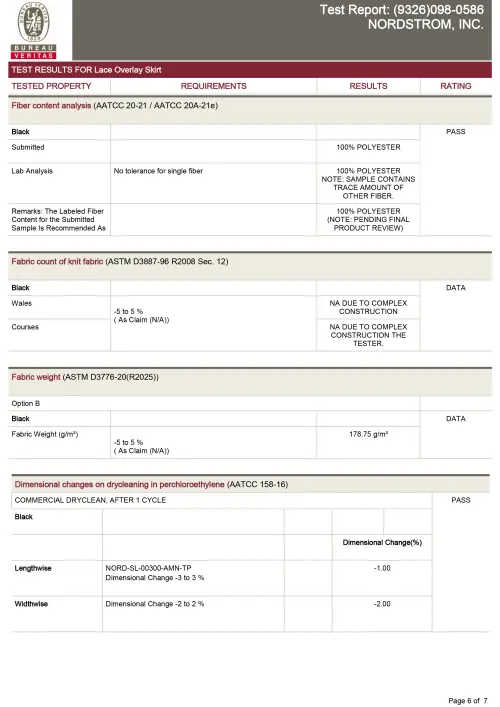
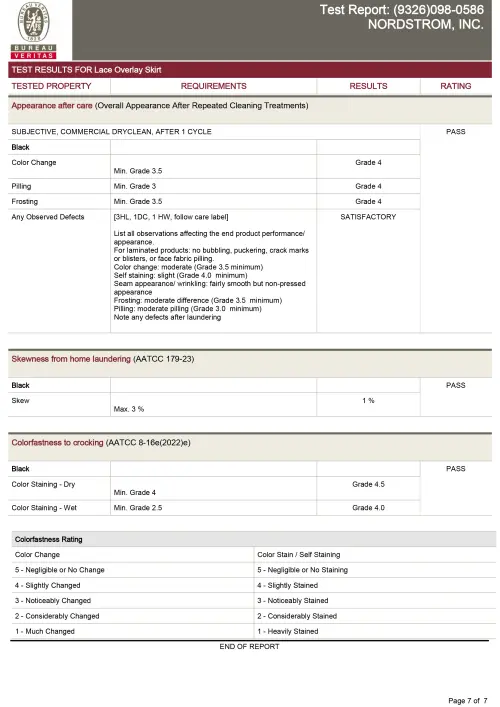
The significance of this type of report is not simply the word "PASS".
For a B2B buyer, the more useful question is:
How does a lace supplier control the product before it reaches an independent testing laboratory?
That question takes us from the finished report back into the factory—from material selection and pattern development to knitting, dyeing, finishing, cutting, garment production and final quality control.
To understand the broader context of lace fabric production and quality management, explore our comprehensive resources.
What the FNPC2011 Test Report Shows
The supplied report identifies several important details about the tested product.
| Report information | Recorded detail |
|---|---|
| Testing organization | Bureau Veritas Consumer Products Services |
| Report number | 9326098-0586 |
| Submitter | Guangzhou Meijara Textile Co., Ltd |
| Product description | Lace Overlay Skirt |
| Raw material supplier | Guangzhou Meijara Textile Co., Ltd |
| Raw material article | FNPC2011 |
| Material marketing name | PETTRA LACE |
| Submitted color | Black |
| End use | Skirt |
The report also identifies the performance standard as a Knit Critical Testing Package.
This information is useful for B2B customers because it connects the tested material with a defined product application rather than treating the lace as an unspecified textile sample.
In other words, the material is being considered in relation to an actual fashion product.
That distinction matters.
A lace fabric intended for a lightweight blouse does not necessarily face the same requirements as lace used as an overlay on a skirt. Likewise, lace intended for a fitted dress, jacket panel or decorative insert may require different development considerations.
The correct approach is therefore to evaluate the material according to its intended garment application.
For more on how lace is used across different product categories, read our guide on how lace fabric is used across different industries .
Why Lace Quality Needs to Be Controlled Before Testing
Third-party testing is an important part of quality assurance, but it should not be the starting point.
A professional lace factory needs to control the product much earlier.
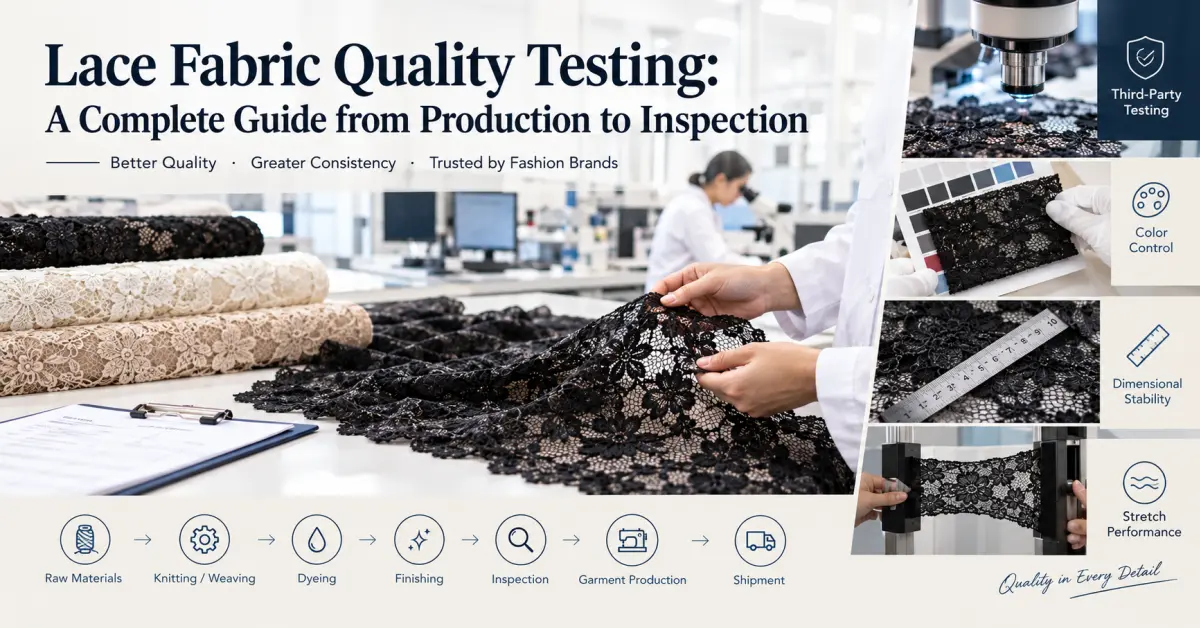
The production process can be viewed as a series of quality checkpoints:
Design → Material Development → Knitting → Dyeing → Finishing → Inspection → Cutting/Sewing → Garment Testing
Each stage can influence the final product.
For example, a pattern that looks correct on a digital design file may require adjustments once it is converted into an actual knitting structure.
A lace fabric can also change in appearance after dyeing or finishing.
When the material is later cut into garment panels, pattern alignment becomes another concern.
This is why experienced buyers should not evaluate a lace supplier only by asking whether the factory can produce a particular pattern.
The more important question is whether the supplier can maintain the required specifications from development through bulk production.
To understand the technical side, explore our lace manufacturing technology category.
Product Development Starts With the Garment Application
The first step is understanding how the lace will be used.
For a lace overlay skirt such as the FNPC2011 application, the supplier needs to understand more than the visual pattern.
Important development considerations may include:
-
garment silhouette
-
fabric width
-
lace repeat
-
fabric weight
-
stretch requirement
-
transparency
-
drape
-
surface texture
-
edge treatment
-
color
-
cutting direction
-
placement of the motif
-
sewing construction
A lace pattern that works well on a small blouse panel may not work equally well across a full skirt.
The scale of the motif is especially important.
A large floral pattern can create an attractive visual effect when used on the body of a garment, but if the repeat is too large or incorrectly positioned, the design can become unbalanced after cutting.
For this reason, Meijara's product development process needs to consider the relationship between lace structure and garment construction, rather than treating fabric development as an isolated step.
Lace Development Requirements for Different Garments
| Application | Important lace considerations |
|---|---|
| Women's dresses | Drape, width, pattern scale, transparency |
| Skirts | Repeat alignment, cutting direction, edge appearance |
| Blouses | Lightweight handle, comfort, transparency |
| Eveningwear | Surface effect, motif placement, decorative detail |
| Jackets | Structural stability, weight and abrasion considerations |
| Resort wear | Breathability, lightweight construction and visual texture |
| Luxury casualwear | Balance between decoration and commercial practicality |
This garment-specific approach becomes increasingly important when working with fashion brands that develop seasonal collections rather than standard commodity products.
For more on garment applications, visit our applications & industry use category.
Lace Structure Has a Direct Effect on Final Garment Quality
Lace is a constructed textile.
Its appearance comes from the relationship between yarns, ground structure and pattern.
For a manufacturer, this means that a small change in construction can influence the final fabric.
Depending on the product, development may involve different yarn compositions, machine settings, pattern structures and finishing treatments.
Meijara's lace production background includes machinery from Karl Mayer Textile Machinery and experience with different lace structures and applications.
The purpose of this capability is not simply to produce more patterns.
It allows the factory to adjust the fabric according to the requirements of the finished product.
For example, a fashion brand may request a lace with:
-
a more open ground
-
stronger floral motifs
-
a softer handle
-
greater elasticity
-
a specific width
-
a particular transparency
-
higher surface definition
-
a specific color
-
a combination of different decorative effects
These requirements need to be translated into an achievable production specification.
For more on lace types and their characteristics, read our lace types & categories guide.
Pattern Development Is a Technical Step
Pattern development is often underestimated when buyers evaluate lace suppliers.
For commercial production, the factory needs to consider how the pattern repeats across the fabric width and length.
A good pattern should not only look attractive in a sample.
It should also be practical to produce and cut.
Several factors need to be considered:
Pattern repeat
The repeat determines how the motif appears across the fabric.
If the repeat is too large, material utilization may become inefficient.
Motif density
A dense pattern can create a richer appearance, but may also increase production complexity and influence fabric handle.
Ground structure
The ground provides the structural base for the decorative motif.
Its openness affects transparency, softness and overall appearance.
Edge design
For lace used around garment hems or decorative panels, the edge can become part of the garment design.
Pattern direction
Some lace designs have a clear vertical direction.
This becomes particularly important when the fabric is used for skirts and dresses.
For a deeper dive into pattern development, explore our pattern design development guide.
Dyeing and Color Control
Color is another major quality checkpoint.
A lace pattern may be technically correct but still fail to meet a brand's requirements if the color is inconsistent.
The challenge becomes greater when a buyer requests a specific seasonal color rather than a standard white, black or nude.
For production, color development can involve:
-
Color reference confirmation
-
Lab dip or sample development
-
Comparison with approved standard
-
Dyeing
-
Drying and finishing
-
Color inspection
-
Bulk production monitoring
The FNPC2011 sample identified in the supplied report is black.
Black lace can appear relatively simple, but it can reveal production differences clearly. Variations in dyeing, yarn appearance or finishing can affect the depth and uniformity of the final surface.
For fashion brands, color consistency becomes particularly important when the same lace is used across multiple production lots.
For more on color management, visit our dyeing and color matching category.
Fabric Inspection Before Cutting
Fabric inspection should happen before the material enters garment production.
This is one of the most important points for a B2B supplier because defects discovered after cutting can result in considerably higher costs.
Once fabric has been cut into garment panels, replacing defective material is no longer as simple as removing a defective roll.
Typical inspection areas include:
| Inspection area | What the factory looks for |
|---|---|
| Width | Consistency with approved specification |
| Surface | Visible defects or irregularities |
| Pattern | Repeat and motif consistency |
| Color | Shade consistency |
| Structure | Broken or irregular areas |
| Edge | Correct shape and finish |
| Stretch | Consistency where applicable |
| Roll condition | Damage, deformation or contamination |
The actual inspection standard depends on the product and customer specification.
This is why experienced suppliers generally establish an approved reference sample before bulk production.
The approved sample becomes the physical reference for subsequent production.
For more on quality standards, explore our quality control standards category.
Why Cutting Is Important for Lace Garments
Once the lace has passed fabric inspection, the next challenge is cutting.
This stage becomes particularly important for lace overlay garments.
Lace is not always treated like a standard plain fabric.
The motif itself can influence how pattern pieces should be positioned.
For example, a skirt panel may need the floral pattern to appear consistently from one panel to another.
If the cutting direction changes unexpectedly, the final garment can lose visual balance.
For some designs, the edge of the lace may also need to be preserved.
This requires the cutting team to understand the relationship between:
fabric repeat + garment pattern + motif placement + sewing construction.
A production line that treats lace simply as another piece of fabric can easily create avoidable inconsistencies.
For more on cut-piece applications, explore our cut piece product range.
From Lace Fabric to Finished Garment
For FNPC2011, the product described in the supplied report is a lace overlay skirt.
This means the quality of the final product depends on more than the fabric itself.
The garment construction also matters.
A simplified production sequence can be understood as:
Lace development → Fabric production → Dyeing → Finishing → Fabric inspection → Pattern making → Cutting → Sewing → Finishing → Final inspection → Testing
Each step creates a new quality checkpoint.
For fashion brands, this is particularly relevant when lace is used as a visible outer layer.
The finished garment needs to maintain:
-
correct silhouette
-
consistent motif placement
-
clean seams
-
appropriate drape
-
stable construction
-
clean finishing
-
consistent color
-
acceptable appearance
The lace may be technically excellent as a fabric, but poor cutting or sewing can still reduce the quality of the finished garment.
For more on the broader production process, visit our processing page.
Quality Control Needs to Follow the Product Through Production
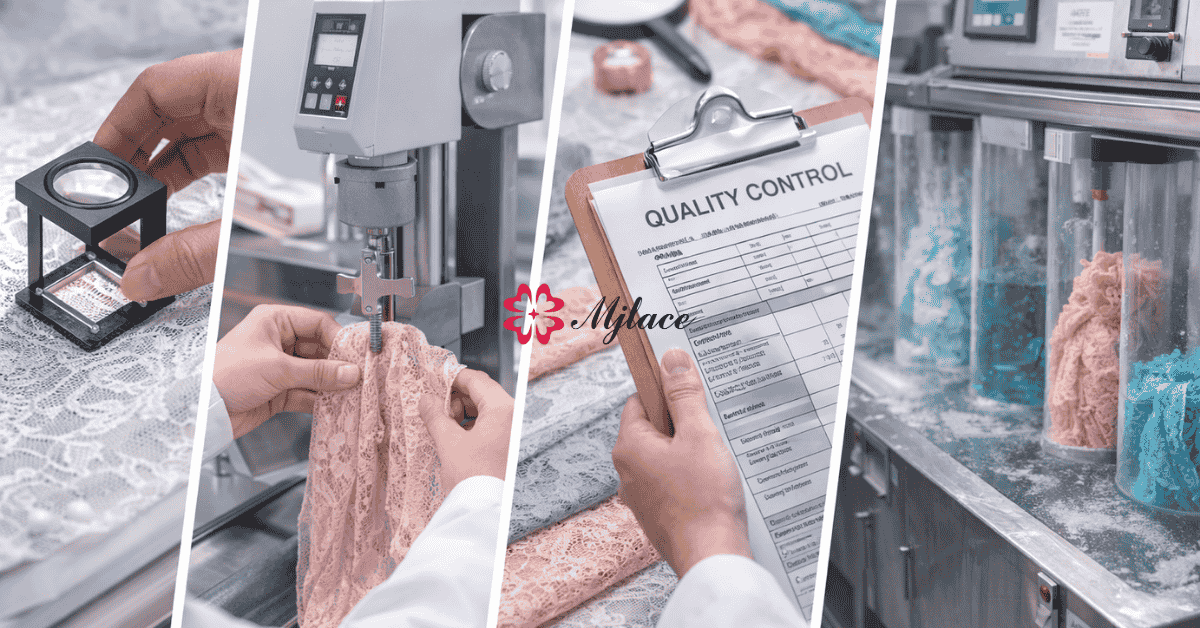
A practical factory quality system therefore needs multiple inspection points.
| Production stage | Main quality focus |
|---|---|
| Design development | Pattern feasibility |
| Sample development | Appearance and construction |
| Knitting | Structure and pattern |
| Dyeing | Color and shade |
| Finishing | Handle, width and appearance |
| Fabric inspection | Defects and consistency |
| Cutting | Pattern and motif placement |
| Sewing | Construction and workmanship |
| Final inspection | Overall garment quality |
| Third-party testing | Performance against applicable requirements |
This layered approach is more useful than relying entirely on final inspection.
The earlier a problem is identified, the easier it is to correct.
What Third-Party Testing Adds to Lace Production
Internal quality control is necessary, but independent testing provides another level of verification.
The FNPC2011 sample was submitted to Bureau Veritas Consumer Products Services (Guangzhou) .
Bureau Veritas is a third-party testing and inspection organization widely involved in consumer product testing.
For the submitted sample, the report records a PASS result.
This is valuable for a B2B customer because the evaluation is not simply based on the factory's own internal statement.
A third-party laboratory has been involved in the assessment of the submitted sample according to the applicable testing package.
However, it is important to understand what a test report does—and does not—prove.
A test report is associated with:
-
a specific sample
-
a specific product
-
a specific submission
-
a specific testing program
-
a specific period
It should not automatically be interpreted as saying that every lace product manufactured by a supplier has identical test results.
This distinction is important for professional sourcing.
Understanding the PASS Result
The most visible information on the supplied report is the large green PASS result.
For the submitted sample, the report states that the sample met the tested requirements.
The report identifies the product as a lace overlay skirt and links the material to article FNPC2011 / PETTRA LACE.
For buyers, the value of the report lies in the connection between:
Supplier → Material → Product → Intended Use → Testing → Result
This provides a clearer quality trail than a generic statement such as "our products are high quality."
A professional buyer can use this information as part of the supplier qualification process.
To learn more about our company's quality approach, visit our about us page.
What Buyers Should Look for in a Lace Testing Report
When reviewing a textile or garment testing report, procurement teams should pay attention to several basic pieces of information.
1. Supplier or submitter
The report should clearly identify who submitted the sample.
2. Product description
The product should correspond to the item being purchased.
3. Material article
The material reference is important when the buyer is sourcing a specific fabric.
In this case, the report identifies FNPC2011.
4. Color
Color should be recorded where relevant.
The submitted sample shown in the report is black.
5. Intended end use
The report identifies the end use as a skirt.
This helps put the test within the correct product context.
6. Testing standard
The report identifies the applicable performance standard as a Knit Critical Testing Package.
7. Final result
The report should clearly state the test conclusion.
For the submitted sample, the result is PASS.
Why Product Traceability Matters for Fashion Brands
Fashion brands often work with multiple suppliers, factories and production batches.
Without clear product references, it can become difficult to determine whether a sample, production order and test report actually refer to the same material.
This is why article numbers are important.
For example:
FNPC2011
is more useful operationally than simply calling a product "black lace."
An article reference can connect:
-
development samples
-
production specifications
-
color references
-
test samples
-
purchase orders
-
bulk production
-
inspection records
This creates a more structured communication process between the fashion brand and the factory.
From Sample Approval to Bulk Production
One of the biggest differences between sampling and commercial production is consistency.
A sample may be produced under carefully controlled conditions.
Bulk production must reproduce the same product repeatedly.
This is where factory experience becomes important.
A commercial lace supplier needs to manage variables such as:
-
yarn availability
-
machine settings
-
production tension
-
dyeing conditions
-
finishing parameters
-
fabric width
-
pattern repeat
-
production lot differences
The approved sample therefore becomes an important reference point.
Before bulk production, the factory and buyer should ideally confirm:
| Item | Recommended confirmation |
|---|---|
| Article number | Confirmed |
| Pattern | Approved |
| Color | Approved |
| Width | Confirmed |
| Material composition | Confirmed |
| Stretch requirement | Confirmed where applicable |
| Weight | Confirmed where applicable |
| Application | Confirmed |
| Sample | Physical reference retained |
This reduces ambiguity during production.
Quality Is Not Only About Laboratory Testing
A common mistake in textile sourcing is to treat laboratory testing as the entire quality-control system.
It is not.
Laboratory testing provides valuable evidence about the submitted sample and the specified test requirements.
But a fashion factory also needs production controls.
Consider a simple example.
A lace fabric may pass a specific laboratory test but still be unsuitable for a particular garment if:
-
the pattern is too large for the garment;
-
the fabric width creates excessive cutting waste;
-
the lace does not drape as required;
-
the motif cannot be aligned properly;
-
the color does not match the collection;
-
the garment construction is inappropriate.
This is why product development and quality control need to work together.
How Meijara Approaches Lace Production for Fashion Applications
Meijara Textile's production experience is centered on lace fabrics and related textile development for fashion applications.
The company works with different types of lace structures and customized developments, including stretch lace , jacquard lace , embroidered lace and other decorative textile products.
For B2B customers, this allows product development to begin from the actual application rather than from a fixed catalog alone.
A buyer may approach the factory with:
-
a reference garment
-
a sketch
-
a fabric sample
-
a pattern
-
a color reference
-
a mood board
-
a seasonal collection concept
The factory can then evaluate the technical requirements and determine how the lace should be developed.
This is particularly useful for brands that need custom fabrics rather than standard stock lace.
Explore Meijara Textile's customized lace development process .
The Role of Machinery in Lace Quality
Lace production depends heavily on machine capability.
Machine configuration influences:
-
pattern complexity
-
fabric structure
-
width
-
elasticity
-
repeat
-
production efficiency
-
surface appearance
Meijara's lace production background includes Karl Mayer textile machinery, with machine models used for different lace development and production requirements.
For a B2B customer, machinery itself is not necessarily the most important factor.
What matters more is whether the manufacturer can translate equipment capability into stable commercial production.
A sophisticated machine does not automatically guarantee a good fabric.
The production team still needs to control:
machine setting + yarn + pattern + tension + finishing + inspection.
For more on production equipment, visit our machinery and equipment category.
How Quality Control Supports Fashion Collection Development
For a fashion brand, quality control should ultimately support the collection.
This is especially important when the same lace concept appears across several styles.
For example, a brand may develop one floral lace and use it for:
-
a blouse
-
a skirt
-
a dress
-
a cropped jacket
-
a resort top
The lace needs to remain visually consistent while each garment may have different construction requirements.
This creates a need for both material consistency and application flexibility.
A supplier that understands fashion production can help identify these issues before bulk production.
For more on fashion trends, explore our fashion trends & design inspiration category.
Common Quality Risks When Buying Lace From a Factory
B2B buyers should consider several practical risks during supplier evaluation.
| Potential issue | Possible production impact |
|---|---|
| Pattern inconsistency | Uneven garment appearance |
| Color variation | Different shades between production lots |
| Width variation | Cutting problems |
| Poor edge control | Difficult garment finishing |
| Excessive fabric deformation | Pattern distortion |
| Incorrect motif placement | Poor visual balance |
| Inconsistent handle | Different garment feel |
| Weak production traceability | Difficult quality investigation |
| Lack of testing documentation | Greater buyer uncertainty |
The purpose of identifying these risks is not to make lace production appear complicated.
It is to show why supplier selection should be based on production capability rather than price alone.
For practical sourcing strategies, visit our buying guide & sourcing tips category.
Why Third-Party Reports Matter During Supplier Evaluation
A third-party report should not be viewed as a marketing certificate.
It is better understood as one piece of supplier evidence.
When combined with:
-
factory production capability
-
product specifications
-
sample approval
-
internal inspection
-
production records
-
final inspection
-
third-party testing
it contributes to a more complete quality-management process.
For a fashion brand sourcing lace internationally, this type of documentation can also improve communication between product development, sourcing and quality teams.
Instead of relying entirely on verbal descriptions, the teams can work from defined product references.
For more on sourcing from China, explore our importing logistics category.
A Practical Quality Workflow for Lace Buyers
When developing a new lace product, a practical workflow can look like this:
Step 1: Define the application
Specify whether the lace will be used for a dress, skirt, blouse, jacket, resortwear or another product.
Step 2: Confirm the design
Review the pattern, motif, scale, repeat and visual direction.
Step 3: Develop the sample
The factory develops the fabric according to the approved design requirements.
Step 4: Approve the physical sample
The buyer evaluates appearance, handle, color and application.
Step 5: Confirm production specifications
Article number, color, width, material and other requirements are documented.
Step 6: Start bulk production
The factory produces according to the approved reference.
Step 7: Conduct internal inspection
Fabric and finished products are inspected during production.
Step 8: Conduct applicable third-party testing
Where required by the customer or market, representative samples can be submitted for independent testing.
Step 9: Final inspection
The finished goods are checked before shipment.
Step 10: Maintain records
Product references and quality documents are retained for future orders.
This workflow is particularly useful for brands developing repeat seasonal programs.
What the FNPC2011 Example Tells B2B Buyers
The FNPC2011 report provides a useful example of how a lace product can be connected to an actual fashion application and independent testing.
The report does not simply describe an anonymous piece of fabric.
It identifies:
Guangzhou Meijara Textile Co., Ltd → FNPC2011 → PETTRA LACE → Black → Lace Overlay Skirt → Third-Party Testing → PASS
That traceability is important.
For a sourcing manager, it creates a clearer relationship between the material and the finished product.
For a designer, it provides additional confidence that the fabric is being developed for a defined application.
For a quality-control team, it provides a document that can be included in the supplier and product records.
And for the factory, it demonstrates that product development does not stop when a sample looks good.
For more on our product range, explore our lace and bridal lace collections.
Beyond One Test Report: Building Long-Term Quality
A single PASS report is useful, but long-term supplier reliability depends on repeatability.
Fashion brands rarely place only one order.
A successful supplier relationship may involve:
-
multiple seasons
-
multiple colors
-
multiple lace structures
-
different garment applications
-
repeat orders
-
new developments
The factory therefore needs to maintain consistency over time.
This requires a production system rather than a one-time effort.
For Meijara, lace manufacturing experience provides the foundation for this process.
The combination of lace development, production equipment, technical experience and quality control allows the factory to support customized requirements from initial development through commercial production.
How Fashion Brands Can Evaluate a Lace Supplier
Before placing a large order, buyers can use the following checklist.
| Supplier evaluation point | Questions to ask |
|---|---|
| Factory capability | Can the supplier produce the required lace structure? |
| Custom development | Can the factory develop patterns from references? |
| Material control | Can the supplier maintain consistent raw materials? |
| Color control | Can approved colors be reproduced in bulk? |
| Production capacity | Can the supplier support the expected order volume? |
| Quality control | Are there inspection procedures during production? |
| Traceability | Are articles and production records clearly identified? |
| Testing | Can the supplier support required third-party testing? |
| Garment application | Does the supplier understand how the lace will be used? |
| Communication | Can technical issues be resolved before bulk production? |
The last point is often overlooked.
For custom lace, communication between designer, sourcing team and factory can directly influence the final result.
For more on our manufacturing capabilities, visit our about us page or explore our customized process .
Lace Quality Should Be Evaluated at Product Level
The most reliable way to evaluate lace is to consider it as part of a product system.
The fabric itself has technical requirements.
The garment has construction requirements.
The brand has aesthetic and commercial requirements.
The testing laboratory has defined performance requirements.
A successful product needs these elements to work together.
This is especially relevant for decorative lace products because the visual design is often highly specific.
The fabric is not simply expected to "look good."
It needs to work within the actual garment.
For an overlay skirt, this may mean maintaining the desired motif placement and drape.
For a blouse, it may mean achieving the right combination of lightweight construction and appearance.
For an evening dress, it may mean controlling surface decoration without making the garment unnecessarily heavy.
For a jacket, structural stability may become more important.
The same principle applies across different fashion categories.
Frequently Asked Questions
Is lace fabric tested before bulk production?
Testing requirements depend on the customer, market and product application. For commercial fashion programs, suppliers may conduct internal inspections and, where required, submit samples for third-party testing before or during production.
What does PASS mean on a lace testing report?
PASS means that the submitted sample met the requirements covered by the applicable testing program. It should be understood in the context of the specific sample, product and test scope recorded in the report.
Who tested the FNPC2011 lace overlay skirt?
The supplied report identifies Bureau Veritas Consumer Products Services (Guangzhou) as the testing organization.
What is FNPC2011?
FNPC2011 is the raw material article reference identified in the supplied report. The report also identifies the material marketing name as PETTRA LACE.
What color was the tested sample?
The submitted color shown in the report is black.
Can one test report represent all lace products from a factory?
No. A test report applies to the specific submitted sample and testing scope. Different materials, constructions, colors or end uses may require separate evaluation.
Why is the garment application important when developing lace?
Because fabric requirements change according to how the lace is used. A skirt, blouse, dress and jacket can have different requirements for drape, weight, stretch, transparency, durability and motif placement.
What should a buyer check before ordering custom lace?
At minimum, buyers should confirm the design, material specification, color, width, pattern repeat, intended application, physical sample and applicable quality requirements before bulk production.
Can Meijara develop customized lace fabrics?
Yes. Meijara specializes in lace development and customized lace production for fashion applications, including different lace structures and decorative textile requirements.
Learn more about Meijara's customized lace process .
Why should fashion brands work directly with a lace manufacturer?
Direct factory communication can make it easier to discuss pattern development, material specifications, production feasibility, sampling, quality control and bulk-production requirements.
For more answers, visit our FAQs page.
Quality Starts in the Factory
The quality of a lace garment cannot be created at the testing laboratory alone.
It starts much earlier—with product development, yarn selection, machine settings, pattern construction, dyeing, finishing, fabric inspection and garment production.
Third-party testing then provides an additional level of verification based on the applicable testing requirements.
The FNPC2011 lace overlay skirt is a practical example.
The supplied Bureau Veritas report identifies the material article, product application, color and testing information, with the submitted sample receiving a PASS result.
For fashion brands, the more important takeaway is the production system behind the sample.
A reliable lace supplier should be able to connect design development, manufacturing, quality control and product testing into one continuous process.
That is particularly important when developing customized lace for seasonal collections, where appearance, consistency and production reliability all need to be controlled at the same time.
For buyers looking for a long-term lace manufacturing partner, the factory's ability to document and control this process can be just as important as the lace pattern itself.
To discuss your custom lace requirements, contact us or submit an inquiry .