

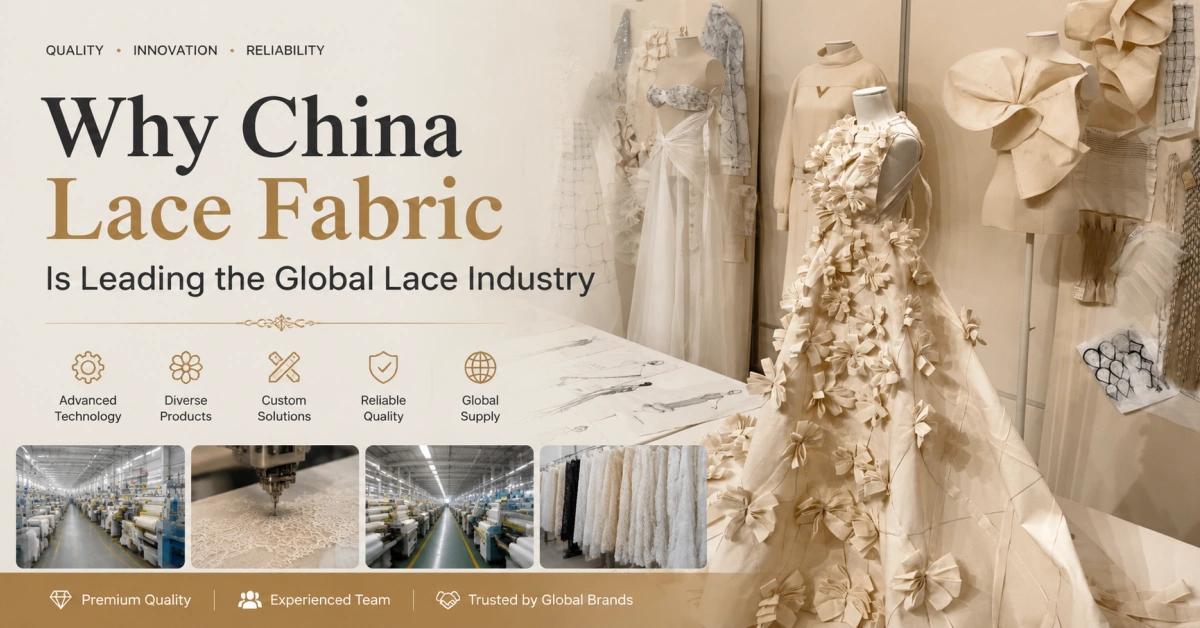
The Growing Global Influence of China Lace Fabric
Lace has always represented elegance, craftsmanship, and creativity in the fashion industry. From luxury bridal gowns and haute couture collections to lingerie, evening wear, accessories, and ready-to-wear fashion, lace fabric continues to play an important role in modern textile design.
However, behind the beautiful lace patterns seen on global runways and fashion collections, there is a highly developed manufacturing ecosystem supporting the industry.
Today, China lace fabric has become one of the most important sources for international fashion brands, garment manufacturers, wholesalers, and sourcing companies worldwide.
For many global buyers, sourcing lace fabric from China is no longer simply about competitive pricing. Instead, China has developed into a comprehensive lace manufacturing hub with advanced knitting technology, professional production capabilities, extensive customization options, and reliable supply chain management.
From stretch lace fabric and jacquard lace to embroidered lace, bridal lace, eyelash lace trim, and customized lace solutions, Chinese manufacturers are supplying materials for fashion markets across Europe, North America, the Middle East, and Asia.
So why is China lace fabric leading the global lace industry?
The answer lies in several key advantages:
-
Strong textile manufacturing foundation
-
Advanced lace production technology
-
Extensive product variety
-
Flexible customization capabilities
-
Competitive cost structure
-
Mature export experience
-
Ability to support global fashion brands
This article explores the reasons behind China's leadership in the lace fabric industry and explains what international buyers should know when sourcing lace fabric from China.
1. China Has Built One of the World's Largest Lace Manufacturing Ecosystems
The development of China's lace industry is closely connected with the country's long-established textile manufacturing infrastructure.
Over the past decades, China has developed complete textile supply chains covering:
-
Yarn production
-
Fiber development
-
Textile machinery
-
Knitting
-
Dyeing and finishing
-
Printing
-
Garment manufacturing
-
International logistics
Unlike some traditional lace-producing regions that focus mainly on craftsmanship or luxury applications, China combines traditional textile knowledge with modern industrial production.
This allows Chinese lace manufacturers to provide both:
-
High-volume commercial production
-
Customized premium lace development
For international buyers, this integrated supply chain creates significant advantages.
A fashion brand looking for a new lace collection does not only need fabric. They need a manufacturing partner who understands:
-
Design requirements
-
Fabric performance
-
Color development
-
Production consistency
-
Delivery schedules
China's textile ecosystem makes it possible to complete the entire process from concept development to finished lace fabric production within one supply chain.
The Importance of Textile Clusters in China
China's lace production is concentrated in several major textile regions.
Among them, Fujian Province is one of the most recognized areas for lace manufacturing.
Cities such as Changle have developed strong capabilities in:
-
Warp knitting lace
-
Stretch lace
-
Jacquard lace
-
Embroidery fabrics
These textile clusters provide manufacturers with:
-
Experienced technical workers
-
Specialized machinery
-
Supporting suppliers
-
Efficient logistics networks
For example, many professional lace manufacturers have decades of experience developing fabrics for:
-
European fashion brands
-
Bridal designers
-
Garment factories
-
International wholesalers
This industrial concentration is one of the reasons China has become a preferred sourcing destination for lace fabric buyers.
2. Advanced Lace Manufacturing Technology Drives China's Global Competitiveness
One of the biggest reasons behind the success of China lace fabric is continuous investment in textile technology.
Modern lace production requires much more than traditional weaving skills.
Manufacturers need advanced equipment capable of producing:
-
Complex floral patterns
-
Fine mesh structures
-
Stretch performance
-
Lightweight designs
-
Multi-layer effects
-
Embroidery details
Leading Chinese lace manufacturers use advanced warp knitting and embroidery machines from global textile equipment suppliers.
These technologies allow manufacturers to produce lace fabrics with:
-
Higher precision
-
Better consistency
-
More complex patterns
-
Improved durability
Warp Knitting Technology in Lace Production
Warp knitting is one of the most important technologies used in modern lace manufacturing.
Compared with traditional lace-making methods, warp knitting provides:
-
Faster production speed
-
Stable fabric structure
-
Better elasticity control
-
Large-scale manufacturing capability
This technology is widely used for producing:
-
Stretch lace fabric
-
Fashion lace
-
Lingerie lace
-
Decorative lace
For fashion brands, this means they can develop sophisticated lace designs while maintaining consistent quality across large production volumes.
Digital Design and Pattern Development
Another important development is the integration of digital design technology.
Today, lace manufacturers can transform creative concepts into production-ready patterns through:
-
CAD design systems
-
Digital pattern development
-
Computer-controlled embroidery
-
Customized jacquard programming. Learn about pattern design development.
This greatly improves the efficiency of custom lace development.
A designer can provide:
-
Sketches
-
Reference images
-
Brand patterns
-
Color concepts
Professional lace manufacturers can then develop samples based on these requirements.
This capability is especially valuable for fashion brands launching seasonal collections.
3. China Lace Fabric Offers One of the Widest Product Ranges Worldwide
Another major reason why China dominates the global lace market is product diversity.
International buyers often require different lace materials for different applications.
A single fashion collection may include:
-
Lightweight lace for dresses
-
Stretch lace for body-conscious garments
-
Embroidered lace for luxury products
-
Bridal lace for wedding gowns
-
Lace trims for accessories
Chinese suppliers are capable of providing almost every major lace category.
Stretch Lace Fabric
Stretch lace is one of the most popular lace categories in the global market.
It is widely used in:
-
Lingerie
-
Dresses
-
Active fashion
-
Bodywear
-
Evening wear
China lace fabric manufacturers produce stretch lace using materials such as:
-
Polyester
-
Nylon
-
Spandex blends
The addition of elastane provides:
-
Better flexibility
-
Comfortable wearing experience
-
Improved garment fitting
For brands producing large fashion collections, stretch lace from China provides a balance between aesthetics and functionality.
Embroidered Lace Fabric
Embroidered lace represents the combination of textile technology and artistic design.
It is commonly used in:
-
Bridal gowns
-
Luxury dresses
-
Couture collections
-
Premium fashion products
Chinese manufacturers have developed strong capabilities in:
-
Water soluble embroidery lace. See water-soluble embroidery.
-
Sequin embroidery lace. Explore sequins and beads embroidery.
-
Beaded lace. See crystal elegance bead sequin fabric.
-
Heavy embroidery lace. Explore cord embroidery.
These fabrics allow designers to create three-dimensional effects with:
-
Floral motifs
-
Botanical patterns
-
Geometric designs
-
Customized brand elements
Bridal Lace Fabric
The wedding industry has always been one of the largest consumers of lace.
Modern bridal designers require lace fabrics that combine:
-
Elegant appearance
-
Soft texture
-
Premium quality
-
Custom patterns
China has become a major supplier of bridal lace because manufacturers can provide:
-
Chantilly lace. Explore chantilly lace.
-
Floral lace
-
Applique lace
-
Beaded bridal lace
-
Heavy embroidered lace
Many international bridal brands source lace materials from China because suppliers can support both small design development and large-scale production.
5. The Advantages of Sourcing Lace Fabric from China
For international fashion brands, choosing the right lace fabric supplier is not only about finding competitive prices. A reliable supplier must provide consistent quality, advanced manufacturing capability, flexible customization options, and stable global supply chain support.
Over the past decades, China has developed one of the world's most complete textile manufacturing ecosystems. From yarn production and knitting technology to dyeing, embroidery, finishing, and logistics, lace manufacturers in China can provide integrated solutions for fashion brands, garment factories, and sourcing companies worldwide.
This complete industrial chain is one of the main reasons why China lace fabric has become an important sourcing choice for global buyers.
5.1 Complete Lace Manufacturing Supply Chain
One of the biggest advantages of China's lace industry is the complete production ecosystem.
Unlike some regions where lace production focuses only on specific processes, Chinese lace manufacturers can usually manage the entire development cycle:
-
Design concept development
-
Pattern creation
-
Lace knitting
-
Jacquard development
-
Embroidery processing
-
Dyeing and color matching. Learn about dyeing and color matching.
-
Special finishing
-
Quality inspection. Learn about quality control standards.
-
International shipment preparation
For fashion brands, this means shorter communication processes and better control over product development.
A designer can provide an inspiration image, sketch, or fabric sample, and an experienced China lace fabric manufacturer can help transform the idea into a finished textile product.
This capability is particularly important for:
-
Bridal gown brands
-
Evening wear designers
-
Luxury fashion labels
-
Women's apparel manufacturers
-
Textile wholesalers
5.2 Advanced Lace Production Technology
Modern lace manufacturing requires more than traditional craftsmanship.
Today's fashion market demands:
-
More detailed patterns
-
Higher elasticity
-
Better durability
-
More complex structures
-
Sustainable production methods
Chinese lace manufacturers have continuously invested in advanced machinery and production technology.
Many professional factories use high-speed warp knitting machines, jacquard lace machines, embroidery equipment, and digital design systems to improve production efficiency and product consistency.
Common lace manufacturing technologies include:
Warp Knitted Lace
Warp knitting technology is one of the most widely used methods for producing modern lace fabrics.
It allows manufacturers to create:
-
Stretch lace fabric
-
Lightweight lace
-
High elasticity lingerie lace
-
Fashion lace for garments
Stretch lace produced through advanced warp knitting technology provides excellent comfort and recovery, making it popular for:
-
Dresses
-
Tops
-
Intimate apparel
-
Bodywear
-
Fashion accessories
Jacquard Lace Technology
Jacquard lace is widely used in premium fashion collections because of its complex patterns and three-dimensional appearance.
Compared with basic lace designs, jacquard lace offers:
-
Rich visual effects
-
More artistic patterns
-
Better texture
-
Higher design value
Luxury fashion brands often select jacquard lace for:
-
Couture dresses
-
Bridal gowns
-
Premium evening wear
-
Designer collections
Embroidered Lace Production
Embroidery technology adds additional decorative value to lace fabrics.
Modern embroidered lace can include:
-
Floral embroidery
-
Sequin embroidery
-
Beaded embroidery
-
Heavy embroidery
-
Cord embroidery
These techniques allow brands to create exclusive fabrics with unique visual identities.
For example, a bridal designer may combine:
-
Soft tulle base
-
Floral embroidery
-
Pearl beads
-
Three-dimensional flowers
to develop a high-end wedding dress fabric.
5.3 Strong Customization Capability for Fashion Brands
Customization is becoming increasingly important in the global fashion industry.
Many brands no longer want standard fabrics available in the market. Instead, they need exclusive materials that match their own design language.
This is where China lace fabric suppliers have significant advantages.
Professional manufacturers can provide:
Custom Pattern Development
Brands can create unique lace patterns based on:
-
Hand drawings
-
CAD files
-
Existing fabric samples
-
Inspiration images
Experienced lace designers can adjust:
-
Pattern density
-
Floral arrangement
-
Border design
-
Repeat size
-
Texture effects
Custom Color Matching
Color accuracy is critical for fashion brands.
Professional China lace manufacturers usually provide:
-
Pantone color matching
-
Lab dip approval
-
Custom dyeing service
-
Seasonal color development
This allows brands to maintain consistent colors across different production batches.
Custom Finishing Options
Beyond basic lace production, manufacturers can provide various finishing processes:
-
Printing
-
Hot stamping
-
Flocking
-
Sanding
-
Coating
-
Sequins
-
Beads. Explore multi-color embroidery.
These processes help brands create differentiated products in competitive markets.
6. China Lace Fabric Applications Across Global Fashion Markets
The popularity of China lace fabric comes from its wide range of applications.
Today, lace is no longer limited to traditional wedding dresses or lingerie. It has become an important design material across multiple fashion categories.
6.1 Bridal Industry
The bridal industry remains one of the largest consumers of premium lace fabrics.
Wedding dress designers choose lace because it represents:
-
Elegance
-
Romance
-
Craftsmanship
-
Luxury
Popular bridal lace types include:
Chantilly Lace
Known for its delicate floral patterns and lightweight texture.
Applications:
-
Wedding veils
-
Sleeves
-
Overlays
-
Romantic bridal gowns
Embroidered Bridal Lace
Embroidered lace creates a more luxurious appearance.
Common designs include:
-
Floral embroidery
-
Botanical patterns
-
Beaded details
-
Three-dimensional flowers
Used in:
-
Luxury wedding dresses
-
Couture bridal collections
-
Custom wedding gowns
Guipure Lace
Guipure lace features bold patterns and strong structure.
It is suitable for:
-
Modern bridal styles
-
Fashion-forward wedding designs
-
Statement sleeves
6.2 Women's Fashion Industry
Beyond bridal applications, lace has become a key element in women's fashion.
Fashion brands use lace fabrics for:
-
Dresses
-
Blouses
-
Skirts
-
Jackets
-
Outerwear
-
Resort collections
Modern designers often combine lace with:
-
Silk
-
Satin
-
Chiffon
-
Mesh
to create layered textures.
6.3 Luxury and Designer Fashion
Luxury brands frequently use lace because it adds craftsmanship and emotional value.
In premium fashion collections, lace represents:
-
Handmade feeling
-
Artistic expression
-
Historical craftsmanship
Modern applications include:
-
Couture gowns
-
Red carpet dresses
-
Luxury accessories
Chinese lace manufacturers support these markets by providing customized solutions with complex designs.
6.4 Home Textile Applications
Although fashion remains the largest market, lace is also used in home decoration.
Applications include:
-
Curtains
-
Table decoration
-
Decorative fabrics
-
Interior accessories
Custom lace patterns can create unique aesthetic styles for premium home brands.
7. How to Evaluate a Reliable China Lace Fabric Manufacturer
Choosing the right supplier is one of the most important decisions for international buyers.
Not every lace supplier can provide the same level of quality, customization, and service.
Before cooperation, buyers should evaluate several key factors.
7.1 Manufacturing Experience
Experience matters in textile production.
A professional lace manufacturer should have:
-
Years of production experience
-
Skilled technical team
-
Stable production process
-
Knowledge of international markets
Experienced factories understand:
-
Different market requirements
-
Quality expectations
-
Export standards
-
Fashion trends
For example, suppliers serving European and American brands usually have stronger experience with:
-
Strict quality inspection
-
Color requirements
-
Delivery schedules
-
Compliance standards
7.2 Production Capacity
Production capability directly affects delivery reliability.
Before placing orders, buyers should confirm:
-
Factory size
-
Equipment quantity
-
Monthly production capacity
-
Sample development ability
For brands developing seasonal collections, suppliers must handle:
-
Small development orders
-
Repeated production
-
Large volume orders
7.3 Quality Control System
Quality consistency is critical for international fashion brands.
A professional lace manufacturer should have quality control procedures covering:
Raw Material Inspection
Checking:
-
Yarn quality
-
Elasticity
-
Color stability
Production Inspection
Monitoring:
-
Pattern accuracy
-
Fabric defects
-
Machine performance
Final Inspection
Checking:
-
Width
-
Length
-
Color difference
-
Surface quality
7.4 Export Experience
International trade experience helps avoid many supply chain problems.
An experienced exporter understands:
-
Export documentation
-
Packaging requirements
-
Shipping methods. Learn about importing logistics.
-
Customs procedures
This reduces risks for overseas buyers.
8. Why Meijara Textile Is a Trusted China Lace Fabric Manufacturer
With decades of experience in lace manufacturing, professional suppliers like Meijara Textile provide integrated lace solutions for global fashion brands.
A reliable lace partner should not only supply fabric but also support customers throughout product development.
Key capabilities include:
-
Custom lace development
-
Stretch lace production
-
Jacquard lace manufacturing
-
Embroidered lace solutions
-
Bridal lace customization
-
OEM textile services. Explore customized processes.
From initial design concept to final production, professional manufacturers help brands transform creative ideas into market-ready products.
9. China Lace Fabric Market Trends and Future Development Direction
The global fashion industry is experiencing significant changes. Consumer expectations are shifting from simple appearance-driven products toward materials that offer:
-
Unique design value
-
Better performance
-
Sustainable production
-
Customization possibilities
As a result, the China lace fabric industry is also evolving rapidly.
Chinese lace manufacturers are no longer focused only on large-scale production. Many suppliers are investing in:
-
Product innovation
-
Sustainable materials. Visit our sustainability section.
-
Digital development
-
High-end customization
-
International brand cooperation
These changes are helping China strengthen its position as one of the world's leading lace fabric manufacturing centers.
9.1 Increasing Demand for Custom Lace Fabric
One of the most important trends in the global lace market is customization.
Fashion brands are facing increasingly competitive markets. Standard fabrics available from multiple suppliers are no longer enough to create differentiation.
Brands now require:
-
Exclusive patterns
-
Customized colors
-
Special textures
-
Unique embroidery effects
This trend has created growing demand for custom lace fabric manufacturers.
Why Brands Prefer Custom Lace Development
Custom lace provides several advantages:
1. Stronger Brand Identity
A unique lace pattern can become part of a brand's signature style.
For example:
A bridal brand may develop exclusive floral lace used only in its wedding collections.
A luxury fashion label may create a special embroidered lace fabric for seasonal launches.
2. Higher Product Value
Unique materials allow brands to position products at a higher price level.
Compared with standard lace fabrics, customized lace creates:
-
Premium appearance
-
Emotional value
-
Design exclusivity
3. Better Market Differentiation
In today's fashion market, customers increasingly look for unique products.
Custom lace helps brands avoid direct price competition.
9.2 The Growth of Premium Lace Applications
Although lace has traditionally been associated with feminine fashion, its applications continue expanding.
In 2026 and beyond, premium lace will increasingly appear in:
-
Luxury ready-to-wear
-
Contemporary fashion
-
Designer collections
-
High-end accessories
-
Sustainable fashion lines
Designers are experimenting with lace in new ways.
Examples include:
-
Lace combined with structured fabrics
-
Transparent lace layering
-
Oversized lace patterns
-
Mixed material designs. Explore laser embroidery.
This creates more opportunities for manufacturers with strong development capabilities.
9.3 Lightweight and Functional Lace Fabrics
Modern consumers expect clothing to be both beautiful and comfortable.
Therefore, lace development is moving toward improved functionality.
Future lace fabrics will focus on:
-
Soft hand feeling
-
Lightweight construction
-
Better elasticity
-
Improved breathability
-
Comfortable wearing experience
This is particularly important for:
-
Bridal gowns
-
Women's dresses
-
Lingerie
-
Daily fashion products
For example, a wedding dress may require lace that looks luxurious but remains comfortable for many hours of wearing.
This creates new technical requirements for lace manufacturers.
10. Sustainability and Eco-Friendly Development of China Lace Fabric
Sustainability has become one of the most important topics in the textile industry.
International fashion brands are increasingly evaluating suppliers based on:
-
Material responsibility
-
Production processes
-
Environmental standards
-
Supply chain transparency
The lace industry is also adapting to these changes.
10.1 Recycled Lace Fabric Development
Recycled fibers are becoming more common in textile production.
For lace fabrics, recycled polyester is one of the most practical solutions.
Advantages include:
-
Reduced dependence on virgin materials
-
Similar fabric performance
-
Suitable for large-scale production
Applications:
-
Sustainable fashion collections
-
Eco-conscious bridal products
-
Responsible apparel brands
A professional China lace fabric supplier can provide recycled material options while maintaining:
-
Pattern quality
-
Color accuracy
-
Fabric durability
10.2 Sustainable Dyeing and Production
Color production is a critical stage in lace manufacturing.
Modern manufacturers are improving sustainability through:
-
Better dye management
-
Reduced production waste
-
More efficient energy usage
-
Improved process control
For international buyers, working with manufacturers that understand environmental requirements helps build stronger brand credibility.
10.3 Certifications and Compliance
Global fashion brands increasingly request textile certifications.
Common certifications include:
Global Recycled Standard (GRS)
Used for recycled materials.
Benefits:
-
Material traceability
-
Responsible production verification
OEKO-TEX Standard 100
Focuses on:
-
Chemical safety
-
Consumer protection
For brands entering international markets, certification support can become an important supplier selection factor.
11. How International Buyers Source China Lace Fabric Successfully
For overseas buyers, purchasing lace fabric from China involves more than selecting products.
A successful sourcing process requires:
-
Supplier evaluation
-
Sample confirmation
-
Production communication
-
Quality inspection
-
Logistics management
11.1 Define Product Requirements Before Contacting Suppliers
Before contacting a China lace fabric manufacturer, buyers should prepare clear information.
Important details include:
Fabric Type
Examples:
-
Stretch lace
-
Embroidered lace
-
Bridal lace
-
Jacquard lace
-
Lace trim
Material Requirements
Such as:
-
Nylon
-
Polyester
-
Spandex blend
-
Recycled fiber
Design Requirements
Including:
-
Pattern style
-
Color
-
Width
-
Weight
-
Application
Order Information
Including:
-
Estimated quantity
-
Target market
-
Delivery requirements
Clear requirements help suppliers provide accurate solutions.
11.2 Request Samples Before Bulk Orders
Sampling is an essential step in lace sourcing.
Professional buyers should evaluate:
Appearance
Check:
-
Pattern clarity
-
Design accuracy
-
Surface quality
Fabric Performance
Evaluate:
-
Stretch recovery
-
Softness
-
Durability
-
Sewing performance
Color
Confirm:
-
Color accuracy
-
Batch consistency
For customized lace projects, sample approval helps reduce production risks.
11.3 Understand MOQ and Production Lead Time
Different lace products have different production requirements.
Typical situations:
Standard Lace Products
May have lower MOQ because existing designs are already available.
Custom Lace Development
Usually requires higher MOQ because:
-
New patterns need development
-
Machines require adjustment
-
Production preparation takes time
For example:
Custom Lace Fabric
Typical:
-
MOQ: 3000–5000 meters
-
Sampling: around 20–25 days
-
Bulk production: around 35–40 days
Embroidery Lace
Typical:
-
MOQ: 300–500 meters per color
-
Sampling: around 8–10 days
-
Production: around 18–20 days
11.4 Choose a Long-Term Lace Supplier Partner
For fashion brands, a supplier should not only provide fabric.
A strong manufacturing partner should support:
-
Product development
-
Market trend suggestions
-
Quality improvement
-
Production planning
Long-term cooperation helps brands achieve:
-
Stable quality
-
Faster development
-
Better communication
-
Lower sourcing risks. Explore cut piece and processing.
12. Why Choose China Lace Fabric Instead of Other Sources?
The global lace market includes suppliers from different regions.
However, China has developed unique advantages.
12.1 Competitive Manufacturing Capability
China combines:
-
Advanced technology
-
Experienced workforce
-
Complete supply chain
This allows manufacturers to provide competitive solutions for global buyers.
12.2 Wide Product Selection
Buyers can source:
-
Fashion lace
-
Bridal lace
-
Stretch lace
-
Embroidery lace
-
Decorative trims
from one manufacturing region.
12.3 Strong Customization Ability
Chinese suppliers are experienced in OEM projects.
They can support:
-
Small design adjustments
-
New pattern development
-
Large production orders
13. Future Outlook: China Lace Fabric Will Continue Leading the Global Market
The future of the lace industry will be shaped by:
Innovation
New technologies will create more advanced lace structures.
Sustainability
Eco-friendly materials and responsible production will become industry standards.
Customization
Brands will increasingly seek unique textile solutions.
Global Cooperation
Chinese lace manufacturers will continue working with international brands to develop innovative products.
For fashion companies looking for reliable textile partners, China will remain one of the most important sourcing destinations for lace fabric.
FAQ: China Lace Fabric Industry
1. Why is China lace fabric popular worldwide?
China lace fabric is popular because of its combination of advanced manufacturing technology, product variety, customization capability, and competitive supply chain.
2. What types of lace fabric are made in China?
China manufacturers produce:
-
Stretch lace fabric
-
Embroidered lace
-
Bridal lace
-
Jacquard lace
-
Eyelash lace trim
-
Chemical lace
-
Decorative lace
3. Is China lace fabric suitable for luxury fashion brands?
Yes. Many luxury and premium fashion brands use customized China lace fabric because manufacturers can develop exclusive patterns and high-quality designs.
4. How can I find a reliable China lace fabric manufacturer?
Buyers should evaluate:
-
Factory experience
-
Product quality
-
Customization ability
-
Production capacity
-
Export experience
5. Can Chinese lace manufacturers make custom designs?
Yes. Professional suppliers can develop custom lace based on:
-
Drawings
-
Samples
-
Digital designs
-
Brand requirements
6. What is the MOQ for China lace fabric?
MOQ depends on the product.
Generally:
-
Standard lace may require lower quantities.
-
Custom lace development usually requires 3000–5000 meters.
-
Embroidery lace may require 300–500 meters per color.
7. How long does China lace fabric production take?
Production time depends on product complexity.
Typical timelines:
-
Custom lace sampling: 20–25 days
-
Lace bulk production: 35–40 days
-
Embroidery lace production: 18–20 days
8. What industries use China lace fabric?
Main applications include:
-
Bridal fashion
-
Women's clothing
-
Evening dresses
-
Lingerie
-
Luxury fashion
-
Accessories
9. Is sustainable lace fabric available from China suppliers?
Yes. Many manufacturers now offer:
-
Recycled lace options
-
Eco-friendly materials
-
Certified textile solutions
10. Why should fashion brands work directly with China lace manufacturers?
Direct cooperation provides:
-
Better customization
-
More competitive pricing
-
Faster communication
-
Stronger product development support
Conclusion
China lace fabric has become a global industry leader because it combines manufacturing expertise, advanced technology, product diversity, and customization capabilities.
For international fashion brands, sourcing lace fabric from China is no longer only a cost-driven decision. It is a strategic choice that provides access to innovation, flexibility, and reliable textile solutions.
As fashion continues moving toward personalization, sustainability, and premium design, Chinese lace manufacturers will continue playing an important role in shaping the future of the global lace industry.
For brands seeking a professional lace partner, choosing an experienced China lace fabric manufacturer can help transform creative ideas into successful fashion collections.
Ready to source China lace fabric for your brand? Visit our homepage to explore our collections or contact us for inquiries. You may also submit an inquiry for custom pricing.