

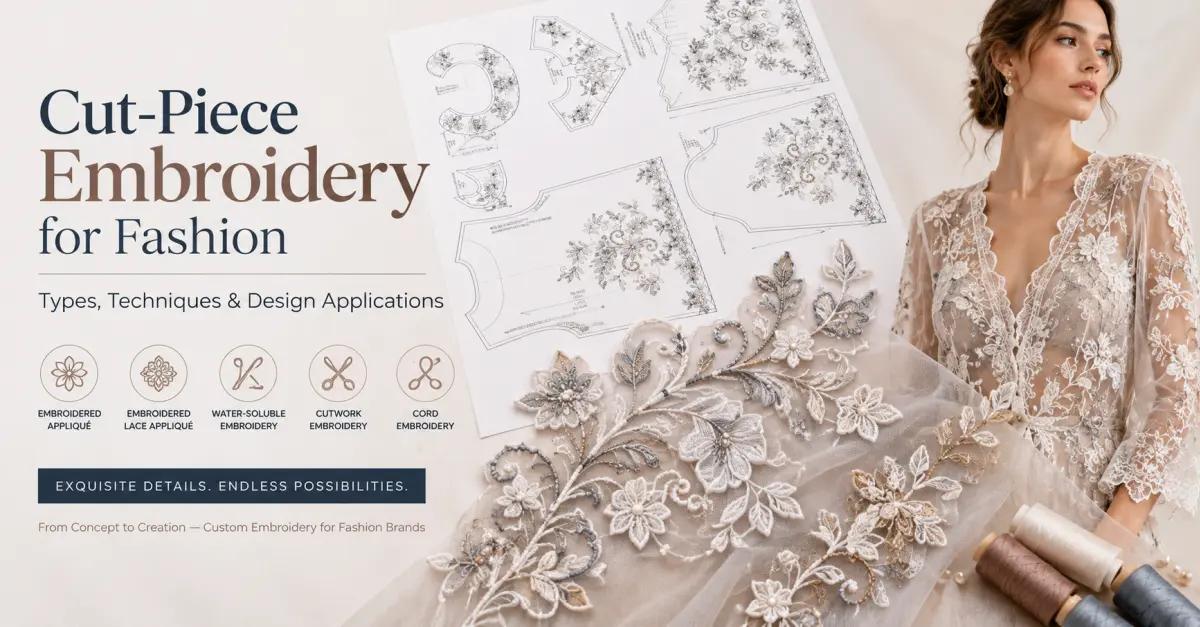
Why Cut-Piece Embroidery Is Becoming More Important in Fashion
Fashion designers are constantly looking for ways to make garments more distinctive without necessarily increasing the complexity of the entire garment.
One increasingly practical solution is cut-piece embroidery.
Instead of producing embroidery across an entire roll of fabric, manufacturers can create individual embroidered sections, motifs, borders, appliqués, or garment-shaped panels that are later positioned and assembled onto the finished garment.
This approach gives designers much more control over where embroidery appears.
A floral embroidered piece can be placed across a shoulder. A large botanical motif can be applied to the front of a dress. A decorative embroidered panel can be inserted into a skirt or jacket. Small embroidered appliqués can also be positioned individually to create a more controlled visual effect.
For fashion brands, this means embroidery is no longer limited to an all-over fabric surface.
It becomes a design component.
From the factory perspective, however, producing cut-piece embroidery is considerably more technical than simply embroidering a pattern onto fabric and cutting it afterward. The embroidery design, base material, stitch density, cutting method, edge treatment, dimensional stability and garment construction all have to work together.
This is particularly important for fashion brands developing custom collections.
A visually attractive embroidery design may not perform well during cutting or sewing. A highly detailed motif may become too stiff. An incorrectly engineered edge may fray during garment production. A beautiful sample may also be difficult to reproduce consistently at bulk quantities.
That is why the relationship between fashion design and embroidery manufacturing matters.
For manufacturers such as MJlace , cut-piece and panel-based embroidery can also connect embroidery production with garment pattern engineering, allowing brands to develop decorative components specifically for their collections. MJlace's product range includes
What Is Cut-Piece Embroidery?
Cut-piece embroidery refers to embroidered textile components that are produced and then separated into individual pieces, motifs, panels, borders or specific shapes for garment application.
The finished piece may be:
-
A floral motif
-
A geometric appliqué
-
A decorative collar piece
-
A sleeve panel
-
A bodice panel
-
A skirt insert
-
A garment-shaped embroidery panel
-
A lace appliqué
-
A border or hem section
-
A free-standing embroidered motif
The important distinction is that the embroidery is treated as an individual component rather than simply part of continuous fabric yardage.
A simplified production concept is:
Design → Digitizing → Base Preparation → Embroidery → Cutting → Edge Finishing → Inspection → Garment Application
This production method provides designers with much greater freedom in placement.
For example, a brand may not want a floral embroidery pattern across an entire dress. Instead, the designer may want three large motifs concentrated around the waist and lower skirt.
With cut-piece embroidery, the manufacturer can develop individual motifs according to the garment's design requirements.
This can reduce unnecessary embroidery coverage while creating stronger visual focus.
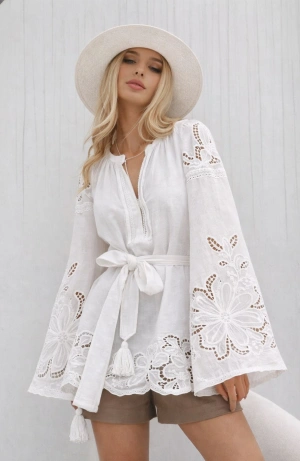
Cut-Piece Embroidery vs. Embroidered Fabric
These two products are closely related but should not be treated as the same thing.
| Feature | Embroidered Fabric | Cut-Piece Embroidery |
|---|---|---|
| Production format | Continuous fabric | Individual pieces |
| Pattern placement | Repeating/all-over | Specific placement |
| Design control | Medium to high | Very high |
| Fabric waste | Depends on garment cutting | Can be optimized by motif |
| Garment application | Cut and sew | Apply, insert or sew |
| Suitable for | Dresses, blouses, skirts | Strategic garment details |
| Customization | Pattern-focused | Shape and placement-focused |
| Typical production | Roll/yardage | Panels, motifs or pieces |
Continuous embroidery is often the better solution when a designer wants an entire garment to share the same surface pattern.
Cut-piece embroidery becomes more attractive when the design depends on specific placement.
For fashion brands, choosing between the two should therefore begin with the garment construction rather than the embroidery pattern alone.
Main Types of Cut-Piece Embroidery for Fashion
Cut-piece embroidery is not one single technique.
Different products can be developed depending on the base fabric, embroidery structure, cutting method and intended application.
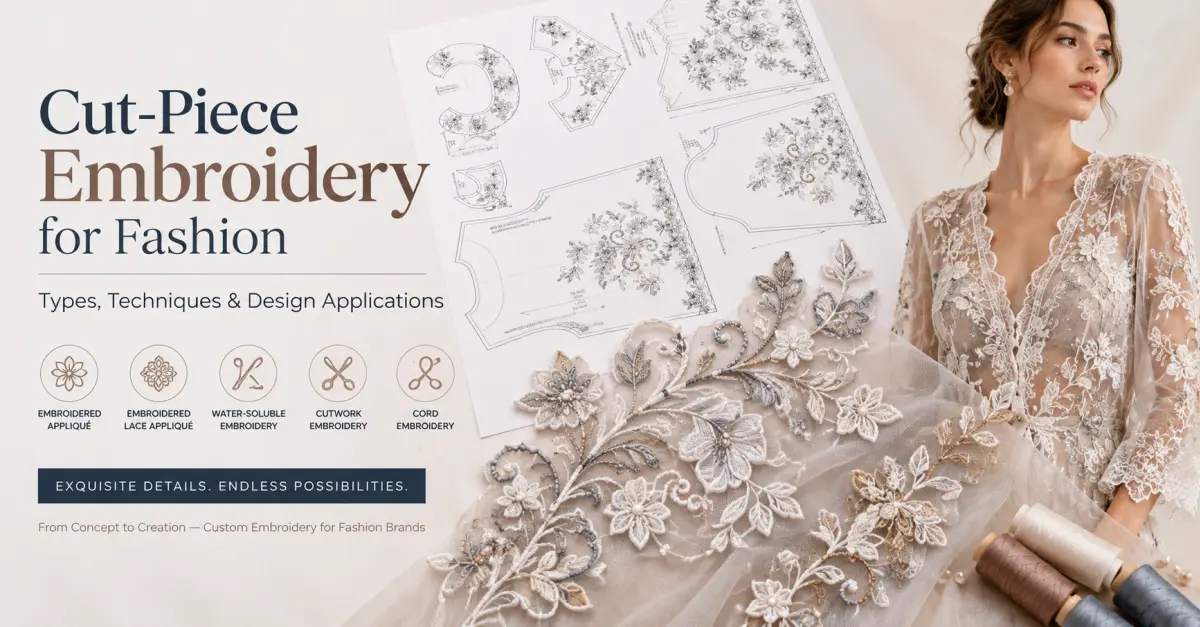
Embroidered Appliqué
Embroidered appliqué is one of the most recognizable forms of cut-piece embroidery.
A decorative embroidery is created on a base material and then cut into an individual motif.
Common motifs include:
-
Flowers
-
Leaves
-
Vines
-
Geometric shapes
-
Abstract patterns
-
Butterflies
-
Birds
-
Decorative borders
The finished appliqué can then be sewn or otherwise attached to a garment.
For fashion brands, appliqués are particularly useful because the same motif can be positioned differently across multiple garment styles.
A single floral appliqué, for example, could be used on:
-
A blouse shoulder
-
A dress neckline
-
A skirt hem
-
A jacket pocket
-
A sleeve cuff
This gives designers more flexibility during collection development.
Embroidered Lace Appliqué
Embroidered lace appliqué combines embroidery with an open lace or mesh structure.
Compared with conventional embroidered fabric, the design can appear lighter and more integrated into the garment.
This makes it suitable for:
-
Evening dresses
-
Blouses
-
Luxury casualwear
-
Resort collections
-
Fashion skirts
-
Decorative sleeves
-
Statement garments
Lace appliqué can also be produced as individual floral motifs or larger placement panels.
MJlace's broader embroidery production includes custom embroidery and panel-based applications designed around garment requirements. Its existing lace guide also identifies motif embroidery and panel embroidery as important categories for contemporary fashion production.
Water-Soluble Embroidered Pieces
Water-soluble embroidery uses a temporary soluble base that is removed after embroidery.
The result can be a freestanding embroidered structure without a conventional permanent ground fabric.
This technique is particularly useful when the designer wants:
-
Lightweight decoration
-
Transparent effects
-
Floating motifs
-
Dimensional floral elements
-
Decorative appliqués
-
High-end surface effects
The process requires careful control of stitch density because the embroidery structure must maintain its shape after the soluble base is removed.
Water-soluble embroidery is already widely used for freestanding lace structures and appliqué development.
For fashion designers, the major advantage is visual integration.
The embroidered motif can appear almost as though it has grown directly onto the garment.
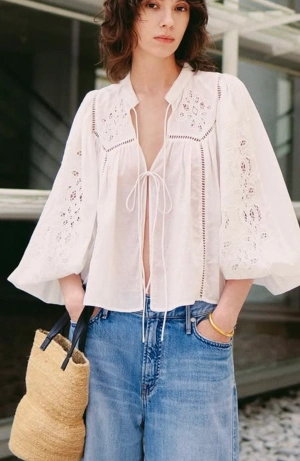
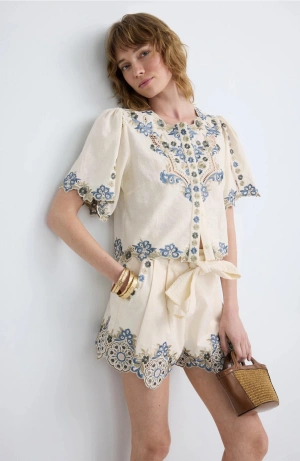
Cutwork Embroidery
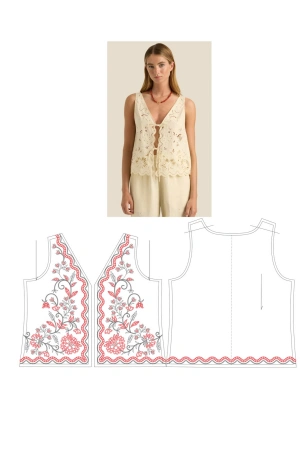
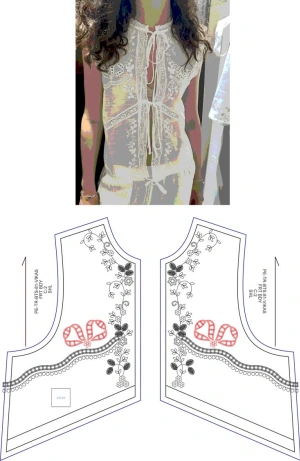
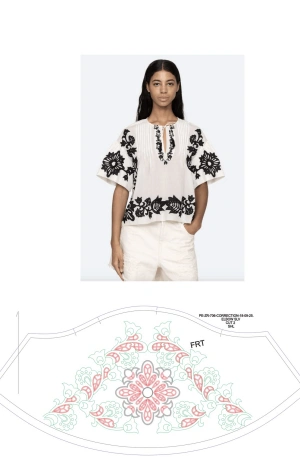
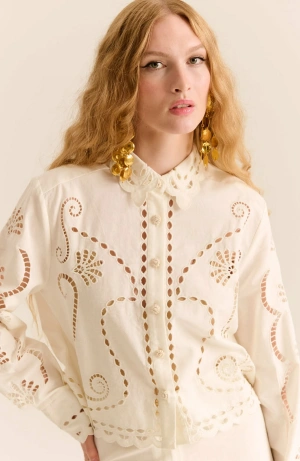
Cutwork embroidery combines embroidery with controlled removal of sections of the base material.
The embroidery reinforces the areas around the cut sections, creating decorative openwork.
This technique can be used on:
-
Cotton
-
Linen
-
Denim
-
Woven fabrics
-
Fashion panels
-
Lightweight apparel fabrics
Cutwork can create a more graphic appearance than conventional embroidery.
It is especially effective when the designer wants a combination of solid embroidered areas and transparent openings.
MJlace has also explored panel-based cutwork applications in denim , where embroidered structures and fabric cut-outs are integrated into garment construction.
Cord Embroidery
Cord embroidery introduces cord or thicker decorative elements into the embroidery structure.
This creates:
-
Raised outlines
-
Stronger motif definition
-
Three-dimensional texture
-
More pronounced decorative effects
Cord embroidery is particularly useful for fashion brands looking for embroidery with a stronger tactile presence.
However, additional thickness also affects garment handling.
A heavy cord design may not be suitable for a soft, flowing chiffon garment but may work extremely well on:
-
Structured jackets
-
Evening dresses
-
Statement skirts
-
Luxury outerwear
-
Decorative bodices
The manufacturer's role is therefore not simply to reproduce the artwork but to evaluate whether the embroidery construction matches the intended garment.
How Cut-Piece Embroidery Is Made in a Factory
The quality of a finished embroidered piece depends heavily on what happens before the embroidery machine starts.
A professional factory typically treats the project as a combination of design engineering and textile production.
Step 1: Reviewing the Design
The first stage is reviewing the artwork.
The factory needs to understand:
-
Finished size
-
Motif shape
-
Number of colors
-
Stitch direction
-
Embroidery density
-
Base material
-
Edge requirements
-
Final garment position
A designer may submit an illustration that looks excellent visually but is not immediately suitable for machine embroidery.
The manufacturer must translate the visual concept into a technically workable embroidery structure.
Step 2: Embroidery Digitizing
The artwork is converted into an embroidery program.
This is one of the most important technical stages.
Digitizing determines:
-
Stitch type
-
Stitch direction
-
Stitch density
-
Underlay
-
Thread sequence
-
Color sequence
-
Border construction
-
Layering
-
Running stitch
-
Satin stitch
-
Fill stitch
Poor digitizing can result in:
-
Thread buildup
-
Uneven surfaces
-
Fabric distortion
-
Gaps between motifs
-
Weak edges
-
Excessive stiffness
Good digitizing balances appearance and production stability.
This is one reason experienced embroidery manufacturers can often produce better results than suppliers who simply outsource the embroidery process.
Step 3: Selecting the Base Material
The base material affects the final appearance and performance of the embroidered piece.
Common options include:
| Base Material | Typical Characteristics | Fashion Applications |
|---|---|---|
| Tulle | Lightweight, sheer | Dresses, overlays |
| Mesh | Flexible and breathable | Blouses, dresses |
| Organza | Crisp and structured | Statement garments |
| Cotton | Natural hand feel | Resort, casualwear |
| Satin | Smooth and luxurious | Eveningwear |
| Lace | Decorative and textured | Dresses, blouses |
| Denim | Durable and structured | Jackets, jeans |
| Leather | Firm and premium | Accessories, outerwear |
The same embroidery design can look completely different depending on the base fabric.
A fine floral design on soft tulle will produce a very different effect from the same design on organza.
Therefore, material selection should happen during development rather than after the embroidery design has already been finalized.
Step 4: Machine Embroidery
Once the design has been digitized and the base prepared, production moves to embroidery.
Modern computerized embroidery machines allow manufacturers to control:
-
Stitch placement
-
Thread sequence
-
Pattern repetition
-
Color changes
-
Stitch density
-
Production positioning
At industrial scale, machinery becomes especially important because production consistency depends on repeatability.
For buyers, the question is not simply whether a supplier owns embroidery machines.
It is whether the supplier can maintain the same embroidery quality across:
Sample → Pilot Production → Bulk Production → Repeat Orders
MJlace highlights its industrial machinery and embroidery production capabilities as part of the manufacturing system behind its lace and embroidery products.
Step 5: Cutting the Embroidered Pieces
After embroidery, the material can be cut into individual pieces.
This is where cut-piece embroidery differs significantly from ordinary embroidered fabric production.
The cutting process needs to preserve the embroidery design while maintaining the intended motif shape.
Depending on the product, cutting may involve:
-
Manual cutting
-
Die cutting
-
Precision cutting
-
Laser cutting
-
Embroidery-supported edge cutting
The appropriate method depends on:
-
Fabric structure
-
Motif complexity
-
Production quantity
-
Edge design
-
Required accuracy
For high-volume production, repeatability becomes particularly important.
A variation of only a few millimeters may become noticeable when hundreds or thousands of identical appliqués are assembled into garments.
Step 6: Edge Finishing
The edge is one of the most important features of a cut-piece embroidered product.
Different edge treatments create different visual and functional results.
Clean Cut Edge
Suitable for designs where the motif will be sewn directly onto the garment.
Embroidered Edge
An additional satin or dense stitch structure can reinforce the perimeter.
Scalloped Edge
Useful for decorative floral or lace-inspired motifs.
Free-Form Edge
The edge follows the natural shape of the embroidery.
Laser-Finished Edge
Laser cutting can provide precise contours on compatible materials.
The correct edge treatment depends on how the piece will eventually be attached to the garment.
Step 7: Quality Inspection
A professional factory should inspect cut pieces before packing.
Typical inspection points include:
-
Missing stitches
-
Broken threads
-
Uneven density
-
Incorrect colors
-
Distorted motifs
-
Cutting errors
-
Loose edges
-
Stains
-
Fabric damage
-
Size inconsistency
For B2B fashion production, inspection is particularly important because cut-piece embroidery is often applied manually or semi-manually during garment production.
A small defect repeated across hundreds of pieces can become a significant production problem.
How Designers Should Develop Cut-Piece Embroidery
The best results usually come from involving the embroidery manufacturer early.
A designer does not necessarily need to provide a fully finished embroidery file.
A factory can often work from:
-
Sketches
-
CAD artwork
-
Reference images
-
Existing embroidery samples
-
Lace samples
-
Color cards
-
Garment patterns
-
Technical drawings
The more precise the development information, however, the easier it becomes to control the final product.
Recommended Design Specification
| Item | Information to Provide |
|---|---|
| Artwork | AI, PDF, CAD or high-resolution image |
| Finished Size | Length × width |
| Base Fabric | Tulle, mesh, organza, etc. |
| Thread Color | Pantone or physical reference |
| Thread Type | Polyester, rayon, cotton, metallic |
| Embroidery Density | Light, medium or heavy |
| Motif Position | Front, back, sleeve, hem, etc. |
| Edge | Clean, scalloped, embroidered |
| Quantity | Sampling and bulk requirement |
| Garment Type | Dress, blouse, skirt, jacket |
This information gives the factory a practical starting point for development.
For more detailed guidance on the creative side, explore our fashion trends & design inspiration category.
Cut-Piece Embroidery Applications in Modern Fashion
One of the biggest advantages of cut-piece embroidery is its versatility.
It can be used across multiple fashion categories rather than being restricted to bridalwear.
Women's Dresses
Dresses are one of the most common applications.
Designers can use embroidered pieces to emphasize:
-
Necklines
-
Waistlines
-
Shoulders
-
Sleeves
-
Bodices
-
Skirt panels
-
Hems
-
Back details
Rather than covering the entire dress with embroidery, strategic placement can create a more sophisticated result.
For commercial fashion, this can also help control material consumption and production costs.
Evening Wear
Eveningwear benefits particularly from dimensional embroidery.
A dark dress with tonal embroidered appliqués can create subtle texture without changing the silhouette.
Alternatively, contrasting embroidery can become the main visual feature.
Popular combinations include:
-
Black base + black embroidery
-
Ivory base + ivory embroidery
-
Navy base + metallic embroidery
-
Neutral base + tonal floral embroidery
The embroidery can therefore become part of the garment's visual identity.
Blouses
Blouses provide smaller but highly visible areas for appliqué placement.
Common locations include:
-
Collar
-
Cuffs
-
Shoulder
-
Chest
-
Sleeve
-
Back yoke
For commercial collections, this is an efficient way to add perceived value without turning the entire garment into a heavily embroidered product.
Skirts
Cut-piece embroidery can be particularly effective on skirt hems and panels.
For example, a designer can create a large botanical motif and place it along the lower section of a skirt.
This creates visual weight toward the hem while keeping the upper section relatively clean.
It can work particularly well with:
-
Midi skirts
-
Maxi skirts
-
A-line skirts
-
Pleated skirts
-
Resort skirts
Resort Wear
Resort collections are increasingly suitable for lightweight embroidery.
Designers can combine:
-
Cotton
-
Linen
-
Mesh
-
Lightweight lace
-
Sheer fabrics
-
Embroidered appliqués
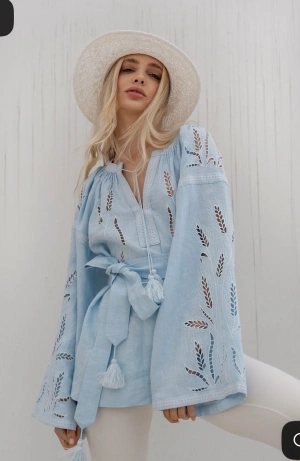
with open floral or botanical designs.
The result can provide a handcrafted appearance while still being suitable for industrial garment production.
Luxury Casualwear
Embroidery is no longer limited to formal clothing.
Luxury casualwear can use small embroidered pieces to create distinctive details on:
-
Shirts
-
Knitwear
-
Denim jackets
-
Sweatshirts
-
Lightweight jackets
-
Casual dresses
This is where cut-piece embroidery becomes particularly useful.
A brand can develop a signature embroidered motif and apply it consistently across multiple products.
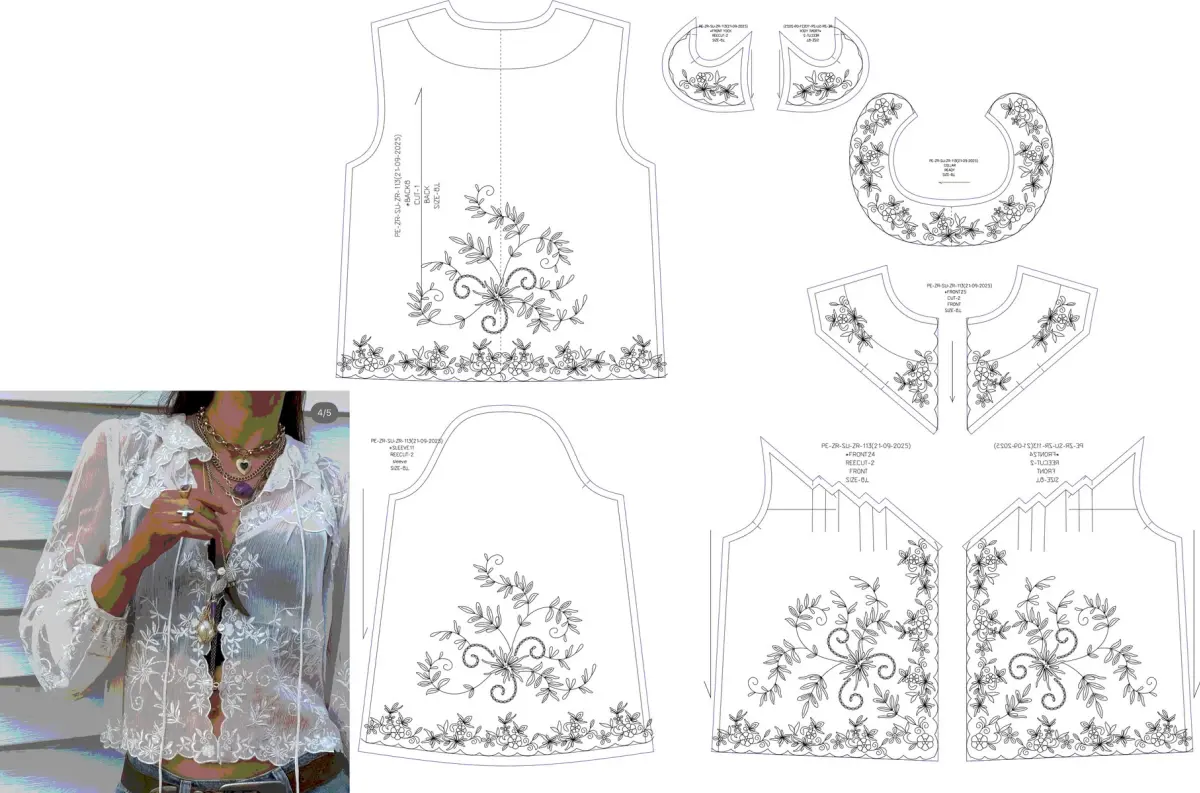
Cut-Piece Embroidery and Garment Pattern Engineering
One of the most important differences between ordinary embroidery and advanced cut-piece development is the relationship between the embroidery and the garment pattern.
A conventional embroidery design may be developed independently from the garment.
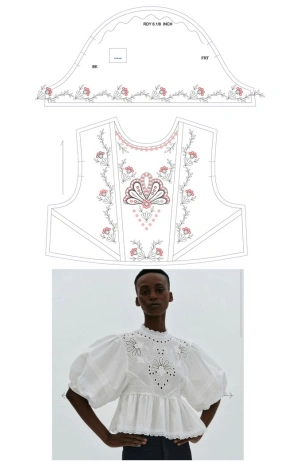
A panel-based embroidery design is developed around the garment.
For example, a sleeve panel needs to account for:
-
Sleeve width
-
Seam allowance
-
Arm movement
-
Curve
-
Joining points
-
Motif direction
A bodice panel may need to account for:
-
Bust shaping
-
Waist seams
-
Darts
-
Neckline
-
Center front
-
Center back
This is why garment pattern information can be extremely valuable during development.
The manufacturer can use the pattern to determine the most appropriate embroidery layout.
MJlace describes panel embroidery as a production method designed around garment pattern shapes, with the aim of improving motif placement, reducing waste and supporting structured garment production.
How Embroidery Density Affects the Garment
Embroidery density is not only an aesthetic issue.
It affects:
-
Weight
-
Flexibility
-
Hand feel
-
Drapability
-
Breathability
-
Sewing performance
-
Cost
A very dense embroidery structure can make lightweight fabric significantly firmer.
For example:
Light embroidery
→ softer
→ lighter
→ more flexible
→ suitable for flowing garments
Heavy embroidery
→ stronger visual impact
→ more dimensional
→ heavier
→ suitable for structured or statement garments
The correct density therefore depends on the garment.
A supplier should not automatically reproduce the highest possible embroidery density simply because it looks more luxurious in a sample.
The goal is to achieve the right balance between appearance and garment performance.
Thread Selection for Cut-Piece Embroidery
Thread is another important factor.
Common options include:
Polyester Thread
Widely used because of its strength and production stability.
Rayon Thread
Known for its smooth appearance and visual sheen.
Cotton Thread
Offers a more natural and matte appearance.
Metallic Thread
Useful for decorative and eveningwear applications.
Special Effect Threads
Can create textured or reflective finishes.
The selection depends on:
-
Garment positioning
-
Desired appearance
-
Washing requirements
-
Production conditions
-
Budget
-
Design concept
For fashion brands, thread color should ideally be confirmed using a physical sample rather than relying exclusively on digital screens.
To understand the critical role of color in premium fabrics, read our guide to dyeing and color matching .
Quality Control: What Buyers Should Check
For brands sourcing cut-piece embroidery, visual inspection should not be the only quality-control method.
A more complete inspection system should cover several areas.
| Quality Area | What to Check |
|---|---|
| Embroidery | Stitch consistency |
| Pattern | Motif accuracy |
| Color | Thread color consistency |
| Cutting | Shape and dimensions |
| Edge | Clean and secure finish |
| Fabric | No holes or damage |
| Weight | Consistency between batches |
| Size | Piece-to-piece tolerance |
| Packaging | Protection against deformation |
For a deeper dive into quality standards, explore our quality control standards category.
Sample Approval Is Critical
Before bulk production, the buyer should approve a final production sample.
The approved sample should establish the reference for:
-
Color
-
Size
-
Stitch density
-
Edge finish
-
Base fabric
-
Thread
-
Motif shape
This becomes particularly important for repeat orders.
Common Problems in Cut-Piece Embroidery Production
Understanding potential production problems can help brands prevent them.
1. Excessive Thread Density
This can make the piece too stiff.
Solution: Adjust stitch density and underlay during digitizing.
2. Fabric Distortion
Dense embroidery can pull lightweight fabrics.
Solution: Optimize stabilization and embroidery parameters.
3. Uneven Cutting
Inaccurate cutting changes the appearance of repeated motifs.
Solution: Use appropriate precision cutting methods and inspection procedures.
4. Loose Edges
Poor edge finishing can create fraying during garment assembly.
Solution: Select an edge treatment appropriate to the base material.
5. Color Variation
Different thread batches may produce visible differences.
Solution: Establish approved color references and control production batches.
6. Motif Misalignment
This can occur when embroidery is designed without considering garment construction.
Solution: Develop embroidery with garment pattern information where necessary.
Cut-Piece Embroidery vs. Lace Trim
These two techniques serve different design purposes.
| Feature | Cut-Piece Embroidery | Lace Trim |
|---|---|---|
| Form | Individual motif/panel | Continuous strip |
| Placement | Highly flexible | Usually edge-based |
| Main function | Surface decoration | Edge/detail decoration |
| Design scale | Small to large | Narrow to wide |
| Application | Bodice, skirt, sleeve, jacket | Neckline, hem, cuff, seam |
| Customization | Very high | High |
| Visual impact | Strong | Subtle to moderate |
For example, a brand may use lace trim around the neckline while using a large embroidered floral piece across the bodice.
The two products can therefore work together within the same garment.
Cut-Piece Embroidery vs. Water-Soluble Embroidery
Water-soluble embroidery can itself become a source material for cut-piece appliqués.
| Feature | Conventional Embroidered Piece | Water-Soluble Embroidered Piece |
|---|---|---|
| Base | Permanent fabric | Temporary soluble base |
| Final structure | Embroidery + base | Mainly embroidery structure |
| Weight | Depends on base | Often very lightweight |
| Transparency | Depends on base | High |
| Dimensional effect | Medium to high | High |
| Typical positioning | Garment panels | Appliqué, couture details |
| Production complexity | Moderate | Higher |
Water-soluble lace production involves embroidery onto a temporary backing, followed by dissolution, shaping and stabilization.
For brands developing premium collections, the choice depends on the intended visual and functional result.
Why Factory Capability Matters for Custom Embroidery
When buying standard embroidery, the supplier's catalog may be enough.
When developing custom cut pieces, it is not.
Brands should evaluate the manufacturer's ability to manage the entire development chain.
A capable supplier should ideally be able to support:
Artwork → Digitizing → Material Selection → Sampling → Embroidery → Cutting → Finishing → QC → Bulk Production
This reduces communication gaps between different suppliers.
It also makes it easier to solve technical issues.
For example, if an embroidery motif is too heavy for the selected fabric, a manufacturer with control over digitizing and production can adjust the embroidery rather than simply reporting the problem back to the customer.
MJlace positions its manufacturing operation around lace, embroidery, cutting and processing capabilities , allowing custom projects to move from design development through sampling and bulk production.
What Fashion Brands Should Ask an Embroidery Manufacturer
Before starting a custom cut-piece project, buyers should ask:
1. Can you develop embroidery from artwork?
This determines whether the factory can support design development rather than simply reproduce existing files.
2. Can you work with garment patterns?
Important for panel embroidery and placement designs.
3. What base fabrics can you embroider?
The answer should include practical material capabilities rather than simply listing fabric names.
4. Can you produce different edge finishes?
This matters greatly for appliqués.
5. Can you produce samples before bulk?
Sample approval should be part of the development process.
6. How is quality controlled?
Ask about inspection procedures, not simply whether the supplier has "quality control."
7. Can you maintain consistency for repeat orders?
This is particularly important for fashion brands with seasonal collections.
How to Source Cut-Piece Embroidery from China
China remains an important sourcing base for lace and embroidery production because the supply chain can combine textile materials, embroidery, cutting, dyeing and garment manufacturing.
However, buyers should distinguish between:
Trading Company
and
Actual Manufacturer
For custom projects, factory capability becomes increasingly important.
Look for evidence of:
-
Production equipment
-
Embroidery capability
-
Pattern development
-
Sampling
-
Quality inspection
-
Customization
-
Bulk production
-
Export experience
A supplier that only provides product photos may not be sufficient for a complex development project.
A factory that can show the relationship between design development and production is generally more useful for long-term B2B cooperation.
For practical sourcing strategies, visit our buying guide & sourcing tips category.
MJlace currently presents itself as a lace and embroidery manufacturer serving fashion brands, garment manufacturers and other textile buyers, with product categories covering lace , embroidery, lace trim , cut pieces and processing .
Recommended Development Process for Fashion Brands
For brands developing a new embroidered collection, a practical workflow is:
Stage 1 — Concept
Provide the design direction and reference artwork.
Stage 2 — Technical Review
The factory evaluates:
-
Material
-
Size
-
Density
-
Thread
-
Edge
-
Construction
Stage 3 — Digitizing
Artwork is converted into an embroidery program.
Stage 4 — Sampling
The first physical sample is produced.
Stage 5 — Revision
Adjust:
-
Color
-
Density
-
Size
-
Edge
-
Base fabric
Stage 6 — Approval
The buyer approves the final standard.
Stage 7 — Bulk Production
The approved design is reproduced at production scale.
Stage 8 — Inspection
Finished pieces are checked before packing.
This structured approach reduces the risk of discovering technical problems only after bulk production has started.
Cut-Piece Embroidery and Product Development Costs
Cost is determined by much more than the amount of fabric used.
Important cost factors include:
| Cost Factor | Impact on Price |
|---|---|
| Embroidery density | Higher density usually increases production time |
| Number of colors | More colors can increase machine changes |
| Motif size | Larger motifs require more material and stitching |
| Thread type | Specialty threads can increase cost |
| Base fabric | Different materials have different costs |
| Cutting method | Precision cutting may increase processing cost |
| Edge treatment | Additional finishing adds labor |
| Sampling | Custom development requires setup |
| Order quantity | Larger production runs can improve efficiency |
For this reason, brands should not compare cut-piece embroidery suppliers solely by price per piece.
The technically cheaper option may create higher costs later if:
-
Cutting is inconsistent
-
Motifs require rework
-
Pieces do not match garment patterns
-
Color varies between batches
-
Embroidery is too stiff
-
Production delays occur
The better comparison is total production value, not just unit price.
How Cut-Piece Embroidery Adds Value to Fashion Collections
The biggest advantage of cut-piece embroidery is design flexibility.
A brand can create a recognizable decorative language without covering every garment with embroidery.
For example, a signature floral motif could appear as:
-
A shoulder appliqué on a blouse
-
A hem panel on a skirt
-
A bodice motif on a dress
-
A sleeve detail on a jacket
-
A small decorative element on accessories
This creates visual consistency across a collection.
At the same time, each garment can remain different.
That balance is particularly valuable for contemporary fashion brands.
FAQ: Cut-Piece Embroidery for Fashion
What is cut-piece embroidery?
Cut-piece embroidery is an embroidered textile component that is cut into an individual motif, panel, border or specific shape for application to a garment. It is commonly used for dresses, blouses, skirts, jackets and other fashion products.
What is the difference between cut-piece embroidery and embroidered fabric?
Embroidered fabric is generally produced as continuous yardage, while cut-piece embroidery is produced as individual decorative pieces. Cut-piece production provides greater control over motif placement and garment-specific decoration.
Can cut-piece embroidery be customized?
Yes. Custom cut-piece embroidery can be developed according to artwork, dimensions, colors, thread types, base fabrics, embroidery density and edge requirements.
What fabrics can be used for embroidered appliqués?
Common bases include tulle, mesh, organza, cotton, lace, satin, denim and other compatible textile materials. The appropriate material depends on the garment and embroidery construction.
Can embroidered pieces be made according to garment patterns?
Yes. Panel-based embroidery can be engineered around garment pattern shapes. This is particularly useful for bodices, sleeves, skirts and structured garments.
Is water-soluble embroidery suitable for cut-piece appliqués?
Yes. Water-soluble embroidery can create lightweight, open and freestanding embroidered motifs after the temporary backing is removed. It is particularly useful for decorative appliqués and premium fashion applications.
How long does custom embroidery development take?
Development time depends on the complexity of the artwork, material, embroidery density, number of colors and sampling requirements. A physical sample should normally be approved before bulk production.
What information should a fashion brand provide to an embroidery factory?
Brands should ideally provide artwork, finished dimensions, garment application, preferred materials, colors, thread references, quantity requirements and any specific edge or finishing requirements.
Can cut-piece embroidery be produced in bulk?
Yes. Once the embroidery program, material and finished specifications have been approved, cut-piece embroidery can be produced for commercial fashion collections.
How do I choose a cut-piece embroidery supplier?
Look beyond catalog designs and compare the supplier's ability to handle artwork development, digitizing, material selection, embroidery, cutting, finishing, quality control and bulk production.
Cut-Piece Embroidery Is a Manufacturing Tool as Much as a Design Technique
Cut-piece embroidery has evolved beyond being a simple decorative detail.
For modern fashion brands, it can function as a practical design and production tool that connects embroidery technology with garment construction.
The biggest advantage is flexibility.
Designers can control exactly where embroidery appears, how large the motif is, how much of the garment is decorated and how the embroidery interacts with the silhouette.
But successful cut-piece embroidery depends on more than a beautiful artwork.
The factory needs to control:
Digitizing → Materials → Stitch Density → Embroidery → Cutting → Edge Finishing → Quality Control
And for more complex fashion projects, the embroidery should also be developed alongside the garment pattern.
This is where an experienced embroidery manufacturer can provide greater value than a conventional fabric supplier.
For fashion brands developing new collections, the right supplier should be able to move beyond standard catalog products and support the project from the first design concept through sampling and bulk production.
At MJlace, embroidery is part of a broader lace and textile manufacturing system covering custom embroidery , water-soluble embroidery, lace, cut pieces and processing for fashion brands and garment manufacturers.
For brands looking to develop custom embroidered fabric pieces, lace appliqués or garment-specific embroidery panels, the most effective starting point is not simply choosing an existing pattern. It is discussing the garment, design, material and production requirements with the manufacturer before development begins.
That approach gives the designer more freedom---and gives the factory the technical information needed to turn that design into a repeatable commercial product.