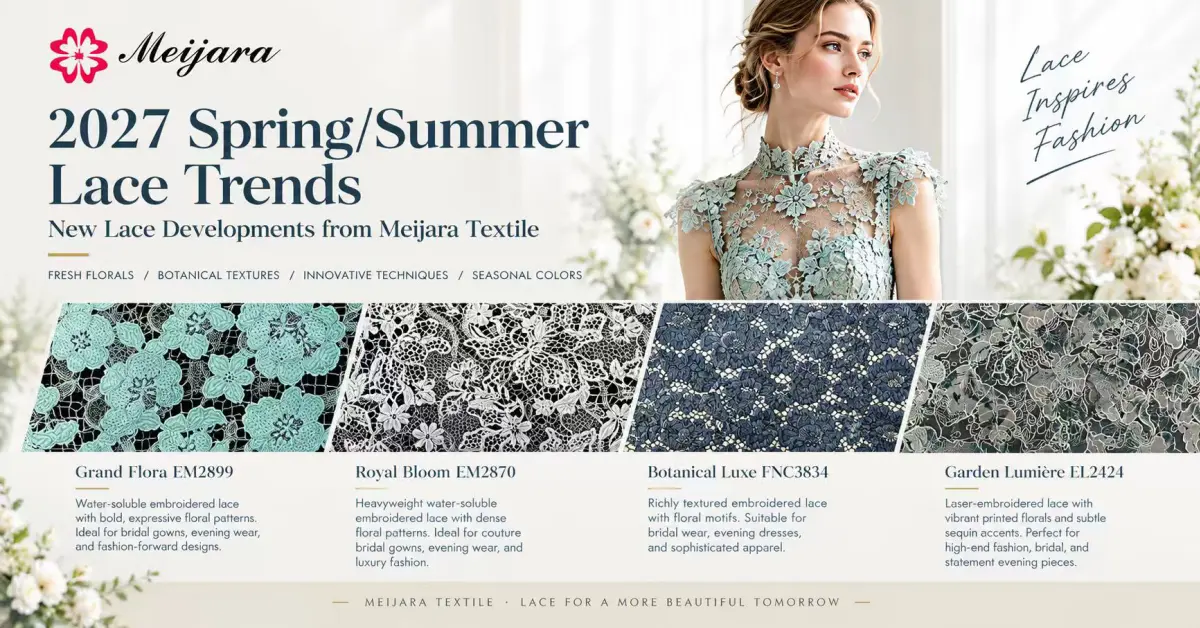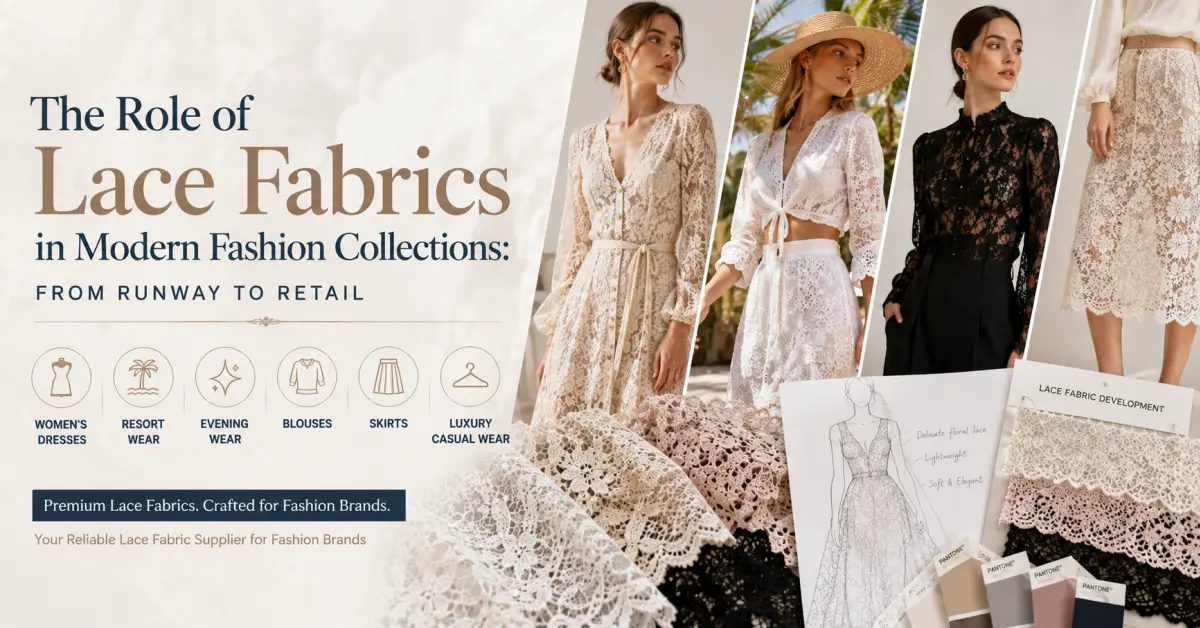

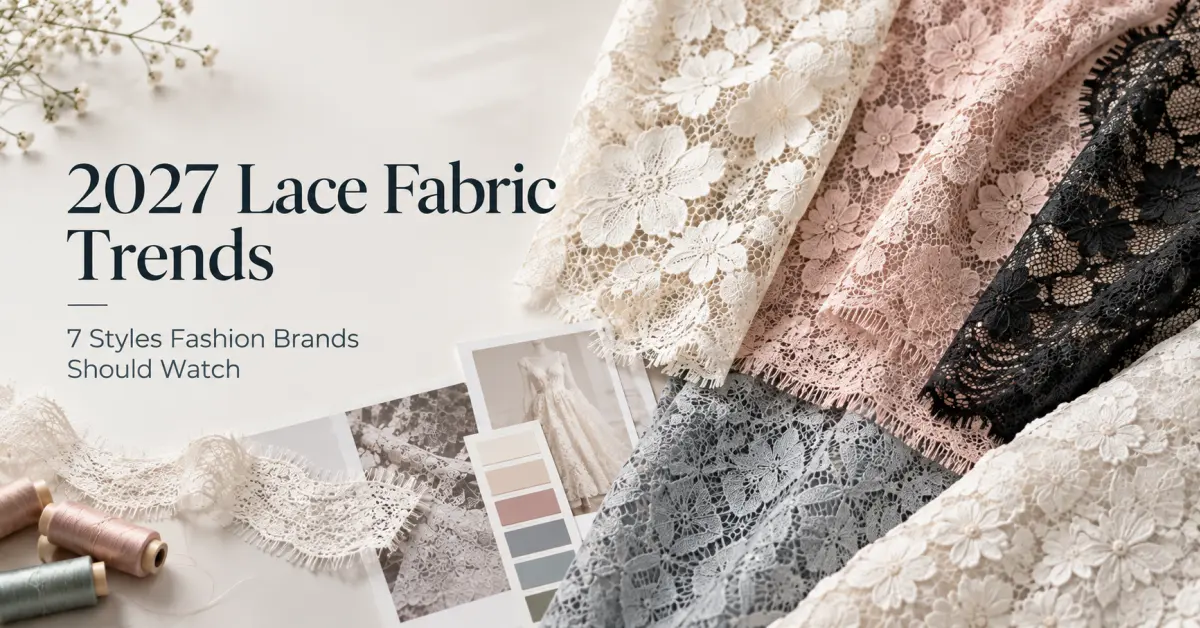

Lace fabric is becoming a versatile design material across contemporary apparel, extending beyond traditional occasionwear into blouses, skirts, jackets, resortwear and statement separates. Its visual impact depends not only on the pattern, but also on motif scale, ground structure, transparency, texture and edge construction.
For fashion brands developing 2027 collections, these details offer different ways to create distinctive garments while maintaining control over material selection and production requirements.
The following directions are intended for collection planning and design exploration. They should not be interpreted as a definitive ranking of officially confirmed 2027 fashion trends.
Large-Scale Floral Lace

Large floral motifs create a strong visual focal point, particularly when the pattern occupies a substantial part of the fabric width. Compared with small, evenly distributed flowers, oversized motifs place greater emphasis on the relationship between pattern and garment silhouette.
This direction is suitable for dresses, skirts, blouses and statement panels. The main development consideration is pattern placement: a large flower can be divided awkwardly by a seam or cut into an unbalanced position if the fabric repeat is not considered during patternmaking.
When evaluating floral lace, buyers should check:
-
Motif scale: Does the pattern suit the garment's proportions?
-
Pattern repeat: Can the design be positioned consistently across panels?
-
Usable width: Is there enough fabric for the intended cutting layout?
-
Motif density: Does the balance between open ground and floral coverage match the desired appearance?
Comparing different structures within a lace fabric collection can help narrow the options before sampling.
2. Sheer Lace and Layered Transparency

Sheer lace creates depth through the contrast between open ground, decorative motifs and the fabric underneath. Its appearance changes considerably depending on motif density, base color and whether the lace is used alone or layered over another material.
Potential applications include lightweight blouses, sleeves, overlays, skirts and resortwear. Open structures emphasize transparency, while denser motifs provide greater visual coverage.
For product development, evaluate the lace both independently and over the intended lining or base fabric. Transparency, drape and stability should be considered together, especially when the material will be cut into narrow panels or used in fitted garments.
A fabric that looks balanced as a flat swatch may appear very different once gathered, stretched or layered. Sampling should therefore reflect the intended garment construction whenever possible.
3. Geometric Lace and Repeating Patterns

Geometric lace offers a more ordered alternative to floral designs. Grids, diamonds, linear motifs and abstract repeats can introduce structure without relying on elaborate ornamentation.
These patterns are suitable for contemporary blouses, skirts, dresses and contrast panels. They can also provide a consistent visual language across several styles within the same collection.
Pattern accuracy is particularly important. Misalignment is often more noticeable in geometric designs than in irregular floral patterns, especially at center fronts, side seams and symmetrical panels.
Buyers should review the full repeat, usable width and edge alignment before confirming fabric consumption. If symmetry is important to the finished garment, motif placement should be considered during pattern development rather than left until cutting.
4. Textured Lace with Raised Details

Surface texture gives lace a stronger tactile and visual identity without requiring a high-contrast color palette. Raised motifs, corded outlines and differences in yarn structure can create depth across selected areas of a garment.
This direction works well for statement tops, dresses, skirts and decorative inserts. The technical challenge is balancing surface relief with fabric performance. Dense or raised details can increase weight, reduce flexibility and affect sewing at seams.
When comparing samples, assess the following:
-
Height and definition of raised details
-
Fabric weight and hand feel
-
Drape and flexibility
-
Seam bulk and cutting performance
-
Stability of decorative elements during handling
Where a design requires more pronounced decorative stitching, comparing lace constructions with embroidered fabric techniques can help determine which material approach better matches the intended surface effect.
Eyelash Lace and Defined Edges

In eyelash lace, fine threads extending from the edge become part of the design. Rather than serving only as a finishing detail, the fringe can frame a neckline, sleeve, hem or layered panel.
Although often associated with narrow trims, eyelash lace is also available in wider fabric formats. The appropriate width depends on whether it will be used for edging, garment inserts or larger decorative sections.
For sourcing and development, check:
-
Fringe length and consistency
-
Edge construction and pattern definition
-
Width and placement requirements
-
Stability during cutting and sewing
-
How the edge will appear on the finished garment
A decorative edge that looks attractive on a sample may require careful positioning during assembly to prevent the fringe from being caught in seams or losing its intended outline.
For edge-focused designs, Meijara's eyelash lace trim collection provides a relevant reference for comparing different styles.
Stretch Lace for Close-Fitting Garments

Stretch lace serves a different purpose from rigid decorative lace. Its value lies in combining a patterned surface with the flexibility required for fitted garments and selected body-contouring panels.
Its performance depends on fiber composition, fabric construction, stretch direction and recovery. A fabric may stretch sufficiently during fitting but fail to return to its original dimensions after repeated extension.
Buyers should evaluate stretch and recovery in the direction relevant to the garment, then check pattern distortion and transparency under extension. These factors are especially important for fitted tops, dresses and elasticated panels.
Stretch performance should also be considered alongside sewing requirements. The most suitable material is not necessarily the one with the greatest extension, but the one that maintains the required fit, appearance and dimensional stability.
Lace Combined with Other Materials

Combining lace with contrasting fabrics or decorative elements creates variation within a garment. Lace may be paired with satin, mesh, embroidery, cord details or embellishments to distinguish selected panels from the main material.
This approach is useful when a collection needs a clear visual feature without relying entirely on a new fabric structure. A lace overlay, for example, can introduce transparency against an opaque base, while a decorative panel can create contrast within an otherwise simple silhouette.
The main consideration is material compatibility. Differences in weight, stretch, shrinkage and care requirements can complicate garment assembly, particularly where several materials meet at a seam.
For custom development, review the materials together rather than approving each component in isolation. A representative sample should show how the fabrics interact and whether the intended construction remains practical.
Choosing Lace Fabric for Different Garments
A trend direction only becomes commercially useful when it suits the intended garment. Pattern scale, transparency, weight, stretch and edge construction all influence the final result.
|
Garment application |
Key fabric characteristics |
Main consideration |
|---|---|---|
|
Blouses and shirts |
Softness, transparency and drape |
Comfort and ease of sewing |
|
Dresses and skirts |
Pattern repeat, coverage and weight |
Balanced motifs across panels |
|
Jackets and structured separates |
Stability, thickness and surface texture |
Seam construction and durability |
|
Fitted garments |
Stretch and recovery |
Fit retention and pattern distortion |
|
Resortwear and overlays |
Transparency and lightweight construction |
Layering and intended use |
|
Hems, necklines and inserts |
Edge quality, width and placement |
Cutting accuracy and finishing |
Before selecting a fabric, confirm the intended garment, composition, usable width, approximate weight, stretch requirements and pattern layout. These details help narrow the options more effectively than visual appearance alone.
For repeat orders, the approved sample and specifications should be retained as references for production.
Developing Custom Lace for a 2027 Collection
For brands seeking a distinctive material, custom lace development can translate a design reference, sketch or existing fabric sample into a fabric that better matches the collection.
The process generally involves four key stages.
Design review: The buyer provides the artwork, reference sample, intended garment and target specifications.
Material assessment: The manufacturer evaluates the pattern, fabric structure, width, color and any finishing requirements.
Sample development: The proposed material is produced for review of appearance, dimensions, hand feel and suitability for the intended application.
Specification approval: The final design and production requirements are confirmed before bulk manufacturing.
Clear communication at the beginning can reduce unnecessary revisions. Pattern scale, color, fabric width, estimated quantity and delivery requirements should be discussed before the sample is finalized.
Meijara's current planning guidance for new custom lace fabric development is an MOQ of approximately 3,000–5,000 meters. Sampling typically takes 20–25 days, with bulk production generally requiring 35–40 days. Actual requirements depend on the design, materials, finishing and approval process, so project-specific terms should be confirmed before ordering.
For an overview of the development stages, see Meijara's custom lace development process.
Frequently Asked Questions
What lace fabric styles are worth considering for 2027?
Large floral motifs, sheer structures, geometric repeats, textured lace, eyelash edges, stretch lace and mixed-material designs are useful directions to evaluate during collection planning. The final choice should reflect the target market, garment application and collection concept.
How do I choose lace fabric for a specific garment?
Start with the garment's construction and intended fit. Compare transparency, drape, weight, stretch, pattern repeat and edge requirements. A sample should be evaluated in the context of the finished garment rather than as a flat swatch alone.
Can lace patterns and colors be customized?
Customization depends on the fabric structure and production requirements. Buyers can provide artwork, a physical reference or color specifications for the manufacturer to assess before sampling.
What should buyers check before approving a lace sample?
Check pattern scale and alignment, color, usable width, hand feel, transparency, stretch and finishing. For fitted or structured garments, assess the fabric using the intended construction method.
What is the MOQ for custom lace fabric?
Meijara's typical MOQ for new custom lace fabric development is approximately 3,000–5,000 meters. The actual MOQ should be confirmed for the specific design and production requirements.
Conclusion
The lace styles worth exploring for 2027 differ in pattern, transparency, texture, edge construction and stretch performance. Their suitability depends on how these characteristics work with the garment's design and manufacturing requirements.
For fashion brands and sourcing teams, effective lace selection begins with a clear application, a well-defined material specification and a representative sample. Evaluating these factors early helps turn trend inspiration into a fabric that is practical for commercial production.