
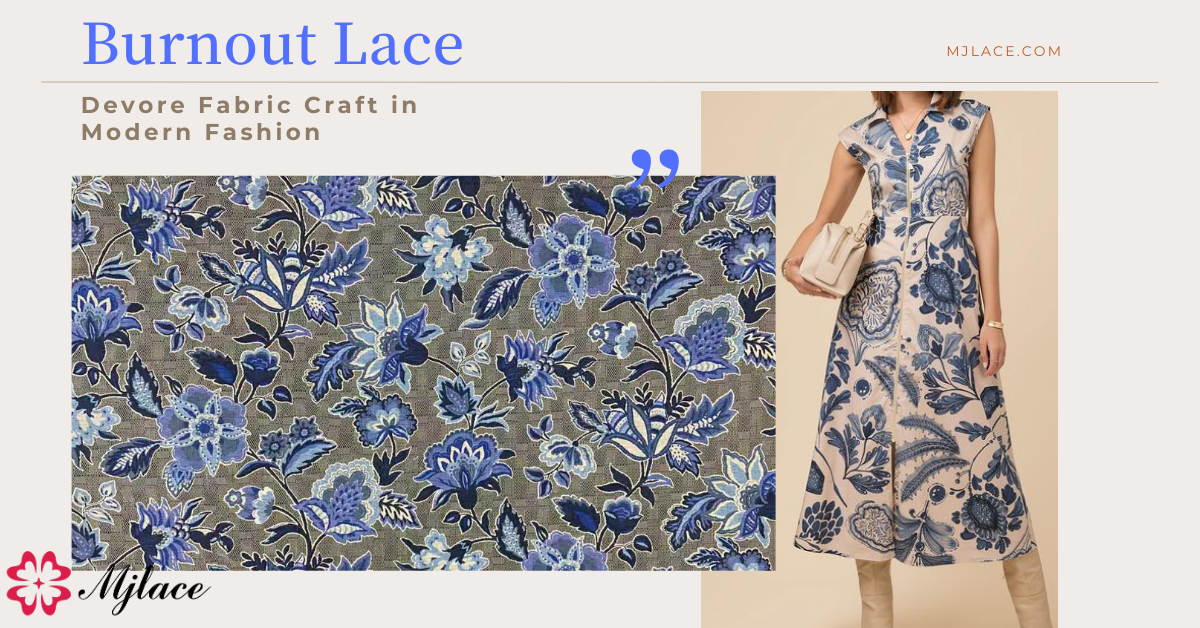

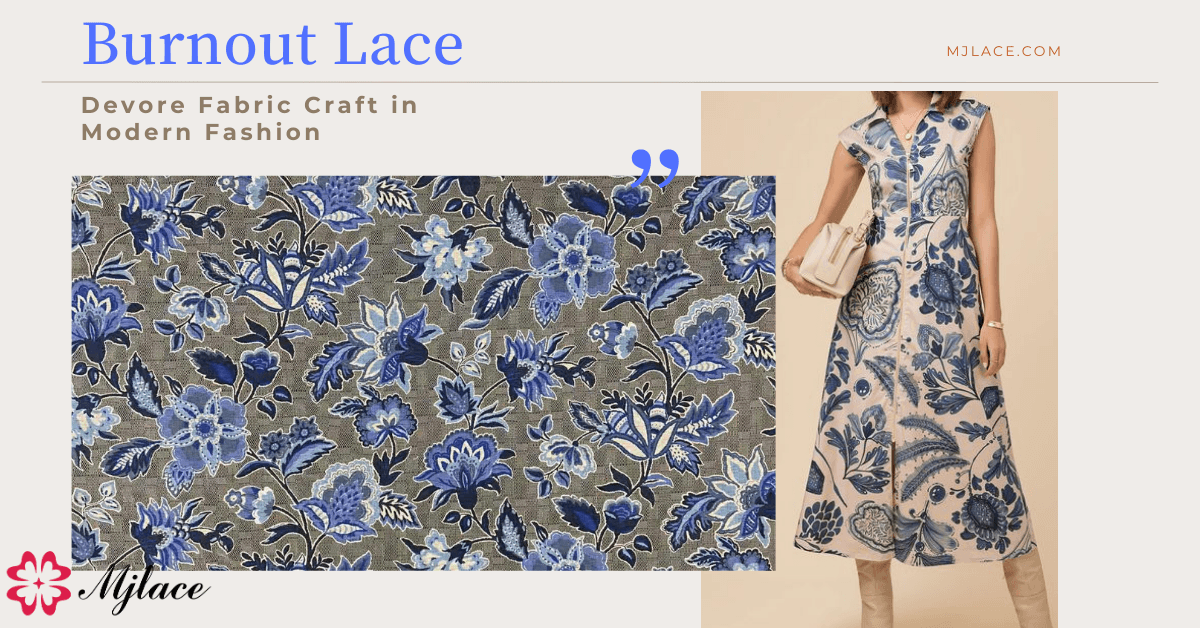
In the ever-evolving world of fashion textiles, burnout lacestands out for its unique blend of artistry, chemistry ,and craftsmanship. Renowned for its translucent patterns and luxurious texture, burnout lace has become a popular fabric in contemporary apparel—from high fashion to ready-to-wear collections.
This article explores what burnout lace is, how it is made, its advantages, its application in modern fashion, and why it remains a valuable choice for designers and garment manufacturers seeking elegance and innovation.
What is burnished lace?
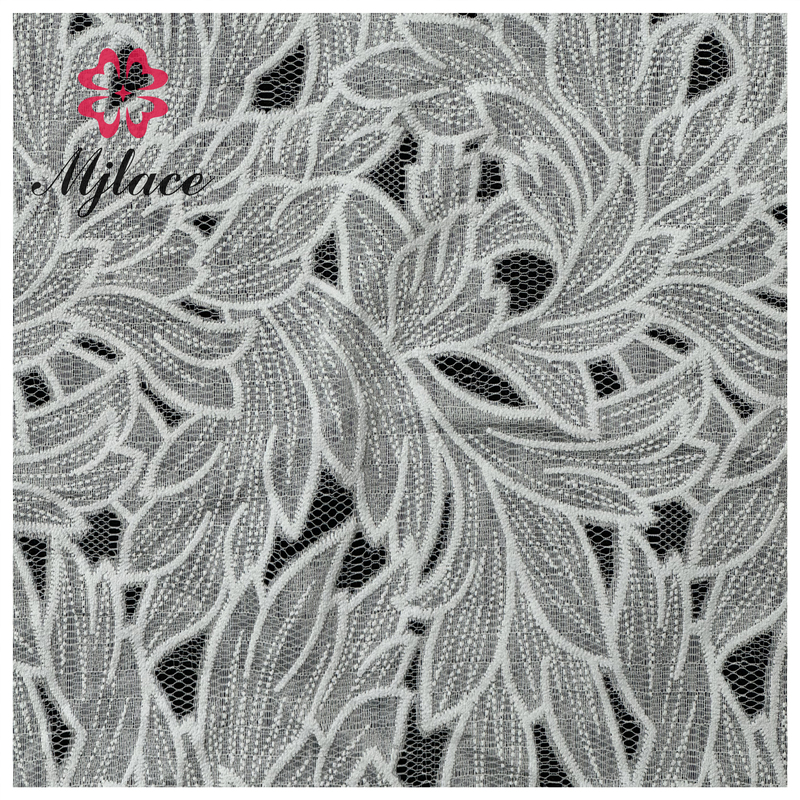
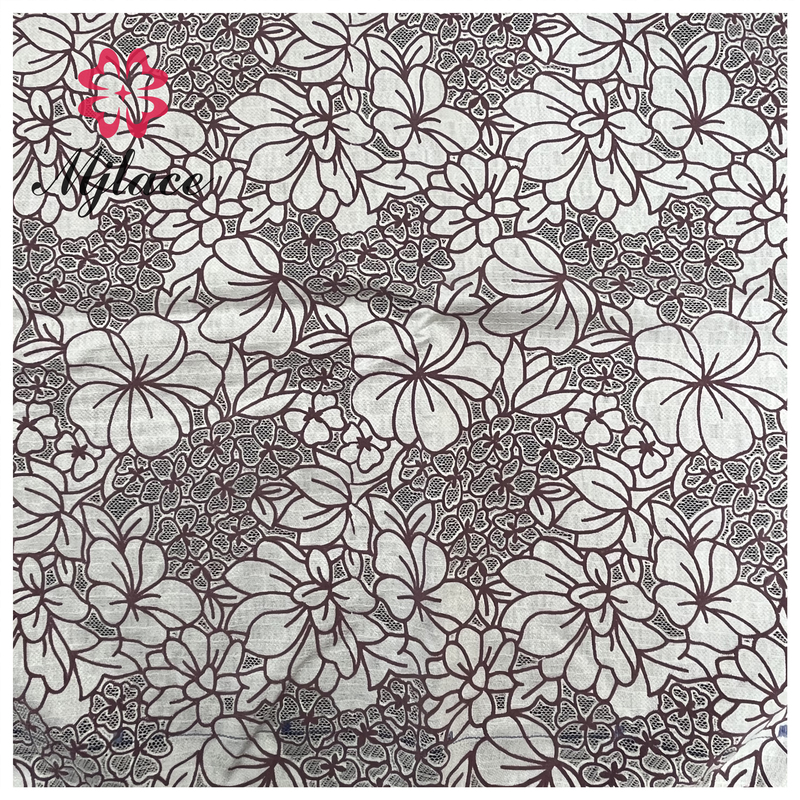
Burnished laceis a special type of textile that uses a chemical processto selectively remove one type of fiber from a blended fabric, creating a patterned, semi-transparent design.
Main characteristics of burnished lace
-
Transparent or semi-transparent patterns
-
Soft and textured
-
A strong visual contrast is created between the solid and transparent areas.
-
Lightweight and breathable
The final result is a lace-like appearance without the need for traditional embroidery or weaving methods.
How are burnished lace pieces made?
Burnishing (also known as dévoré)relies on the chemical properties of fibers, rather than mechanical embroidery.
The process of gradually overcoming burnout
-
Fabric selection:
Blended fabrics are typically used, and their components usually include:-
Natural fibers (cotton, silk, rayon)
-
Synthetic fibers (polyester, nylon)
-
-
Pattern application:
A chemical paste is printed onto the fabric in the desired pattern. -
Controlled fiber removal:
This chemical dissolves one type of fiber (usually cellulose fibers), while insoluble fibers remain intact. -
Washing and organizing:
The fabric is washed to remove residue and then stabilized through finishing processes.
This process can create complex patterns with extremely high precision and consistency.
Burnt lace and traditional lace
Although both exude an elegant temperament, burnout lace is quite different from traditional lace.
| feature | Burnt Flower Lace | Traditional lace |
|---|---|---|
| Production | Chemical processes | Weaving or embroidery |
| texture | Contrast between transparent and solid | Raised or stitched |
| weight | Light | It may be heavier |
| cost | More scalable | Typically labor-intensive |
| Pattern precision | high | Depends on technology |
Burnished lace offers a modern alternative to mass production or semi-custom production, with excellent scalability.
Why did the designer choose burnt lace?
Burnished laceis popular for its unique balance between visual impact and production efficiency .
Main advantages
-
An elegant, transparent texture, without elaborate embroidery.
-
Smooth surface, suitable for cutting and sewing
-
It has an excellent drape, making it suitable for flowing clothing.
-
Mass production is economical
-
Easy to combine with embroidery, appliqué or panel decoration
These advantages make it particularly attractive to contemporary fashion brands.
Application of burnished lace in the fashion industry
Burnished lace is widely used in various clothing categories.
Women's ready-to-wear
-
Women's shirts and women's blouses
-
dresses and corsets
-
A dress with tulle trim
Burnished lace adds a touch of femininity and lightness without being overpowering.
Wedding dresses and evening gowns
-
wedding dress
-
Bridal shawl and sleeves
-
evening gown
This light and sheer texture adds a touch of romance and elegance, especially when layered over satin or tulle.
Underwear and intimate apparel
-
pajamas
-
Sundress and camisole
-
Decorative panels
Its softness and breathability make it an ideal choice for underwear.
Fashionable layered items
Burnished lace is often used for:
-
Overlay
-
Panel inserts
-
Decorative sleeves
It pairs well with solid-color fabrics, creating a sense of layering and contrast.
Burnished lace and custom
Customizationis one of the biggest advantages of burnished lace.
Custom options include
-
Custom patterns and designs
-
Controllable transparency
-
Combined with embroidery or appliqué embroidery
-
Custom fabric blends
-
Color customization
For OEM and private label customers, burnout lace is both flexible and does not incur excessive mold costs.
Sustainability considerations
Although burnished lace uses chemical processes, modern production is increasingly focused on environmental responsibility.
Sustainable practices include
-
Low-impact chemical formulations
-
Water recycling system
-
Processes conforming to OEKO-TEX® standards
-
Precise cutting techniques reduce fabric waste.
If produced responsibly, burnout lace can align with sustainable textile strategies.
Using the design technique of burnished lace
To maximize the aesthetic appeal and functionality of burnished lace, designers should consider the following points:
-
The position of the pattern relative to the garment structure
-
Strengthen pressure area
-
Lining options for comfort and light blocking
-
Compatibility with cutting and sewing techniques
Sampling is crucial for ensuring a balance between performance and visual appeal.
Burnout lace in modern fashion trends
The current trend is to use burnout lace as:
-
A bridge connecting classical and modern aesthetics
-
Key fabrics for romantic minimalism
-
Lightweight, breathable, and stylish solutions
-
A material that is understatedly luxurious rather than overly ornate.
It continues to evolve alongside modern embroidery, digital printing, and panel production technologies .
Final words
Burnished lace is more than just a decorative fabric; it's a technical textile solution thatcombines design flexibility, scalability, and exquisite aesthetics. For fashion brands, designers, and garment manufacturers, it offers a clever way to achieve lace-like beauty while maintaining production efficiency.
As the fashion industry increasingly emphasizes texture, transparency, and sustainable design, burnout lace remains a...
In the global apparel industry, this is a material that is both classic and forward-thinking.