
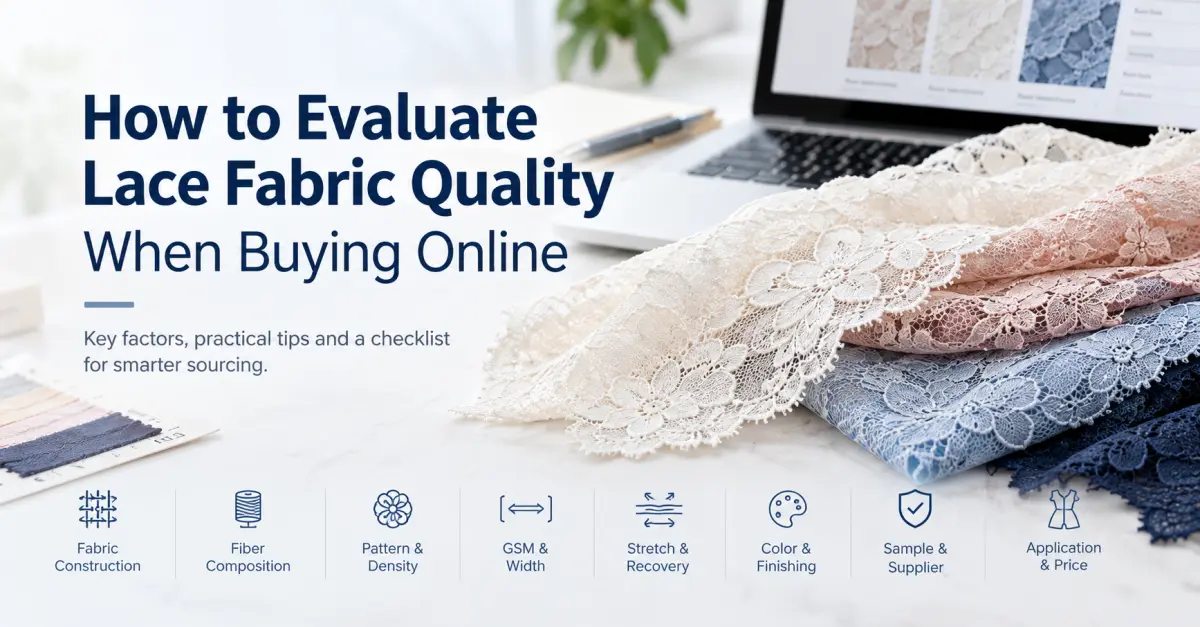

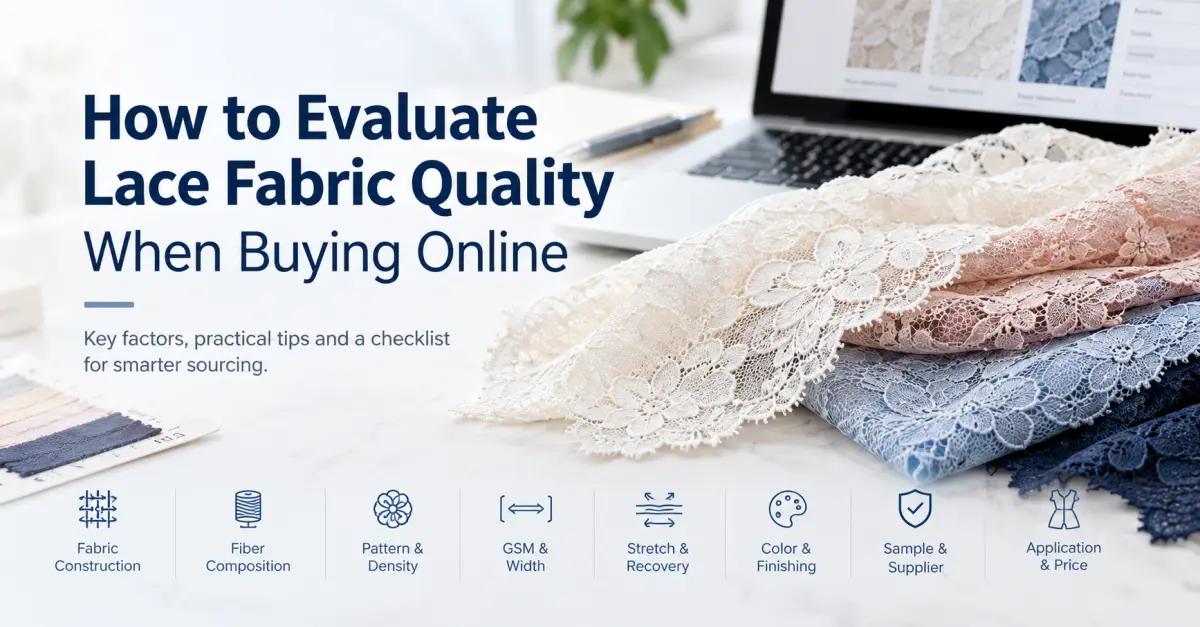
Start With Fabric Construction and Fiber Composition
The construction of a lace fabric determines much of its appearance, strength, elasticity, and behavior during garment production.
Lace can be produced using different structures and technologies, including warp knitting, jacquard construction, embroidery, chemical processes, and combinations of these techniques. The same decorative appearance does not necessarily mean the fabrics have the same performance.
Fiber composition is equally important.
Common lace materials include:
-
Nylon
-
Polyester
-
Cotton
-
District
-
Spandex or elastane
-
Blended fibers
For example, a lace containing spandex may be suitable for fitted garments where stretch and recovery are important. Cotton lace may offer a different hand feel and appearance, while polyester or nylon constructions may be selected for specific durability, appearance, or production requirements.
When buying online, do not rely only on terms such as "premium lace" or "high-quality lace." Ask for the actual fiber composition and fabric construction.
| Specification | Why It Matters |
|---|---|
| Fiber composition | Affects hand feel, stretch, durability and care |
| Fabric construction | Determines structure and appearance |
| Yarn type | Influences surface texture and performance |
| Stretch content | Important for fitted garments |
| Manufacturing method | Affects pattern and fabric characteristics |
For more information about different lace structures and categories, see our guide to lace types and categories .
Check Pattern Definition, Repeat and Density
Pattern quality is one of the easiest things to notice visually, but it is also one of the areas where online images can be misleading.
A good lace fabric should have a clearly defined pattern with consistent structure across the fabric. Buyers should pay attention to:
-
Pattern sharpness
-
Pattern repeat
-
Open areas
-
Pattern density
-
Symmetry
-
Motif size
-
Pattern alignment
For machine-produced lace, consistency should be maintained across the fabric width and throughout the roll. Changes in yarn tension, machine settings, production conditions, dyeing, or finishing can affect the final appearance.
This becomes especially important when lace is used for garments with matching panels.
For example, if a lace pattern is inconsistent from one section to another, matching front and back garment panels can become more difficult and material waste may increase.
When requesting a sample, ask whether the pattern repeat and fabric construction will remain consistent during bulk production.
For insights into how patterns are developed, read our pattern design development guide.
Compare GSM, Width and Fabric Yield
GSM, or grams per square meter, is one of the most useful technical specifications when comparing lace fabrics online.
However, higher GSM does not automatically mean better quality.
A lightweight lace may be exactly what a designer needs for a sheer blouse or lingerie application, while a heavier lace may be more appropriate for structured garments or decorative panels.
The correct GSM depends on:
-
Fabric construction
-
Fiber composition
-
Garment application
-
Desired drape
-
Pattern density
-
Finishing
-
Required coverage
Fabric width is another important factor that is sometimes overlooked.
A lace listed at 150 cm wide and another listed at 110 cm wide cannot be compared only by price per meter. The wider fabric may provide better material utilization depending on the garment pattern.
For B2B buyers, the relevant question is not simply:
"How much does one meter cost?"
It is:
"How much usable fabric do I receive for the finished garment?"
| Specification | What Buyers Should Check |
|---|---|
| GSM | Whether the weight suits the application |
| Width | Usable width rather than nominal width alone |
| Pattern repeat | Whether garment panels can be positioned efficiently |
| Fabric yield | Expected material consumption |
| Roll consistency | Whether specifications remain stable throughout production |
For more on garment applications, visit our applications & industry use category.
Evaluate Stretch and Recovery for Elastic Lace
For stretch lace, elasticity is a quality requirement rather than simply an additional feature.
Two fabrics can both be described as "stretch lace" but behave very differently during garment production.
Buyers should evaluate:
Stretch percentage, Stretch direction, Recovery after stretching, Fabric stability, Edge behavior, Performance after repeated stretching
Good stretch recovery is particularly important for fitted dresses, lingerie, tops, skirts, and other garments where the fabric must return to its original shape.
A lace fabric that stretches easily but does not recover properly may cause problems such as:
Distorted garment shape, Loose areas around the body, Wavy seams, Pattern distortion, Poor appearance after wear
For online purchasing, ask the supplier for the actual stretch and recovery specifications or test these properties on a physical sample.
For a deeper understanding of lace constructions, explore our lace fabric collection.
Look Beyond Photos: Hand Feel, Drape and Softness
Photography is useful for evaluating pattern and appearance, but it cannot accurately communicate everything about a fabric.
Three characteristics are particularly difficult to judge online:
Hand Feel
Hand feel describes how the fabric feels when handled. It may be soft, smooth, crisp, firm, dry, or slightly textured.
Drape
Drape describes how the fabric falls when hanging or being worn.
A lace with a soft drape may work well for flowing dresses, while a more stable structure may be preferred for tailored or structured garments.
Surface Texture
Embroidery, raised patterns, flocking, satin details, sequins, beads, and other decorative elements can significantly change the tactile quality of lace.
For products with decorative elements, explore our sequins and beads embroidery collection.
This is why physical samples remain important for commercial development.
What Can and Cannot Be Judged Online?
| Can Usually Be Checked Online | Usually Requires a Physical Sample |
|---|---|
| Pattern appearance | Hand feel |
| Listed fiber composition | Actual softness |
| Product width | Drape |
| Product specifications | Stretch recovery |
| Product photos | Fabric stability |
| Listed GSM | Surface texture |
Check Color Accuracy, Dyeing and Finishing
Color is another area where online purchasing can create problems.
The color shown on a product page may be affected by:
-
Camera settings
-
Lighting conditions
-
Screen calibration
-
Image processing
-
Photography background
Therefore, a color that appears white, ivory, beige, or pink on screen may look different under natural light or on another display.
For production orders, buyers should clarify whether the supplier offers:
-
Standard colors
-
Custom dyeing
-
Pantone matching
-
Color sample matching
-
Lab dips or approval samples
Finishing should also be considered because it can influence:
-
Softness
-
Surface appearance
-
Dimensional stability
-
Hand feel
-
Shrinkage
-
Final garment performance
For more on color management, visit our dyeing and color matching category.
Inspect Embroidery, Edges and Decorative Details
Embroidery lace requires additional quality checks beyond the base fabric.
For embroidered products, buyers should examine:
Embroidery density, Thread consistency, Pattern definition, Thread tension, Loose threads, Embroidery alignment, Base fabric stability, Decorative elements, Edge finishing
For lace trims, the edge is particularly important.
Poor edge quality can affect sewing efficiency and the appearance of the finished garment. Buyers should check whether the edge is clean, consistent, and suitable for the intended sewing process.
For products incorporating sequins, beads, ribbons, or other decorative materials, attachment security should also be considered.
The quality of decorative lace is therefore not determined by appearance alone. The construction needs to remain stable during cutting, sewing, handling, and garment finishing.
For more on embroidery techniques, explore our embroidery collection.
Understand Colorfastness and Dimensional Stability
A lace fabric may look excellent when it arrives but still perform poorly after washing, pressing, or garment processing.
Two important quality characteristics are colorfastness and dimensional stability.
Depending on the final application, buyers may need to consider:
-
Colorfastness to washing
-
Colorfastness to rubbing
-
Colorfastness to perspiration
-
Shrinkage
-
Stretch recovery after washing
-
Width stability
-
Pattern distortion
The exact testing requirements depend on the fabric composition and end use.
For commercial orders, buyers should discuss the required testing standards with the supplier before production rather than assuming that every lace product is tested to the same specifications.
Quality inspection should cover the fabric from raw materials and production through finishing and shipment, not only the final visual appearance.
For a complete inspection framework, read our guide on lace fabric quality control standards .
Why Samples Matter When Buying Lace Online
For online B2B purchasing, a sample is one of the most useful quality-control tools available.
Photos can show the pattern. Specifications can describe the material. But only a physical sample allows the buyer to examine several important characteristics together.
A sample can be used to check:
Actual color, Width, GSM, Hand feel, Stretch and recovery, Pattern definition, Embroidery quality, Edge quality, Drape, Fabric stability
For garment manufacturers, the sample can also be tested during cutting and sewing.
This helps identify potential problems before committing to a large production order.
A practical purchasing process is:
For a complete sourcing framework, read our complete guide to buying and sourcing lace fabric .
Lace Quality Depends on the Intended Application
There is no single specification that defines "high-quality lace." A fabric that works well for lingerie may not be the right choice for a structured jacket. Similarly, lightweight lace that is ideal for a flowing blouse may not provide enough stability for another application.
| Application | Important Quality Factors |
|---|---|
| Stretch garments | Stretch, recovery, softness |
| Evening dresses | Drape, pattern definition, hand feel |
| Blouses | Lightweight structure, softness, drape |
| Lingerie | Elasticity, softness, comfort |
| Jackets | Stability, structure, durability |
| Embroidered garments | Embroidery density, thread quality, base stability |
| Lace trims | Edge quality, width consistency, pattern repeat |
| Decorative panels | Pattern definition, dimensional stability |
This is why buyers should describe the final garment application when asking a lace supplier for recommendations.
A supplier can then evaluate the material according to the actual production requirement instead of simply recommending a fabric based on appearance.
For more on how lace is used, visit our applications & industry use category.
Does a Higher Price Mean Better Lace Quality?
Not necessarily.
Lace prices can vary because of differences in:
-
Fiber composition
-
Yarn quality
-
Fabric width
-
GSM
-
Pattern complexity
-
Machine technology
-
Embroidery density
-
Dyeing
-
Finishing
-
Customization
-
Order quantity
-
Inspection requirements
A more expensive lace may contain additional processing or more complex construction, but that does not automatically make it the right fabric for every application.
For B2B buyers, the better approach is to compare specifications and application requirements together with price.
For example, when comparing two suppliers, look at:
Price per meter + width + GSM + composition + usable area + processing requirements + quality consistency
rather than comparing only the quoted unit price.
For practical supplier evaluation, read our guide on how to choose the right lace fabric supplier .
How to Evaluate a Lace Supplier for Bulk Orders
A good sample is important, but it is not the complete picture.
For commercial orders, the supplier must be able to reproduce the approved specifications consistently.
This means buyers should also consider the supplier's:
Production equipment, Raw material control, R&D capability, Sampling process, Color matching process, In-process inspection, Final inspection, Packaging, Production capacity, Experience with custom development
One useful question is:
Can the supplier produce the approved sample consistently at bulk scale?
This is especially important for custom lace fabrics.
For custom development support, visit our customized process page.
During bulk production, buyers should confirm which specifications are controlled, how production defects are handled, and whether inspection records are available when required.
A supplier's quality-control system can provide useful information about its manufacturing capability.
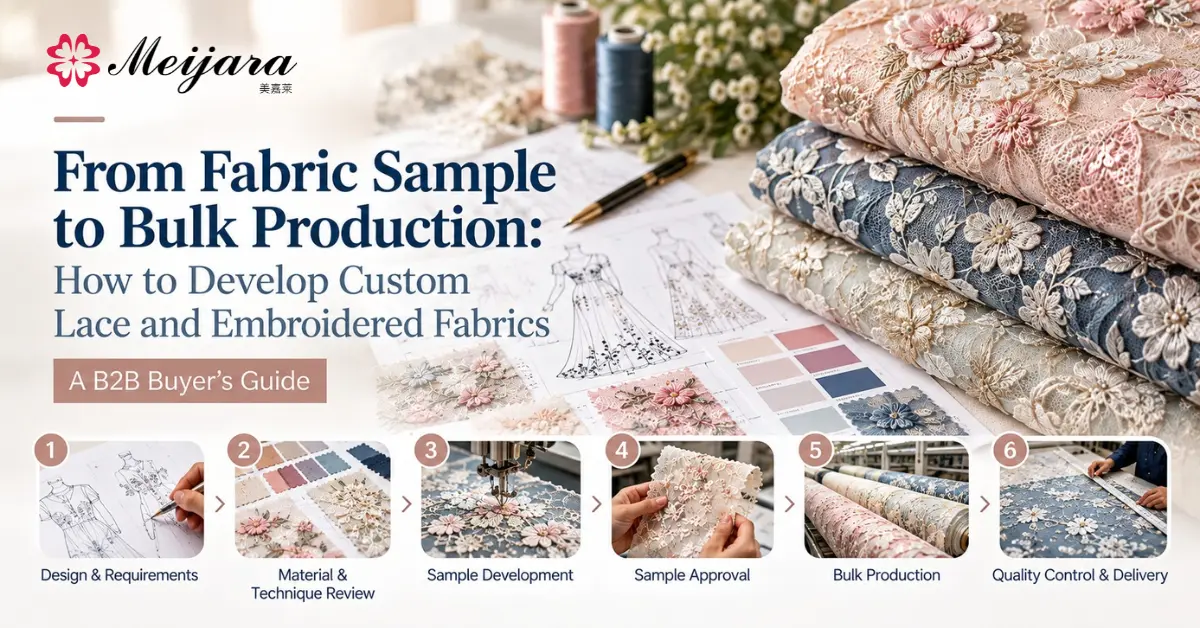
For brands developing custom products, the production process should ideally cover design and pattern development, material selection, sampling, bulk production, quality inspection, and delivery rather than treating quality control as a final step only.
A Practical Lace Fabric Quality Checklist
Before purchasing lace fabric online, buyers can use the following checklist:
| Item | Check Before Ordering |
|---|---|
| Fiber composition | Confirm exact percentages |
| Construction | Confirm lace production method |
| GSM | Check whether weight suits the application |
| Width | Confirm usable fabric width |
| Pattern | Check repeat, density and definition |
| Stretch | Test stretch direction and recovery |
| Color | Compare against an approved standard |
| Finishing | Confirm hand feel and finishing requirements |
| Embroidery | Check thread, density and alignment |
| Edge | Check consistency and sewing suitability |
| Colorfastness | Confirm required testing |
| Dimensional stability | Check shrinkage and deformation |
| Sample | Approve before bulk production |
| Bulk production | Confirm quality-control process |
Questions to Ask a Lace Supplier Before Buying Online
Before placing a commercial order, buyers should consider asking:
-
What is the exact fiber composition?
-
What are the GSM and usable fabric width?
-
Is the lace stretch or non-stretch?
-
What is the stretch and recovery performance?
-
Can you provide a physical sample?
-
Can the color be customized or matched to a reference?
-
What finishing processes are applied?
-
How is pattern consistency controlled during production?
-
What quality tests are performed?
-
How is the approved sample used as a bulk-production reference?
-
What is the MOQ for custom development?
-
What is the expected sampling and bulk production lead time?
These questions help buyers move the conversation from a simple product inquiry to a more useful technical evaluation.
For more on sourcing from China, visit our importing logistics category.
FAQ
How can I tell if lace fabric is good quality when buying online?
Check the fiber composition, construction, GSM, width, pattern consistency, stretch recovery, color, finishing, and supplier quality-control process. A physical sample is recommended before bulk orders.
Does higher GSM mean better lace quality?
No. GSM describes fabric weight, not overall quality. The appropriate GSM depends on the construction and intended application.
What is important when buying stretch lace?
Stretch percentage, recovery, fabric stability, and performance after repeated stretching are important, especially for fitted garments.
How important is fiber composition?
Very important. Fiber composition affects hand feel, elasticity, durability, appearance, care requirements, and garment performance.
Can lace quality be judged from photos?
Only partially. Photos can show pattern and general appearance, but they cannot reliably show hand feel, drape, actual stretch recovery, or dimensional stability.
What should I check when receiving a lace sample?
Check color, width, GSM, pattern, hand feel, stretch, recovery, embroidery, edge quality, drape, and dimensional stability. If possible, test the sample during cutting and sewing.
How can I check lace color before ordering?
For important production colors, compare a physical sample or approved color standard rather than relying only on website images or screen colors.
How can I evaluate a lace supplier for bulk production?
Look beyond the sample. Review the supplier's production equipment, material control, sampling process, QC procedures, customization capability, and ability to maintain consistent specifications during bulk production.
For more answers, visit our FAQs page.
Conclusion
When buying lace fabric online, quality cannot be determined by product photos or price alone.
A more reliable evaluation considers fabric construction, fiber composition, pattern consistency, GSM, width, stretch recovery, hand feel, color accuracy, finishing, embroidery, dimensional stability, and application requirements.
For B2B buyers, the most important step is to connect these specifications with the final garment. A lace fabric should be considered suitable because it meets the technical and visual requirements of the application—not simply because it looks attractive online.
For bulk orders, requesting a physical sample and confirming the supplier's production and quality-control process can reduce the risk of unexpected differences between the approved sample and mass-produced fabric.
For fashion brands and garment manufacturers developing custom lace, working with a manufacturer that can manage design development, material selection, sampling, production, inspection, and delivery provides a more controlled path from an online inquiry to a production-ready fabric.
To discuss your lace fabric requirements, contact us or submit an inquiry .