
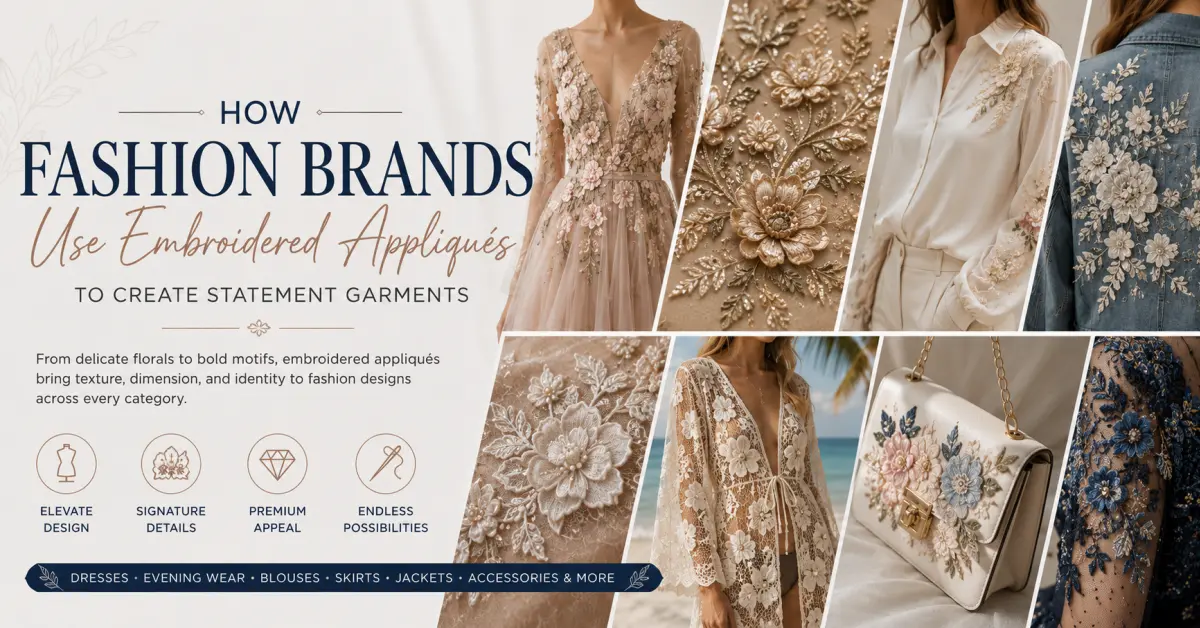

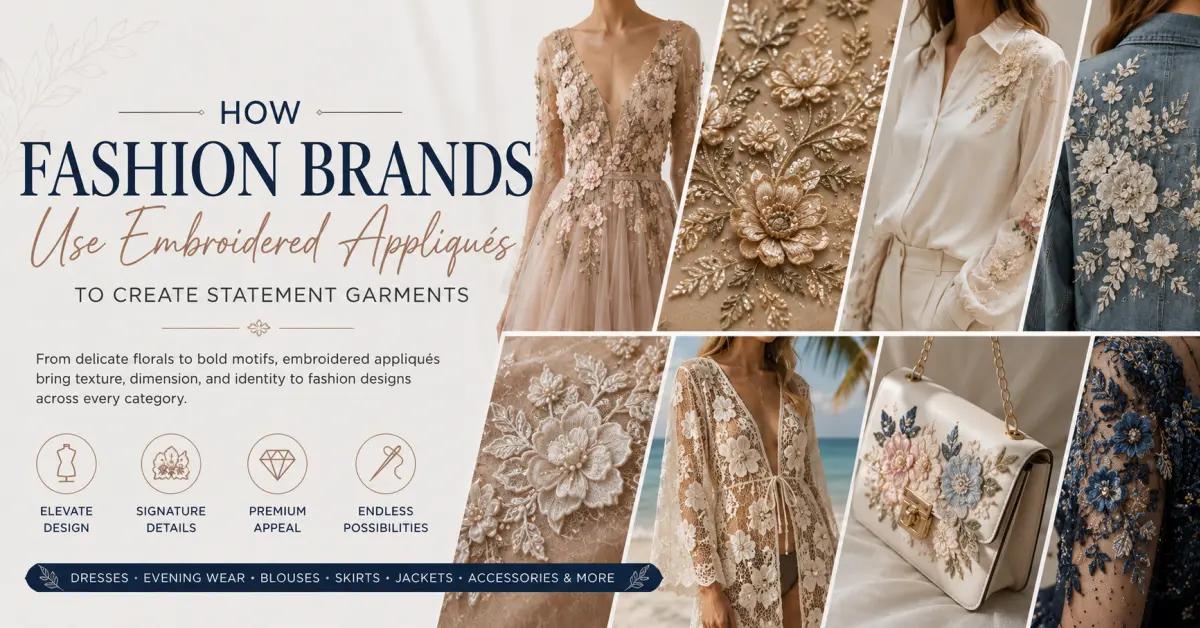
Embroidered appliqués have become an increasingly effective way for fashion brands to add identity, texture and visual impact to a garment without covering the entire product in heavy decoration.
For designers, the appeal is straightforward. A carefully positioned floral motif on a dress, a dimensional appliqué on a jacket, or a series of embroidered elements across a blouse can completely change how a garment is perceived. The base fabric can remain relatively simple while the appliqué creates the visual focus.
This makes embroidered appliqués particularly valuable for contemporary womenswear, evening collections, resort wear and premium ready-to-wear.
Unlike full-surface embroidery, appliqué development gives designers more control over where the decoration appears, how much of it is used and how it interacts with the garment silhouette. It can be used as a border, a central motif, a shoulder detail, a sleeve element, a neckline decoration or an independent statement placed directly onto the garment.
For fashion brands, the opportunity is not simply to make a garment more decorative. The real value lies in using embroidery strategically.
A well-developed appliqué can:
-
Define the visual identity of a garment
-
Highlight a specific part of the silhouette
-
Add perceived value without increasing surface decoration across the entire garment
-
Create recognizable design signatures
-
Combine lace, embroidery, beads, sequins and dimensional elements
-
Give relatively simple garments a more premium appearance
-
Support seasonal design stories without requiring an entirely new base fabric
For suppliers and manufacturers, this also creates opportunities for more customized product development. Instead of selecting a standard embroidered fabric from a catalogue, brands can develop motifs and placement concepts around a specific garment.
This article explores how fashion brands are using embroidered appliqués across different product categories and what designers and buyers should consider when developing them.
What Are Embroidered Appliqués in Fashion?
An embroidered appliqué is a decorative embroidered element designed to be cut, positioned and applied to a garment or textile surface.
The appliqué may be developed on lace, mesh, tulle, organza or another suitable textile base. Depending on the design, it can remain attached to a visible backing or be developed so that the surrounding base is minimized or removed, leaving the embroidered motif as the dominant visual element.
The most important difference between an embroidered appliqué and ordinary embroidered fabric is the way the decoration is used in garment design.
With a conventional embroidered fabric, the embroidery is generally part of the fabric surface. The designer works with the fabric as a whole.
With appliqué, the designer works with individual decorative components.
This allows considerably more flexibility.
A floral motif developed for a dress, for example, might be positioned differently on the bust, waist, sleeve or skirt depending on the collection's final design. The same motif can also be used across several garments in a collection while changing its placement.
That flexibility makes appliqués particularly useful for brands developing coordinated collections.
To explore how appliqués relate to other decorative techniques, read our guide on lace types and categories .
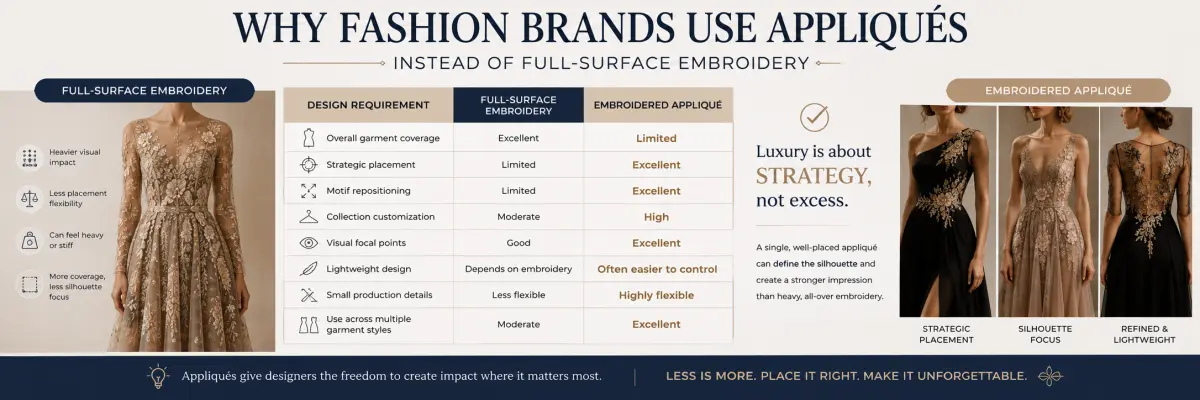
Why Fashion Brands Use Appliqués Instead of Full-Surface Embroidery
Full-surface embroidery can create a strong visual effect, but it is not always the best solution for a fashion garment.
A designer may want the decoration to follow the silhouette rather than cover the entire fabric. In other cases, excessive embroidery can make a garment visually heavy or interfere with drape.
Appliqués provide another approach.
| Design requirement | Full-surface embroidery | Embroidered appliqué |
|---|---|---|
| Overall garment coverage | Excellent | Limited |
| Strategic placement | Limited | Excellent |
| Motif repositioning | Limited | Excellent |
| Collection customization | Moderate | High |
| Visual focal points | Good | Excellent |
| Lightweight design | Depends on embroidery | Often easier to control |
| Small production details | Less flexible | Highly flexible |
| Use across multiple garment styles | Moderate | Excellent |
The distinction is especially important for premium fashion.
Luxury does not always mean more decoration.
In many collections, a smaller amount of carefully positioned embroidery creates a stronger result than dense decoration across the entire garment.
A single large botanical appliqué across one shoulder may be more distinctive than hundreds of small embroidered flowers distributed evenly across a dress.
For more design perspectives, explore our fashion trends & design inspiration category.
Women's Dresses: Creating a Strong Focal Point
Women's dresses are one of the most versatile applications for embroidered appliqués.
The large surface area of a dress gives designers considerable freedom to experiment with placement, scale and composition.
Rather than using embroidery uniformly, designers can use appliqués to guide the eye through the silhouette.
Bodice placement
A large floral or botanical appliqué can be positioned across the bodice to create a structured visual center.
This approach works particularly well when the base dress is made from:
-
Silk-like satin
-
Crepe
-
Chiffon
-
Tulle
-
Mesh
-
Organza
-
Lightweight woven fabrics
The contrast between a relatively clean base fabric and a textured embroidered motif creates depth without requiring an all-over embroidered surface.
Waist placement
Appliqués can also be used around the waist to visually define the transition between the upper and lower parts of a dress.
This is particularly effective when the motif follows the garment's construction lines.
Instead of appearing like decoration placed randomly on the garment, the embroidery becomes part of the silhouette.
Skirt placement
For flowing dresses, larger motifs can be distributed across the lower skirt.
Oversized flowers, vines and abstract botanical forms can be positioned vertically to create movement as the wearer walks.
This is especially effective for long dresses because the appliqué can follow the direction of the garment rather than appearing as an isolated patch.
Sleeve and shoulder placement
Smaller appliqués can be used around:
-
Shoulders
-
Sleeve cuffs
-
Upper arms
-
Elbows
-
Sleeve openings
This provides designers with another way to create visual balance.
For a minimalist dress, a small embroidered motif on the shoulder may be enough to establish the garment's identity.
For custom dress applications, explore our bridal lace collection.
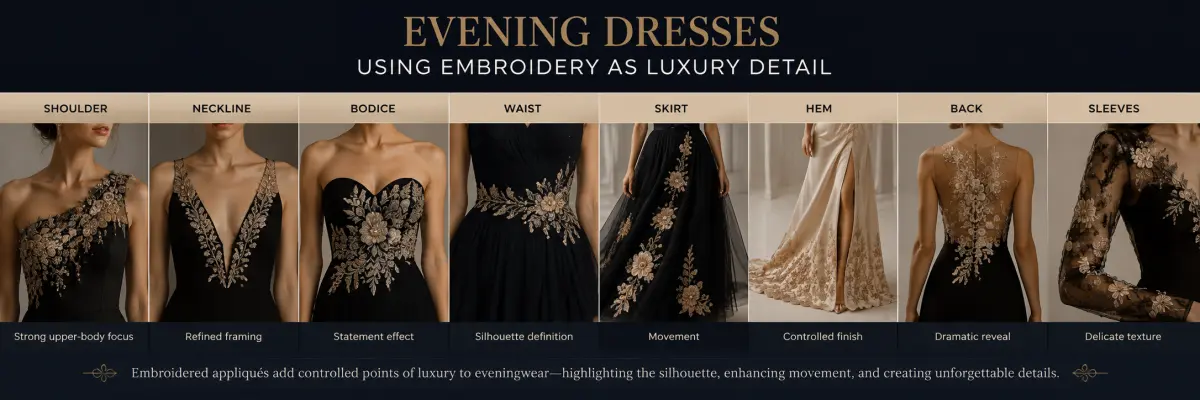
Evening Dresses: Using Embroidery as Luxury Detail
Eveningwear is one of the strongest categories for embroidered appliqués because the technique works particularly well with fabrics that already have a refined surface.
The objective is often not to make the garment look heavily embroidered.
Instead, designers use appliqués to create controlled points of luxury.
A black evening dress with a dark botanical appliqué, for example, can create a tonal effect that becomes visible only when the garment catches the light.
Similarly, metallic embroidery or subtle sequins can be introduced into selected motifs rather than distributed across the entire dress.
Common eveningwear applications
| Garment area | Typical appliqué direction | Design effect |
|---|---|---|
| Shoulder | Botanical or floral | Strong upper-body focus |
| Neckline | Narrow decorative motif | Refined framing |
| Bodice | Large central motif | Statement effect |
| Waist | Horizontal or curved motif | Silhouette definition |
| Skirt | Scattered large motifs | Movement |
| Hem | Border appliqué | Controlled finish |
| Back | Large-scale motif | Dramatic reveal |
| Sleeves | Repeated motifs | Delicate texture |
For eveningwear brands, the relationship between appliqué scale and garment silhouette is particularly important.
A motif that looks impressive on a flat sample may appear too large once placed on a fitted bodice.
This is why professional appliqué development should be considered together with the actual garment pattern rather than separately.
Blouses: Small Details With Strong Commercial Impact
Blouses provide an interesting contrast to evening dresses.
The garment is generally smaller and more structured, so the appliqué needs to work with seams, collars, cuffs and openings.
Here, relatively small decorative elements can create a noticeable difference.
Collar appliqués
An embroidered lace collar can transform a simple blouse into a more distinctive fashion product.
Possible approaches include:
-
Floral collar borders
-
Scalloped embroidered edges
-
Botanical corner motifs
-
Geometric embroidered panels
-
Tonal lace appliqués
The collar can become the primary decorative element while the rest of the garment remains clean.
Cuff appliqués
Cuffs offer another controlled area for decoration.
For premium casualwear, a narrow embroidered motif around the cuff can create a refined finish without making the garment overly formal.
Front placket
A vertically arranged appliqué can also be placed along the front of a blouse.
This creates a visual line that naturally follows the garment's construction.
For brands developing collections, this type of placement can also be standardized across multiple styles.
To see how trim elements can enhance blouse designs, browse our lace trim collection.
Skirts: Building Movement Through Motif Placement
Skirts provide more freedom than blouses because of their larger, flowing surface.
The most effective appliqué designs often work with movement.
Instead of placing motifs at equal distances, designers can create:
-
Vertical arrangements
-
Diagonal compositions
-
Asymmetrical placement
-
Border effects
-
Large-to-small motif transitions
A floral appliqué can begin near the hip and gradually extend toward the hem, creating a visual direction that follows the movement of the skirt.
This is particularly effective on:
-
Tulle skirts
-
Chiffon skirts
-
Satin skirts
-
Organza skirts
-
Lightweight evening skirts
Border appliqués
Border designs remain commercially important because they provide a clear visual finish.
They can be used along:
-
Hemlines
-
Side panels
-
Waistbands
-
Pleat edges
-
Layered skirt panels
A well-designed border can make a relatively simple skirt look significantly more developed.
Jackets: Embroidered Appliqués as a Statement Surface
Jackets provide perhaps the greatest opportunity for more expressive appliqué design.
Unlike lightweight dresses and blouses, jackets can support stronger visual elements.
Large embroidered motifs can be positioned on:
-
Back panels
-
Shoulders
-
Sleeves
-
Chest
-
Pockets
-
Lapels
The back panel is especially valuable.
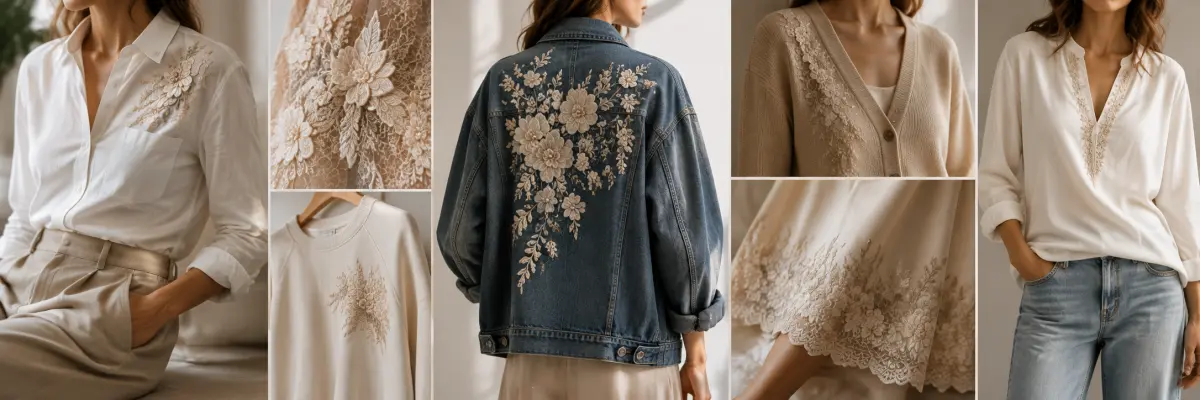
A large botanical, abstract or geometric appliqué placed across the back can become the defining feature of a jacket.
This approach is widely compatible with contemporary fashion because the base garment does not need to be complicated.
A simple denim, cotton, twill or lightweight jacket can become a statement product through one carefully developed embroidered element.
Denim and embroidery
Denim is particularly suitable for appliqué experimentation.
The contrast between:
structured denim + delicate embroidery
creates an interesting balance between casual and decorative design.
This combination works well for contemporary brands that want to introduce feminine details into utility-inspired or casual silhouettes.
For more on decorative techniques, explore our embroidery and cord embroidery collections.
Resort Wear: Lightweight Decoration With a Strong Visual Identity
Resort wear presents different design requirements.
Garments are often lightweight, relaxed and visually connected with travel, summer and outdoor environments.
Heavy embroidery can therefore be unsuitable.
Appliqués provide a way to introduce decorative elements while maintaining an airy visual language.
Typical applications include:
-
Lightweight dresses
-
Cover-ups
-
Beach shirts
-
Resort blouses
-
Kaftans
-
Skirts
-
Lightweight jackets
-
Coordinated sets
Botanical motifs are particularly suitable for resort collections because they naturally support themes related to nature, gardens and tropical environments.
However, designers do not necessarily need literal floral designs.
Abstract leaves, organic lines and oversized botanical forms can create a more contemporary result.
For lightweight decorative solutions, explore our water-soluble embroidery collection.
Luxury Casual Wear: Making Everyday Products More Distinctive
One of the most commercially interesting applications is luxury casualwear.
The challenge is to create something that feels premium without becoming excessively formal.
Embroidered appliqués can solve this problem.
A plain cotton shirt with a small embroidered botanical motif can immediately move away from basic commodity styling.
Likewise:
-
A sweatshirt can receive a sophisticated embroidered chest motif.
-
A denim jacket can use a large back appliqué.
-
A knit cardigan can incorporate floral lace elements.
-
A simple skirt can use an embroidered hem.
-
A casual blouse can combine lace and embroidery around the neckline.
The key is restraint.
Luxury casualwear usually benefits from one or two strong decorative decisions rather than excessive embellishment.
This is also where suppliers need to understand the brand's target price and product positioning.
An appliqué developed for a luxury collection may not be suitable for a mass-market casual product because its development cost, embroidery density or material selection may not fit the intended retail price.
Stage & Performance Wear: Designing for Distance and Movement
Stage and performance garments have different visual requirements from everyday fashion.
The garment needs to communicate its design from a distance.
Small details that work beautifully on a blouse may disappear under stage lighting.
This is where larger embroidered appliqués can become useful.
Design priorities include:
-
Large-scale motifs
-
High visual contrast
-
Strong silhouette placement
-
Reflective or dimensional elements
-
Sequins and beads
-
Metallic embroidery
-
Strategic surface coverage
For stage costumes, appliqués may be developed specifically around the movement of the performer.
For example, a large motif extending from the shoulder toward the waist can emphasize body movement.
Similarly, decorative elements on sleeves can become more visible during choreography.
The development process therefore needs to consider not only the static garment but also how the appliqué behaves when the garment moves.
For dimensional effects, browse our sequins and beads embroidery collection.
Fashion Accessories: Small Products, High Decorative Value
Embroidered appliqués are not limited to apparel.
Accessories offer another commercial application for brands looking to extend a visual theme across a collection.
Potential products include:
-
Handbags
-
Shoes
-
Belts
-
Hair accessories
-
Hats
-
Gloves
-
Scarves
-
Headbands
-
Decorative pouches
A brand may develop one signature floral appliqué and use it across a dress, blouse, handbag and hair accessory.
This creates visual continuity across the collection.
The same design language can therefore appear in multiple product categories without producing identical products.
This is particularly useful for seasonal collections.
For accessory applications, explore our lace trim and cut piece options.
One Appliqué Design, Multiple Fashion Applications
One of the biggest advantages of custom appliqué development is the ability to create a common design language across different garments.
For example, a brand could develop one botanical motif in three sizes:
-
Small
-
Medium
-
Large
The same design could then be applied differently across the collection.
| Product | Motif size | Suggested placement |
|---|---|---|
| Blouse | Small | Collar or cuff |
| Dress | Medium | Shoulder or waist |
| Skirt | Large | Side or hem |
| Jacket | Large | Back panel |
| Handbag | Small/Medium | Front panel |
| Resort dress | Large | Lower skirt |
| Evening dress | Large | Bodice or back |
This approach allows a collection to look cohesive without making every garment identical.
For fashion brands, that distinction is important.
A successful collection normally needs consistency without repetition.
Designing Appliqués Around the Garment, Not the Other Way Around
One common mistake in appliqué development is treating the embroidery as an independent artwork.
In fashion, the garment comes first.
The appliqué should respond to:
-
Silhouette
-
Seam lines
-
Darts
-
Panels
-
Neckline
-
Sleeve construction
-
Hemline
-
Fabric drape
-
Garment movement
For example, a large floral motif that works beautifully on a flat fabric may become visually distorted when placed across a curved bust area.
Similarly, a border appliqué may need to be adjusted when applied to a curved hem.
This is why fashion brands should provide the supplier with more than a simple embroidery artwork whenever possible.
Useful development information includes:
-
Garment sketch
-
Pattern information
-
Placement drawing
-
Motif dimensions
-
Color references
-
Base fabric information
-
Finished garment application
-
Required quantity
For more detailed custom lace development, brands can also refer to our guide on pattern design development , which explains how design concepts can be translated into production-ready textile specifications.
For custom development services, visit our customized process page.
Choosing the Right Base for an Embroidered Appliqué
The base material has a major influence on the final appearance.
There is no single best base for every application.
| Base | Visual character | Suitable applications |
|---|---|---|
| Tulle | Lightweight, transparent | Dresses, eveningwear, sleeves |
| Mesh | Flexible and open | Dresses, tops, stagewear |
| Organza | Crisp and structured | Jackets, dresses, accessories |
| Lace | Decorative and textured | Blouses, dresses, luxury apparel |
| Cotton | Natural and stable | Casualwear, shirts, jackets |
| Satin | Smooth and refined | Eveningwear |
| Stretch mesh | Flexible | Fitted garments, performance wear |
For luxury womenswear, transparent or semi-transparent bases are particularly useful because they allow the embroidery to visually merge with the garment.
This can create the appearance of embroidery directly on the garment while maintaining a more dimensional effect.
For a wide selection of base materials, explore our lace fabric collection.
How Embroidered Appliqués Support Brand Identity
For established fashion brands, appliqués can become more than seasonal decoration.
They can become part of the brand's visual language.
Consider a brand known for:
-
Oversized botanical motifs
-
Fine monochrome floral embroidery
-
Art Deco geometry
-
Hand-drawn linework
-
Tropical motifs
-
Metallic decorative elements
A consistent appliqué language can appear across several collections.
The motif may change each season, but the underlying design characteristics remain recognizable.
This is particularly useful for brands positioned in the premium and luxury segments.
The objective is not necessarily to create a completely different embroidery design every season.
Instead, brands can develop a repeatable design system.
For example:
Signature floral → seasonal variation → different scale → different placement → different garment
This creates continuity while still allowing product development flexibility.
For more on the broader embroidery landscape, explore our key trends shaping the global lace and embroidery industry .
Custom Appliqué Development for Fashion Brands
When a brand moves from standard stock motifs to custom appliqués, the development process becomes more collaborative.
The brand's designer provides the creative direction, while the supplier evaluates how that concept can be translated into a commercially viable textile product.
A typical development sequence may involve:
Design concept → Artwork → Motif development → Material selection → Sample → Placement review → Revision → Production
The goal is not simply to reproduce an artwork.
The supplier also needs to consider:
-
Motif scale
-
Stitch density
-
Fabric stability
-
Edge finishing
-
Pattern repeat
-
Color matching
-
Garment application
-
Production quantity
For more complex projects, the appliqué may be developed as part of a broader custom embroidered lace program.
MJlace provides custom solutions for fashion brands, including multi-color embroidery , laser embroidery , and other specialized techniques.
Appliqué Development and Collection Planning
Fashion brands can also use appliqués strategically at the collection level.
Instead of developing each decorative element independently, designers can establish a common motif library.
For example:
Collection A — Botanical
-
Large flower
-
Small leaf
-
Curved vine
-
Floral border
Collection B — Geometric
-
Art Deco motif
-
Linear border
-
Repeated diamond
-
Abstract circle
The motifs can then be adapted across multiple garment categories.
This reduces unnecessary design repetition and creates a more coherent collection.
It can also simplify communication between the designer, product developer and supplier.
How Much Embroidery Is Enough?
More embroidery does not automatically mean a more valuable garment.
This is one of the most important considerations when using appliqués.
A garment can lose sophistication when too many motifs compete for attention.
For premium fashion, designers often need to consider three levels of decoration:
Level 1 — Accent
One or two small motifs.
Best for:
-
Blouses
-
Casualwear
-
Accessories
-
Minimalist dresses
Level 2 — Statement
Several coordinated motifs or one large appliqué.
Best for:
-
Evening dresses
-
Jackets
-
Resort dresses
-
Premium ready-to-wear
Level 3 — Full Decorative Composition
Large-scale appliqués combined with embroidery, lace, sequins, beads or other elements.
Best for:
-
Stagewear
-
Couture-inspired fashion
-
Statement eveningwear
-
Special collections
The right level depends on the brand's positioning, target consumer and retail price.
Combining Appliqués With Other Textile Details
Appliqués become even more versatile when combined with other surface treatments.
Appliqué + sequins
Useful for eveningwear and stagewear.
Sequins can introduce light reflection while embroidery provides structure.
Appliqué + beads
Suitable for premium evening garments and statement pieces.
Beads can be concentrated in selected areas instead of covering the entire garment.
Appliqué + lace
One of the most natural combinations for women's fashion.
Lace provides the overall textile character while appliqués create stronger focal points.
Appliqué + cord embroidery
Corded elements can increase dimensionality and create stronger outlines around floral or geometric motifs.
Appliqué + printing
Printed backgrounds can be combined with embroidered motifs to create layered visual effects.
For brands looking for a broader range of decorative textile solutions, MJlace also develops water-soluble embroidery and other customized lace constructions.
Appliqués for Different Fashion Price Segments
Not every appliqué needs to be developed to the same specification.
A designer working on a premium casual collection may need a relatively simple embroidered motif, while a luxury evening collection may require multiple materials and significantly higher embroidery density.
| Market segment | Typical approach |
|---|---|
| Contemporary | Clean motifs, controlled placement |
| Premium | More detailed embroidery and better material selection |
| Luxury | Custom motifs, dimensional effects, complex placement |
| Couture-inspired | Highly detailed compositions and hand-finished effects |
| Stagewear | High-impact scale and reflective details |
| Resort | Lightweight motifs and botanical themes |
Understanding the target price point before development helps prevent over-engineering.
This is particularly important for B2B buyers.
A beautiful sample is not necessarily a commercially viable product if the decoration pushes the final garment beyond its intended retail positioning.
What Fashion Brands Should Provide to an Appliqué Supplier
Clear specifications can significantly improve development efficiency.
Before starting a custom project, brands should ideally prepare:
| Information | Why it matters |
|---|---|
| Artwork | Defines the visual direction |
| Garment sketch | Shows intended application |
| Pattern or placement drawing | Helps determine motif position |
| Motif size | Controls scale |
| Color references | Supports accurate color development |
| Base fabric | Determines compatibility |
| Quantity | Helps supplier plan production |
| Target price | Helps control complexity |
| Application | Dress, blouse, jacket, etc. |
| Sample deadline | Supports development planning |
This is especially important when appliqués are developed specifically for a garment rather than purchased as standard stock.
For B2B fashion development, the earlier the supplier understands the final garment application, the easier it is to evaluate the design realistically.
For more sourcing guidance, visit our buying guide & sourcing tips category.
Why Supplier Capability Matters
From a fashion brand's perspective, the supplier is not simply providing embroidery.
The supplier needs to understand how the decorative element will eventually become part of a garment.
That requires coordination between:
-
Textile development
-
Embroidery
-
Pattern placement
-
Material selection
-
Sampling
-
Quality control
-
Production
-
Packaging
A manufacturer with experience in lace and embroidered textiles can therefore provide more value during the development stage.
MJlace's production portfolio includes embroidered lace, cord embroidery, water-soluble embroidery, cut-piece processing and other customized textile solutions. The company's cut piece product range is particularly relevant when embroidered elements need to be developed around specific garment pieces.
For more on our manufacturing capabilities, visit our about us page.
Quality Considerations for Fashion Appliqués
Although this article focuses on fashion applications rather than manufacturing technology, several quality factors directly affect the final garment.
Motif consistency
Repeated motifs should remain consistent in:
-
Size
-
Shape
-
Stitch density
-
Color
-
Edge quality
Edge finishing
The outer edge of an appliqué has a major influence on the final appearance.
Poor edge definition can make an otherwise high-quality garment look unfinished.
Dimensional stability
The appliqué should maintain its intended shape during handling, sewing and garment finishing.
Color consistency
For collection production, color differences between batches can become particularly noticeable when the same appliqué is used across multiple styles.
Placement accuracy
For statement garments, a few millimeters can matter.
A motif positioned correctly on a sample but shifted during production can change the visual balance of the garment.
For quality assurance, explore our quality control standards category.
How Appliqués Can Increase Perceived Garment Value
One reason fashion brands continue to use embroidered appliqués is the relationship between decoration and perceived product value.
A simple garment with an appropriately designed embroidered element can appear considerably more developed than the same garment without decoration.
But the value does not come simply from adding embroidery.
It comes from the combination of:
Design + placement + material + craftsmanship + proportion
A small appliqué in the right location can therefore be more commercially effective than a much larger quantity of poorly positioned decoration.
This is particularly relevant for premium ready-to-wear, where the product needs to balance visual differentiation with production efficiency.
Building a Consistent Appliqué Collection With a Lace Supplier
For brands developing multiple styles, working with one experienced supplier can help maintain consistency across the collection.
A seasonal project may include:
-
Dress appliqués
-
Blouse motifs
-
Jacket panels
-
Skirt borders
-
Accessory motifs
-
Resortwear decorations
Rather than developing each component independently, the supplier can work from one common design direction.
This can help maintain:
-
Consistent thread colors
-
Similar motif language
-
Matching lace structures
-
Coordinated embroidery density
-
Consistent finishing
For a fashion brand, this creates a stronger relationship between individual garments.
For more on how our products are used across industries, read our guide on how lace fabric is used across different industries .
Frequently Asked Questions
What are embroidered appliqués used for in fashion?
Embroidered appliqués are used to add decorative motifs to garments and accessories. Common applications include women's dresses, eveningwear, blouses, skirts, jackets, resort wear, luxury casualwear, stage costumes and handbags.
Are embroidered appliqués suitable for ready-to-wear collections?
Yes. Appliqués are particularly useful for ready-to-wear because designers can control the amount and location of decoration without using embroidery across the entire garment.
Can fashion brands create custom embroidered appliqués?
Yes. Custom appliqués can be developed around a brand's artwork, motif, color palette, garment silhouette and placement requirements.
Can the same appliqué be used on different garments?
Yes. A single motif can be developed in different sizes or adapted for different placements. This allows brands to create a consistent visual language across dresses, blouses, jackets and accessories.
What fabrics can be used with embroidered appliqués?
Common bases include lace, tulle, mesh, organza and other lightweight textiles. The appropriate material depends on the garment, motif and required appearance.
Are appliqués suitable for luxury fashion?
Yes. They are particularly effective in luxury fashion because they allow designers to create highly controlled decorative details and combine embroidery with lace, beads, sequins and dimensional effects.
Can appliqués be used for jackets?
Yes. Jackets are particularly suitable for large-scale appliqués, especially on back panels, sleeves, shoulders and chest areas.
Are embroidered appliqués suitable for resort wear?
Yes. Lightweight floral, botanical and abstract motifs work well for resort dresses, blouses, skirts, kaftans and other relaxed silhouettes.
Can appliqués be combined with lace?
Yes. Lace and embroidery are highly compatible. A lace base can provide transparency and texture while embroidered appliqués create stronger visual focal points.
What should a fashion brand provide when developing custom appliqués?
At minimum, brands should provide the artwork, intended garment application, motif size, placement requirements, color references and expected quantity. A garment sketch or technical drawing is also highly useful.
For more answers, visit our FAQs page.
Conclusion: Appliqués Turn Decoration Into Design
Embroidered appliqués are most effective when they are treated as part of the garment design rather than as an additional decorative component.
For a dress, the appliqué can define the silhouette. For a blouse, it can become a refined collar or cuff detail. On a jacket, it can create a strong back statement. In resort wear, it can add a lightweight botanical element. In luxury casualwear, it can transform a simple product into something more distinctive.
The flexibility is what makes appliqués particularly valuable to fashion brands.
Instead of asking how much embroidery should be added to a garment, designers can ask a more useful question:
Where can embroidery create the strongest design impact?
That shift—from decoration to placement—is what allows embroidered appliqués to become a genuine part of fashion product development.
For brands developing custom embroidered textiles, the most effective approach is to work from the garment outward: define the silhouette, determine the visual focus, develop the motif, select the appropriate textile base and then refine the placement through sampling.
For more information on custom development, visit our customized process page or contact us to discuss your project.