
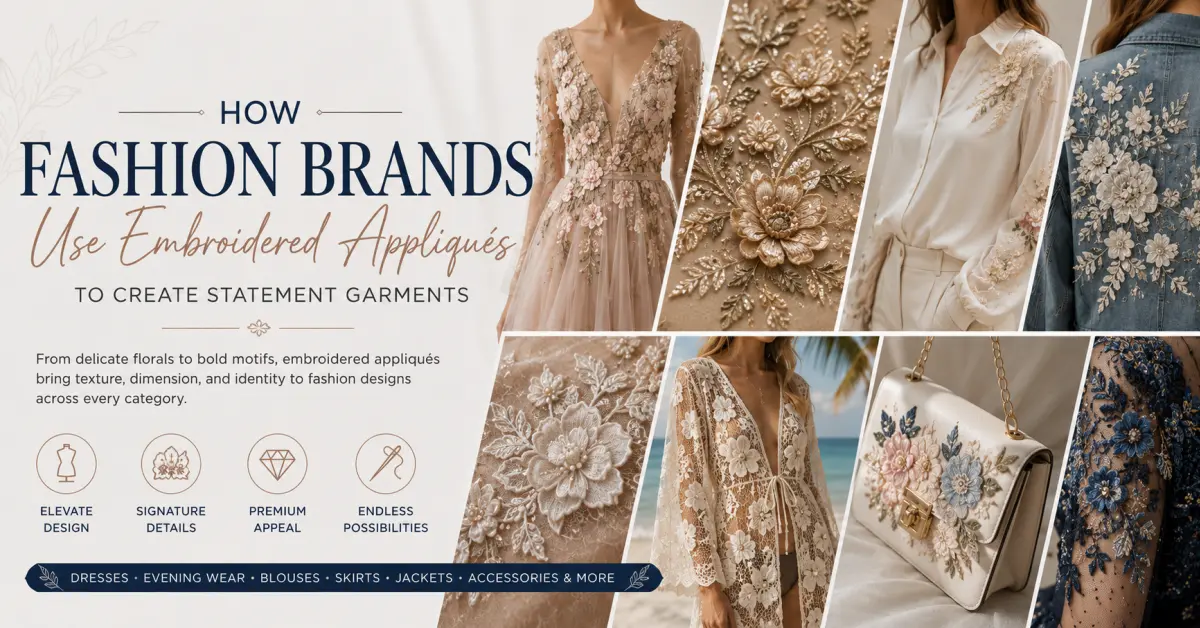

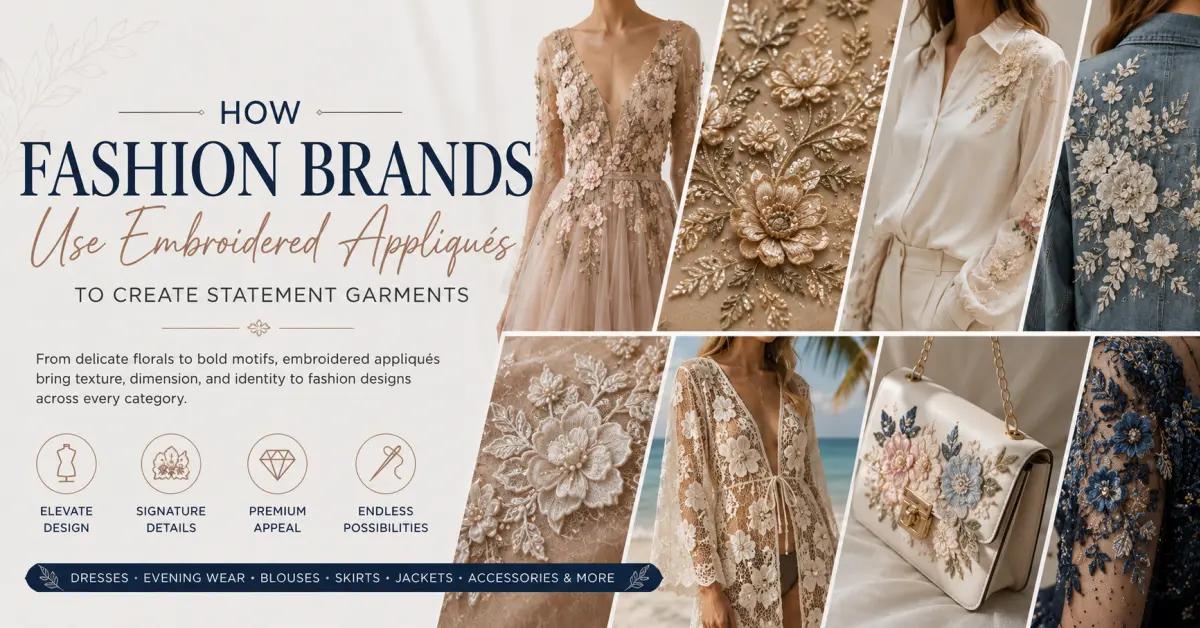
刺绣贴花已成为时尚品牌日益有效的方式,可以为服装增添个性、质感和视觉冲击力,而无需用繁重的装饰覆盖整个产品。
对于设计师来说,吸引力很简单。连衣裙上精心布置的花卉图案、夹克上的立体贴花或衬衫上的一系列刺绣元素可以完全改变服装的外观。底布可以保持相对简单,而贴花则创造视觉焦点。
这使得刺绣贴花对于当代女装、晚装系列、度假装和高级成衣特别有价值。
与全表面刺绣不同,贴花开发使设计师能够更好地控制装饰出现的位置、使用量以及它如何与服装轮廓互动。它可以用作边框、中心图案、肩部细节、袖子元素、领口装饰或直接放置在服装上的独立声明。
对于时尚品牌来说,机会不仅仅是让服装更具装饰性。真正的价值在于战略性地使用刺绣。
精心设计的贴花可以:
-
定义服装的视觉识别
-
突出显示剪影的特定部分
-
在不增加整件衣服表面装饰的情况下增加感知价值
-
创建可识别的设计签名
-
结合蕾丝、刺绣、珠子、亮片和立体元素
-
赋予相对简单的服装更高级的外观
-
支持季节性设计故事,无需全新的基础面料
对于供应商和制造商来说,这也为更加定制化的产品开发创造了机会。品牌可以围绕特定服装开发图案和布局概念,而不是从目录中选择标准刺绣面料。
本文探讨了时尚品牌如何在不同产品类别中使用刺绣贴花,以及设计师和买家在开发它们时应考虑的事项。
什么是时尚刺绣贴花?
刺绣贴花是一种装饰性刺绣元素,设计用于切割、定位并应用于服装或纺织品表面。
贴花可以在蕾丝、网布、薄纱、欧根纱或其他合适的纺织基底上制作。根据设计的不同,它可以保持附着在可见的背衬上,也可以进行开发,以使周围的基底最小化或去除,从而使刺绣图案成为主要的视觉元素。
绣花贴花与普通绣花面料最重要的区别在于服装设计中装饰的使用方式。
对于传统的刺绣面料,刺绣通常是面料表面的一部分。设计师将面料视为一个整体。
通过贴花,设计师可以使用单独的装饰组件。
这提供了更大的灵活性。
例如,为连衣裙开发的花卉图案可能会根据系列的最终设计在胸围、腰部、袖子或裙子上的位置有所不同。相同的图案也可以在一个系列中的多件服装上使用,同时改变其位置。
这种灵活性使得贴花对于开发协调系列的品牌特别有用。
要探索贴花与其他装饰技术的关系,请阅读我们的指南蕾丝类型和类别 .
为什么时尚品牌使用贴花而不是全表面刺绣
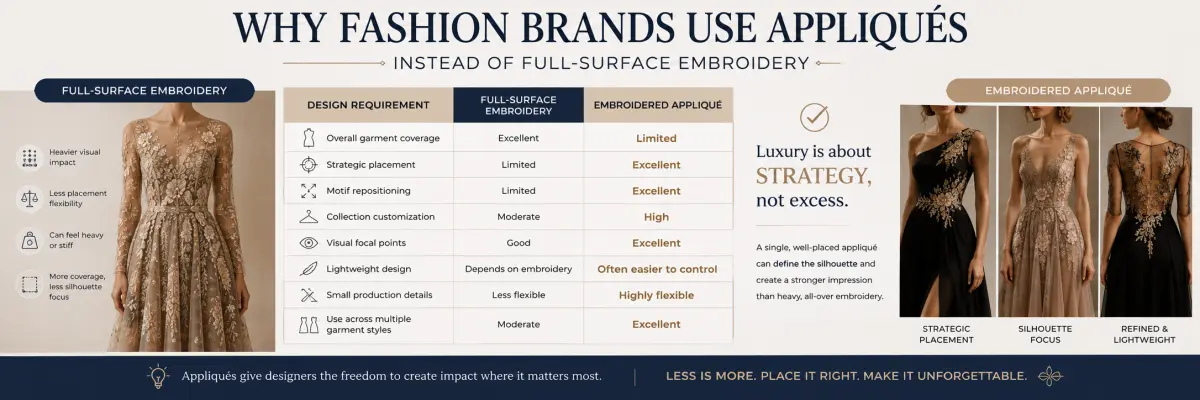
全面刺绣可以营造强烈的视觉效果,但它并不总是时尚服装的最佳解决方案。
设计师可能希望装饰遵循轮廓,而不是覆盖整个面料。在其他情况下,过多的刺绣会使服装看起来很厚重或干扰悬垂性。
贴花提供了另一种方法。
这种区别对于高端时尚尤其重要。
奢华并不总是意味着更多的装饰。
在许多系列中,少量精心定位的刺绣比整件衣服上密集的装饰效果更强烈。
单肩上的大型植物贴花可能比均匀分布在连衣裙上的数百朵小绣花更具特色。
如需更多设计视角,请探索我们的时尚趋势和设计灵感类别。
女装:打造强大焦点
女装是刺绣贴花最通用的应用之一。
连衣裙的大表面积为设计师提供了相当大的自由度来尝试布局、比例和构图。
设计师可以使用贴花来引导视线穿过轮廓,而不是统一使用刺绣。
紧身胸衣位置
可以在衣身上放置大型花卉或植物贴花,打造结构化的视觉中心。
当底裙由以下材料制成时,这种方法特别有效:
-
丝缎
-
绉纱
-
雪纺
-
薄纱
-
网格
-
欧根纱
-
轻质梭织面料
相对干净的底布和纹理刺绣图案之间的对比创造了深度,而不需要全面的刺绣表面。
腰部位置
贴花也可以用在腰部,以视觉上定义连衣裙上半部分和下半部分之间的过渡。
当图案遵循服装的结构线条时,这尤其有效。
刺绣不再像随意放置在服装上的装饰,而是成为轮廓的一部分。
裙子位置
对于飘逸的连衣裙,较大的图案可以分布在下半裙上。
超大花朵、藤蔓和抽象植物形态可以垂直放置,在佩戴者行走时创造动感。
这对于长连衣裙特别有效,因为贴花可以沿着服装的方向移动,而不是显示为孤立的补丁。
袖子和肩部位置
较小的贴花可用于:
-
肩部
-
袖口
-
上臂
-
弯头
-
袖口
这为设计师提供了另一种创造视觉平衡的方式。
对于极简主义连衣裙,肩部的小刺绣图案可能足以彰显服装的特色。
如需定制礼服应用,请探索我们的新娘蕾丝系列。
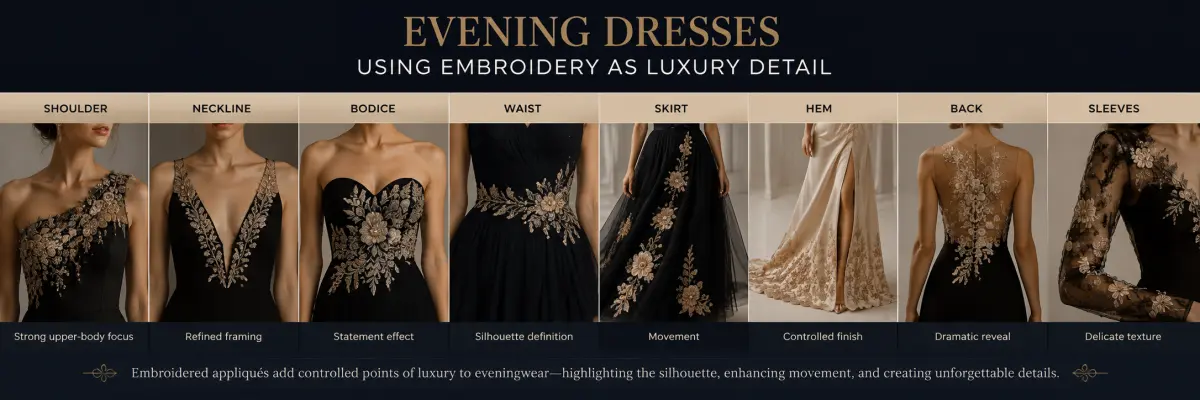
晚礼服:使用刺绣作为奢华细节
晚装是刺绣贴花最强大的类别之一,因为该技术特别适用于已经具有精致表面的面料。
目标通常不是让服装看起来有大量刺绣。
相反,设计师使用贴花来打造奢华的控制点。
例如,带有深色植物贴花的黑色晚礼服可以营造出只有当衣服在光线照射下才可见的色调效果。
同样,金属刺绣或精致的亮片可以引入到选定的图案中,而不是分布在整件连衣裙上。
常见晚装应用
对于晚装品牌来说,贴花比例与服装廓形之间的关系尤为重要。
在平面样品上看起来令人印象深刻的图案一旦放在合身的紧身胸衣上可能会显得太大。
这就是为什么专业贴花开发应与实际服装版型一起考虑,而不是单独考虑。
衬衫:具有强大商业影响力的小细节
衬衫与晚礼服形成有趣的对比。
服装通常较小且更具结构性,因此贴花需要与接缝、衣领、袖口和开口配合使用。
在这里,相对较小的装饰元素可以产生明显的差异。
衣领贴花
刺绣蕾丝领子可以将简单的衬衫变成更具特色的时尚单品。
可能的方法包括:
-
花领边框
-
扇形刺绣边缘
-
植物角图案
-
几何刺绣面板
-
同色蕾丝贴花
衣领可以成为主要的装饰元素,而衣服的其余部分保持干净。
袖口贴花
袖口提供了另一个受控的装饰区域。
对于高级休闲装,袖口周围的窄刺绣图案可以打造精致的外观,而又不会使服装过于正式。
前衣襟
垂直排列的贴花也可以沿着衬衫的正面放置。
这会创建一条自然遵循服装结构的视觉线条。
对于开发系列的品牌,这种类型的展示位置也可以在多种风格中标准化。
要了解装饰元素如何增强衬衫设计,请浏览我们的蕾丝装饰系列。
裙子:通过图案放置营造动感
裙子比衬衫更自由,因为它们的表面更大、更流畅。
最有效的贴花设计通常与运动相结合。
设计师可以创建:
,而不是将图案等距放置-
垂直排列
-
对角线构图
-
不对称放置
-
边框效果
-
大到小主题过渡
花卉贴花可以从臀部附近开始,逐渐向下摆延伸,形成跟随裙子运动的视觉方向。
这对于以下方面特别有效:
-
薄纱半身裙
-
雪纺裙
-
缎面半身裙
-
欧根纱半身裙
-
轻质晚礼服
边框贴花
边框设计在商业上仍然很重要,因为它们提供了清晰的视觉效果。
它们可以一起使用:
-
裙摆
-
侧面板
-
腰带
-
褶皱边缘
-
分层裙板
精心设计的边框可以让相对简单的裙子看起来明显更加发达。
夹克:刺绣贴花作为个性化表面
夹克或许为更具表现力的贴花设计提供了最好的机会。
与轻便的连衣裙和衬衫不同,夹克可以支持更强的视觉元素。
大刺绣图案可以放置在:
-
后面板
-
肩部
-
袖子
-
宝箱
-
口袋
-
翻领
后面板特别有价值。
背面放置的大型植物、抽象或几何贴花可以成为夹克的标志性特征。
这种方法与当代时尚广泛兼容,因为基础服装不需要太复杂。
一件简单的牛仔布、棉质、斜纹布或轻质夹克可以通过精心设计的刺绣元素成为个性化产品。
牛仔布和刺绣
牛仔布特别适合贴花实验。
对比:
结构牛仔+精致刺绣
在休闲和装饰设计之间创造了有趣的平衡。
这种组合非常适合想要将女性化细节引入实用风格或休闲廓形的当代品牌。
度假装:轻质装饰,视觉识别强烈
度假装提出了不同的设计要求。
服装通常轻便、休闲,在视觉上与旅行、夏季和户外环境相关。
因此不适合大量刺绣。
贴花提供了一种在保持轻盈视觉语言的同时引入装饰元素的方法。
典型应用包括:
-
轻质连衣裙
-
罩衫
-
沙滩衬衫
-
度假衬衫
-
长袍
-
裙子
-
轻便夹克
-
协调集
植物图案特别适合度假村系列,因为它们自然支持与自然、花园和热带环境相关的主题。
但是,设计师不一定需要字面上的花卉设计。
抽象树叶、有机线条和超大植物形态可以创造出更现代的效果。
如需轻质装饰解决方案,请探索我们的水溶性刺绣系列。
奢华休闲服饰:让日常用品更具特色
最具商业价值的应用之一是奢华休闲服装。
挑战在于创造出一种让人感觉优质但又不会变得过于正式的东西。
刺绣贴花可以解决这个问题。
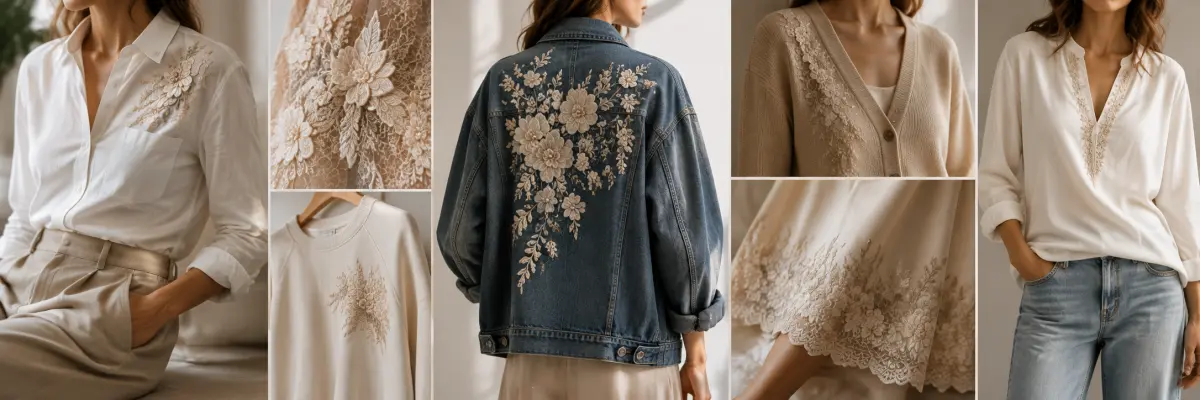
带有小植物图案刺绣的纯棉衬衫可以立即摆脱基本的商品造型。
同样:
-
运动衫上可以饰有精致的刺绣胸部图案。
-
牛仔夹克可以使用大背面贴花。
-
针织开衫可以融入花卉蕾丝元素。
-
简单的裙子可以使用刺绣下摆。
-
休闲衬衫可以在领口结合蕾丝和刺绣。
关键是克制。
豪华休闲装通常受益于一两个强有力的装饰决策,而不是过多的装饰。
这也是供应商需要了解品牌目标价格和产品定位的地方。
为奢侈品系列开发的贴花可能不适合大众市场的休闲产品,因为其开发成本、刺绣密度或材料选择可能不符合预期零售价。
舞台和表演服装:针对距离和运动进行设计
舞台和表演服装与日常时尚有着不同的视觉要求。
服装需要从远处传达其设计。
衬衫上精美的小细节可能会在舞台灯光下消失。
这是较大的刺绣贴花可以发挥作用的地方。
设计优先事项包括:
-
大型图案
-
高视觉对比度
-
醒目的剪影位置
-
反光或维度元素
-
亮片和珠子
-
金属刺绣
-
战略表面覆盖
对于舞台服装,贴花可以专门围绕表演者的动作开发。
例如,从肩部延伸至腰部的大图案可以强调身体的运动。
同样,袖子上的装饰元素在编舞过程中会变得更加明显。
因此,开发过程不仅需要考虑静态服装,还需要考虑服装移动时贴花的行为方式。
如需立体效果,请浏览我们的亮片和珠子刺绣集合。
时尚配饰:小产品,高装饰价值
Embroidered appliqués are not limited to apparel.
Accessories offer another commercial application for brands looking to extend a visual theme across a collection.
Potential products include:
-
Handbags
-
Shoes
-
Belts
-
Hair accessories
-
Hats
-
Gloves
-
Scarves
-
Headbands
-
Decorative pouches
A brand may develop one signature floral appliqué and use it across a dress, blouse, handbag and hair accessory.
This creates visual continuity across the collection.
The same design language can therefore appear in multiple product categories without producing identical products.
This is particularly useful for seasonal collections.
For accessory applications, explore our lace trim and cut piece options.
One Appliqué Design, Multiple Fashion Applications
One of the biggest advantages of custom appliqué development is the ability to create a common design language across different garments.
For example, a brand could develop one botanical motif in three sizes:
-
Small
-
Medium
-
Large
The same design could then be applied differently across the collection.
This approach allows a collection to look cohesive without making every garment identical.
For fashion brands, that distinction is important.
A successful collection normally needs consistency without repetition.
Designing Appliqués Around the Garment, Not the Other Way Around
One common mistake in appliqué development is treating the embroidery as an independent artwork.
In fashion, the garment comes first.
The appliqué should respond to:
-
Silhouette
-
Seam lines
-
Darts
-
Panels
-
Neckline
-
Sleeve construction
-
Hemline
-
Fabric drape
-
Garment movement
For example, a large floral motif that works beautifully on a flat fabric may become visually distorted when placed across a curved bust area.
Similarly, a border appliqué may need to be adjusted when applied to a curved hem.
This is why fashion brands should provide the supplier with more than a simple embroidery artwork whenever possible.
Useful development information includes:
-
Garment sketch
-
Pattern information
-
Placement drawing
-
Motif dimensions
-
Color references
-
Base fabric information
-
Finished garment application
-
Required quantity
For more detailed custom lace development, brands can also refer to our guide on pattern design development , which explains how design concepts can be translated into production-ready textile specifications.
For custom development services, visit our customized process page.
Choosing the Right Base for an Embroidered Appliqué
The base material has a major influence on the final appearance.
There is no single best base for every application.
For luxury womenswear, transparent or semi-transparent bases are particularly useful because they allow the embroidery to visually merge with the garment.
This can create the appearance of embroidery directly on the garment while maintaining a more dimensional effect.
For a wide selection of base materials, explore our lace fabric collection.
How Embroidered Appliqués Support Brand Identity
For established fashion brands, appliqués can become more than seasonal decoration.
They can become part of the brand's visual language.
Consider a brand known for:
-
Oversized botanical motifs
-
Fine monochrome floral embroidery
-
Art Deco geometry
-
Hand-drawn linework
-
Tropical motifs
-
Metallic decorative elements
A consistent appliqué language can appear across several collections.
The motif may change each season, but the underlying design characteristics remain recognizable.
This is particularly useful for brands positioned in the premium and luxury segments.
The objective is not necessarily to create a completely different embroidery design every season.
Instead, brands can develop a repeatable design system.
For example:
Signature floral → seasonal variation → different scale → different placement → different garment
This creates continuity while still allowing product development flexibility.
For more on the broader embroidery landscape, explore our key trends shaping the global lace and embroidery industry .
Custom Appliqué Development for Fashion Brands
When a brand moves from standard stock motifs to custom appliqués, the development process becomes more collaborative.
The brand's designer provides the creative direction, while the supplier evaluates how that concept can be translated into a commercially viable textile product.
A typical development sequence may involve:
Design concept → Artwork → Motif development → Material selection → Sample → Placement review → Revision → Production
The goal is not simply to reproduce an artwork.
The supplier also needs to consider:
-
Motif scale
-
Stitch density
-
Fabric stability
-
Edge finishing
-
Pattern repeat
-
Color matching
-
Garment application
-
Production quantity
For more complex projects, the appliqué may be developed as part of a broader custom embroidered lace program.
MJlace provides custom solutions for fashion brands, including multi-color embroidery , laser embroidery , and other specialized techniques.
Appliqué Development and Collection Planning
Fashion brands can also use appliqués strategically at the collection level.
Instead of developing each decorative element independently, designers can establish a common motif library.
For example:
Collection A — Botanical
-
Large flower
-
Small leaf
-
Curved vine
-
Floral border
Collection B — Geometric
-
Art Deco motif
-
Linear border
-
Repeated diamond
-
Abstract circle
The motifs can then be adapted across multiple garment categories.
This reduces unnecessary design repetition and creates a more coherent collection.
It can also simplify communication between the designer, product developer and supplier.
How Much Embroidery Is Enough?
More embroidery does not automatically mean a more valuable garment.
This is one of the most important considerations when using appliqués.
A garment can lose sophistication when too many motifs compete for attention.
For premium fashion, designers often need to consider three levels of decoration:
Level 1 — Accent
One or two small motifs.
Best for:
-
Blouses
-
Casualwear
-
Accessories
-
Minimalist dresses
Level 2 — Statement
Several coordinated motifs or one large appliqué.
Best for:
-
Evening dresses
-
Jackets
-
Resort dresses
-
Premium ready-to-wear
Level 3 — Full Decorative Composition
Large-scale appliqués combined with embroidery, lace, sequins, beads or other elements.
Best for:
-
Stagewear
-
Couture-inspired fashion
-
Statement eveningwear
-
Special collections
The right level depends on the brand's positioning, target consumer and retail price.
Combining Appliqués With Other Textile Details
Appliqués become even more versatile when combined with other surface treatments.
Appliqué + sequins
Useful for eveningwear and stagewear.
Sequins can introduce light reflection while embroidery provides structure.
Appliqué + beads
Suitable for premium evening garments and statement pieces.
Beads can be concentrated in selected areas instead of covering the entire garment.
Appliqué + lace
One of the most natural combinations for women's fashion.
Lace provides the overall textile character while appliqués create stronger focal points.
Appliqué + cord embroidery
Corded elements can increase dimensionality and create stronger outlines around floral or geometric motifs.
Appliqué + printing
Printed backgrounds can be combined with embroidered motifs to create layered visual effects.
For brands looking for a broader range of decorative textile solutions, MJlace also develops water-soluble embroidery and other customized lace constructions.
Appliqués for Different Fashion Price Segments
Not every appliqué needs to be developed to the same specification.
A designer working on a premium casual collection may need a relatively simple embroidered motif, while a luxury evening collection may require multiple materials and significantly higher embroidery density.
Understanding the target price point before development helps prevent over-engineering.
This is particularly important for B2B buyers.
A beautiful sample is not necessarily a commercially viable product if the decoration pushes the final garment beyond its intended retail positioning.
What Fashion Brands Should Provide to an Appliqué Supplier
Clear specifications can significantly improve development efficiency.
Before starting a custom project, brands should ideally prepare:
This is especially important when appliqués are developed specifically for a garment rather than purchased as standard stock.
For B2B fashion development, the earlier the supplier understands the final garment application, the easier it is to evaluate the design realistically.
For more sourcing guidance, visit our buying guide & sourcing tips category.
Why Supplier Capability Matters
From a fashion brand's perspective, the supplier is not simply providing embroidery.
The supplier needs to understand how the decorative element will eventually become part of a garment.
That requires coordination between:
-
Textile development
-
Embroidery
-
Pattern placement
-
Material selection
-
采样
-
Quality control
-
Production
-
Packaging
A manufacturer with experience in lace and embroidered textiles can therefore provide more value during the development stage.
MJlace's production portfolio includes embroidered lace, cord embroidery, water-soluble embroidery, cut-piece processing and other customized textile solutions. The company's cut piece product range is particularly relevant when embroidered elements need to be developed around specific garment pieces.
For more on our manufacturing capabilities, visit our about us page.
Quality Considerations for Fashion Appliqués
Although this article focuses on fashion applications rather than manufacturing technology, several quality factors directly affect the final garment.
Motif consistency
Repeated motifs should remain consistent in:
-
Size
-
Shape
-
Stitch density
-
Color
-
Edge quality
Edge finishing
The outer edge of an appliqué has a major influence on the final appearance.
Poor edge definition can make an otherwise high-quality garment look unfinished.
Dimensional stability
The appliqué should maintain its intended shape during handling, sewing and garment finishing.
Color consistency
For collection production, color differences between batches can become particularly noticeable when the same appliqué is used across multiple styles.
Placement accuracy
For statement garments, a few millimeters can matter.
A motif positioned correctly on a sample but shifted during production can change the visual balance of the garment.
For quality assurance, explore our quality control standards category.
How Appliqués Can Increase Perceived Garment Value
One reason fashion brands continue to use embroidered appliqués is the relationship between decoration and perceived product value.
A simple garment with an appropriately designed embroidered element can appear considerably more developed than the same garment without decoration.
But the value does not come simply from adding embroidery.
It comes from the combination of:
Design + placement + material + craftsmanship + proportion
A small appliqué in the right location can therefore be more commercially effective than a much larger quantity of poorly positioned decoration.
This is particularly relevant for premium ready-to-wear, where the product needs to balance visual differentiation with production efficiency.
Building a Consistent Appliqué Collection With a Lace Supplier
For brands developing multiple styles, working with one experienced supplier can help maintain consistency across the collection.
A seasonal project may include:
-
Dress appliqués
-
Blouse motifs
-
Jacket panels
-
Skirt borders
-
Accessory motifs
-
Resortwear decorations
Rather than developing each component independently, the supplier can work from one common design direction.
This can help maintain:
-
Consistent thread colors
-
Similar motif language
-
Matching lace structures
-
Coordinated embroidery density
-
Consistent finishing
For a fashion brand, this creates a stronger relationship between individual garments.
For more on how our products are used across industries, read our guide on how lace fabric is used across different industries .
Frequently Asked Questions
What are embroidered appliqués used for in fashion?
Embroidered appliqués are used to add decorative motifs to garments and accessories. Common applications include women's dresses, eveningwear, blouses, skirts, jackets, resort wear, luxury casualwear, stage costumes and handbags.
Are embroidered appliqués suitable for ready-to-wear collections?
是的。 Appliqués are particularly useful for ready-to-wear because designers can control the amount and location of decoration without using embroidery across the entire garment.
Can fashion brands create custom embroidered appliqués?
是的。 Custom appliqués can be developed around a brand's artwork, motif, color palette, garment silhouette and placement requirements.
Can the same appliqué be used on different garments?
是的。 A single motif can be developed in different sizes or adapted for different placements. This allows brands to create a consistent visual language across dresses, blouses, jackets and accessories.
What fabrics can be used with embroidered appliqués?
Common bases include lace, tulle, mesh, organza and other lightweight textiles. The appropriate material depends on the garment, motif and required appearance.
Are appliqués suitable for luxury fashion?
是的。 They are particularly effective in luxury fashion because they allow designers to create highly controlled decorative details and combine embroidery with lace, beads, sequins and dimensional effects.
Can appliqués be used for jackets?
是的。 Jackets are particularly suitable for large-scale appliqués, especially on back panels, sleeves, shoulders and chest areas.
Are embroidered appliqués suitable for resort wear?
是的。 Lightweight floral, botanical and abstract motifs work well for resort dresses, blouses, skirts, kaftans and other relaxed silhouettes.
Can appliqués be combined with lace?
是的。 Lace and embroidery are highly compatible. A lace base can provide transparency and texture while embroidered appliqués create stronger visual focal points.
What should a fashion brand provide when developing custom appliqués?
At minimum, brands should provide the artwork, intended garment application, motif size, placement requirements, color references and expected quantity. A garment sketch or technical drawing is also highly useful.
For more answers, visit our FAQs page.
Conclusion: Appliqués Turn Decoration Into Design
Embroidered appliqués are most effective when they are treated as part of the garment design rather than as an additional decorative component.
For a dress, the appliqué can define the silhouette. For a blouse, it can become a refined collar or cuff detail. On a jacket, it can create a strong back statement. In resort wear, it can add a lightweight botanical element. In luxury casualwear, it can transform a simple product into something more distinctive.
The flexibility is what makes appliqués particularly valuable to fashion brands.
Instead of asking how much embroidery should be added to a garment, designers can ask a more useful question:
Where can embroidery create the strongest design impact?
That shift—from decoration to placement—is what allows embroidered appliqués to become a genuine part of fashion product development.
For brands developing custom embroidered textiles, the most effective approach is to work from the garment outward: define the silhouette, determine the visual focus, develop the motif, select the appropriate textile base and then refine the placement through sampling.
For more information on custom development, visit our customized process page or contact us to discuss your project.